What Is Real Time Analytics and Why It Matters for Your Business
What Is Real Time Analytics and Why It Matters for Your Business

Ollie Efez
February 01, 2026•17 min read
Real-time analytics isn't just a fancy buzzword; it's the practice of seeing, processing, and understanding data the very instant it’s created. This gives you a live, unfiltered view of what’s happening in your business right now, not hours or days after the fact.
It’s about moving from analyzing the past to monitoring the present moment.
Understanding Real Time Analytics In Simple Terms
Think about it this way. Traditional analytics is like getting a monthly report card. It’s useful for seeing how you performed last month, but by the time you have it in your hands, the grading period is over. You can’t go back and change what happened.
Real-time analytics, on the other hand, is like watching the live scoreboard at a sports game. You see every point, every play, and every foul the second it happens. This allows the coach to make critical adjustments on the fly, not wait until after the game is lost to figure out what went wrong.
This shift from being reactive to proactive is what it's all about. Data from events—like a customer clicking a link, an affiliate driving a new sale, or someone making an in-app purchase—is captured and analyzed in milliseconds. For an affiliate manager, this is the difference between seeing a new commission pop up on a dashboard instantly versus finding it in a report the next morning. It’s no longer a luxury; it’s a competitive necessity.
The image below breaks down the core differences between reacting in the moment with live data versus long-term planning with historical data.
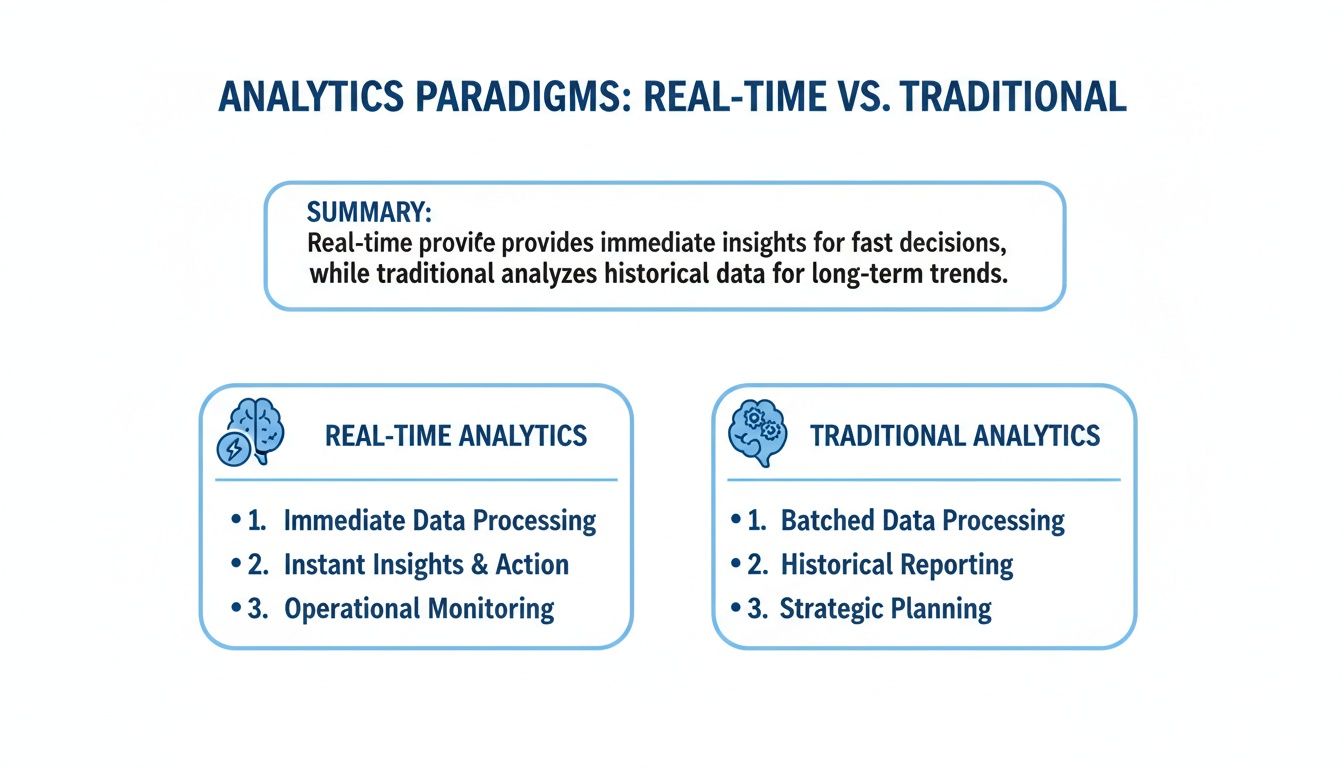
As you can see, real-time analytics is all about immediate action and operational agility, while traditional methods are built for strategic, long-term thinking.
To make this even clearer, let's break down the key distinctions between these two approaches in a simple table.
Real Time Analytics vs Traditional Analytics at a Glance
Ultimately, it’s not that one is "better" than the other; they simply serve completely different purposes. You need both the live scoreboard and the post-game analysis to build a winning strategy.The Growing Demand For Instant Insights
The move toward instant data isn't just a small trend; it's a massive market shift that’s rewriting how companies operate.
The global real-time analytics market was valued at US$27.6 billion and is projected to explode to an incredible US$147.5 billion by 2031. That's a compound annual growth rate of 26%. This rapid expansion points to a clear and urgent demand for platforms that deliver insights without delay. You can learn more about the growth of the real time analytics market to see what’s driving this incredible demand.
This growth is fueled by a simple business reality: companies that see and react faster, win. Whether it’s spotting a fraudulent transaction the second it happens or identifying a top-performing affiliate partner in the middle of a campaign, the ability to act on fresh data is a serious competitive advantage.
How the Technology Behind Real Time Analytics Works
So, how exactly does data get from a user's click to a live dashboard in what feels like an instant? While the architecture humming away in the background is complex, the journey itself is actually pretty straightforward. Once you pull back the curtain, you can see just how powerful and accessible this technology has become.
Let's use a simple analogy: a live news broadcast.
First, a reporter on the scene sees something happen and immediately sends the footage back to the studio. In the world of analytics, this is data collection. A tiny piece of code captures an event—a click, a page view, a sale—the very moment it happens.
Next, a producer in the control room instantly reviews the footage, adds context (like the location or people involved), and decides how to show it on screen. This is the processing stage. The raw data is sent to a high-speed engine that validates it, enriches it with other details (like which affiliate sent the click), and gets it ready for display.
Finally, the report appears on your TV, just seconds after the event took place. This last step is visualization. The processed data populates your dashboard, updating charts and metrics so you can see what’s happening as it unfolds.
The Three Stages of Data Flow
This entire sequence doesn't happen in delayed batches; it flows in a continuous, high-speed stream. Let’s break down each stage in the context of an affiliate marketing platform:
- Event Collection: A user clicks an affiliate's unique referral link. A tracking pixel or a server-side script fires, grabbing the click data and its source. To get a better handle on this first step, check out our guide on what conversion tracking is and how it works.
- Stream Processing: That click data zips over to a processing engine. Here, the system instantly verifies if the click is valid (not from a bot), attributes it to the correct partner, and calculates any initial metrics tied to that action.
- Dashboard Visualization: The validated click pops up on the affiliate's dashboard. At the same time, the program manager's overview dashboard refreshes to reflect the new activity. This whole journey is over in milliseconds.
This seamless flow from collection to visualization is the heart of what is real time analytics. It closes the gap between an action happening and a business being able to see and react to it.
The demand for this technology is exploding, with major players like IBM, Microsoft, and Google driving innovation. Market projections show the industry rocketing from USD 51.36 billion to USD 151.17 billion by 2035. This massive investment is a clear sign that businesses everywhere are hungry for instant data.
It's this ongoing development that allows platforms like LinkJolt to offer flawless tracking and integration, turning complex data streams into simple, actionable insights for our users.
Why Real-Time Data Is a Game Changer for Growth

It’s one thing to understand the tech, but it’s another to see what it can actually do for your bottom line. Real-time data isn’t just about being fast; it’s about creating opportunities for growth that simply didn't exist before.
This is a fundamental shift in decision-making. You move from reviewing last month's reports to reacting to what’s happening right now. For any modern SaaS or affiliate program, that capability changes everything—how you operate, how you optimize, and how you scale.
You’re no longer just reactive. You’re proactive.
How SaaS Companies Drive Growth
In the SaaS world, keeping customers is the name of the game. Real-time analytics acts as an early warning system, helping you spot the first signs of trouble long before a customer churns.
Imagine seeing a user’s engagement with your platform suddenly nosedive. Instead of finding out a month later in a churn report, you see it happening live. This gives your team a window to step in immediately, maybe with a helpful email, an in-app guide, or a quick support call.
This same logic applies to good news, too. When you launch a new feature, you can watch its adoption rate tick up (or down) in real time. Are users loving it or ignoring it? This instant feedback loop is gold for product development, letting you double down on what works and quickly fix what doesn’t.
Acting swiftly on customer input is key, which makes real-time data essential for mastering customer feedback analysis and building a better product.
By monitoring user behavior as it happens, SaaS companies can reduce churn, improve product-market fit, and increase lifetime value. It’s about making smarter decisions, faster.
This need for speed is becoming the market standard. The global real-time analytics market is projected to hit USD 5,258.7 million by 2032, rocketing up at a 25.1% CAGR.
Transforming Affiliate Program Management
For affiliate marketers, data delays are expensive. Real-time analytics delivers two massive benefits here: instant fraud detection and on-the-fly performance optimization.
Click fraud is a constant headache that can bleed marketing budgets dry. With old-school analytics, you might not catch fraudulent activity for hours or even days—long after you’ve paid for bogus traffic. Real-time systems can flag suspicious patterns the second they appear, allowing you to block the source and protect your budget instantly.
Beyond just security, instant data builds trust and empowers your partners. When affiliates see their clicks and commissions pop up on their dashboard the moment they happen, it reinforces their confidence in your program. That transparency is crucial for attracting and keeping top performers.
This immediate feedback loop also lets you:
- Spot top performers instantly: See which partners are driving the most valuable traffic right now and give them the support they deserve.
- Optimize campaigns in real time: If a new campaign is flopping, you can pause it or tweak your strategy without waiting for a daily report to tell you what you already suspect.
- Strengthen partner relationships: Live, transparent data shows you value your affiliates, which helps build a stronger, more motivated network.
Ultimately, real-time analytics gives you the control to scale your affiliate program with confidence, making sure every dollar you spend is working for you.
Key Metrics to Watch on Your Live Dashboard
Think of a live dashboard as your business’s command center. But it’s only powerful if you know which blinking lights and spinning dials actually matter. Just having a flood of data isn't the goal—you need to zero in on the specific metrics that demand an immediate, smart decision.
This is where understanding what real-time analytics truly means changes the game. It’s about moving past passive, backward-looking reports and starting to actively steer your growth. Instead of getting distracted by vanity metrics like total clicks, you can focus on the signals that directly impact your bottom line.
Core Metrics for Affiliate Program Growth
For any affiliate program, some metrics are simply non-negotiable. Tracking them live completely transforms your ability to optimize spending, reward your best partners, and shut down problems before they drain your budget.
Here are the essential indicators you should have front and center on your dashboard:
- Real-Time Conversion Rate Per Affiliate: This tells you which partners are sending traffic that actually converts. A sudden spike could mean a new promotion is a runaway success, while a sharp dip might signal a broken link. Either way, you can react in minutes, not days.
- Live Customer Acquisition Cost (CAC): Knowing your CAC in real time gives you surgical precision over your marketing spend. If a campaign's CAC starts creeping up, you can pause it before it torches your budget and reallocate those funds to more profitable channels on the fly.
- Instant Fraud Alerts: This is one of the most critical uses for real-time data. A system that flags suspicious click patterns or conversion anomalies the second they happen allows you to block fraudulent sources before you pay out for fake traffic.
The table below breaks down these essential metrics, showing exactly what they measure and what kind of immediate action they empower you to take.
Essential Real-Time Metrics for Affiliate Program Growth
Having these KPIs at your fingertips transforms your role from a reactive analyst into a proactive strategist, making smart decisions that protect and grow your revenue.This kind of at-a-glance view empowers you to spot trends as they’re happening, not a week later in a static report.
From Data Points to Strategic Actions
The real value of these metrics isn’t in the numbers themselves, but in the immediate actions they inspire. A live dashboard isn't just for watching charts move; it's a tool for making faster, more intelligent decisions that fuel real growth.
A dashboard should be more than a report—it should be a catalyst for action. When you see a high-performing affiliate, you can immediately reach out to offer them a better commission rate. When you spot a campaign with a low conversion rate, you can tweak the landing page or ad copy in minutes.
This instant feedback loop closes the gap between insight and execution. To learn more about structuring these visualizations effectively, check out our guide on what a marketing dashboard is and how to build one that truly works for you.
Ultimately, tracking the right metrics in real time turns your analytics platform from a passive observer into an active co-pilot for your entire business strategy.
Choosing the Right Real-Time Analytics Platform
Picking the right platform to handle your real-time analytics is a make-or-break decision. It’s a balancing act, weighing your technical muscle against your immediate business needs. The path you take directly shapes your ability to react to data, keep costs in check, and grow without hitting a wall.
Broadly speaking, you’re looking at two main roads: build a custom solution from scratch or buy a ready-made platform.
Going the custom route gives you ultimate control, but it’s a long and expensive journey. It means tying up a dedicated engineering team to stitch together streaming tech, real-time databases, and all the necessary APIs. This can easily spiral into a costly distraction from what your business actually does.
For most companies, especially in the SaaS and affiliate marketing world, a specialized platform is the smarter play. You get all the power of real-time data without the massive headache of building and maintaining a complex system yourself.
Key Factors to Evaluate in a Platform
When you start comparing platforms, you have to look past the slick dashboards. The real value is in the underlying architecture and features that determine if a tool can actually grow with you. Zero in on these three essentials:
- Scalability: Can the platform take a punch? When you launch a new product or a campaign goes viral, you’ll see massive traffic spikes. Your system has to handle that flood of data without breaking a sweat.
- Ease of Integration: How well does it play with your other tools? A great platform should plug right into your existing tech stack—think payment processors like Stripe or marketing automation systems—to ensure all your data flows smoothly and accurately.
- User-Friendly Interface: Can your non-technical team members actually use it? The best tools make data accessible to everyone, allowing marketing managers and execs to find insights without having to ask an engineer for help.
The goal is to find a platform that feels like a natural extension of your team—powerful enough for your engineers but simple enough for your marketers to use daily for strategic decisions.
Why a Specialized SaaS Platform Is Ideal
If you’re a SaaS company running an affiliate program, a dedicated marketing attribution software is a game-changer. Platforms like LinkJolt are purpose-built to solve the exact problems you face in partner marketing, with features like real-time commission tracking, fraud detection, and partner dashboards already baked in.
This specialization hands you a faster, more cost-effective way to get the insights you need. Instead of burning months on development, you can have a powerful system up and running in minutes. That frees up your team to do what they do best: build an amazing product and grow your partnerships, all backed by the immediate, actionable data they need to win.
Putting Real-Time Analytics into Practice
Getting your hands on a powerful real-time analytics tool is a fantastic start, but the magic really happens in how you implement it. Just flipping a switch and flooding your team with a firehose of data is a recipe for confusion, not clarity. True success comes from a thoughtful approach that weaves together the right tech, smart processes, and a forward-thinking company culture.
The best implementations always start with clear business goals. Before you even think about tracking a single click, pull your team together and ask: "What are the most critical questions we need to answer right now?" Your objective might be clamping down on affiliate fraud, smoothing out user onboarding, or optimizing ad spend on the fly. Whatever it is, that goal becomes your North Star, guiding which metrics actually matter.
This simple step helps you dodge the all-too-common trap of "analysis paralysis," where teams are drowning in dashboards but starved for real, actionable insights.
Start with Clean Data
Let's be blunt: your insights are only as good as the data feeding them. If your data is messy or incomplete, you'll end up making bad decisions and, worse, eroding trust in the very system you just invested in.
Getting your data quality right from day one is non-negotiable. This means:
- Validate your tracking setup: Double-check that you’re capturing events like clicks and conversions correctly across every single platform. No exceptions.
- Scrub your data sources: Get rid of duplicate entries, fix inconsistencies, and standardize your formats before they hit your analytics engine.
- Lock down your security: Protect your customer and business data with solid security protocols. This isn't just about compliance; it's about maintaining the trust you've built.
Build a Data-Driven Culture
Ultimately, real-time analytics isn't just about looking at charts. It's about empowering your team to act. The final, and arguably most important, step is to foster a culture where making data-driven decisions is the default, not the exception.
Encourage everyone on your team to have their dashboards open, to ask questions about what they're seeing, and to test hypotheses based on live insights.
A successful implementation isn’t about installing software. It's about shifting your team's mindset from reacting to last month's reports to proactively shaping tomorrow's outcomes with live data.
When your team feels confident enough to make quick, informed decisions based on what's happening at this very moment, you’ve unlocked the true potential of what real time analytics can do. You'll turn your data from a passive, historical record into an active asset that drives growth, day in and day out.
Got Questions About Real-Time Analytics?
Jumping into any new technology brings up good questions. If you're wondering about the cost, complexity, or real-world payoff of real-time analytics, you're in the right place. Here are some straightforward answers to the questions we hear most often.
What's the Real Difference Between "Real-Time" and "Near-Real-Time"?
It all comes down to speed and what you can do with it.
Real-time analytics is instantaneous. Data is processed in milliseconds, giving you insights the very second an event happens. Think of it like a live video feed—what you see is exactly what's happening right now. This is absolutely critical for things like fraud detection or tracking affiliate clicks the moment they occur.
Near-real-time, on the other hand, has a small delay, usually a few seconds to a few minutes. It’s more like a photo slideshow that refreshes every so often. While it's still fast, that slight lag makes it better for watching trends unfold rather than triggering immediate, automated actions.
Is Setting Up Real-Time Analytics Super Expensive?
Building a system from scratch? Yes, it can be incredibly expensive and complicated, often requiring a dedicated team of engineers and a hefty budget.
But here's the good news: using a specialized SaaS platform completely changes the game. Solutions like LinkJolt make it affordable and surprisingly easy. You get all the power of pre-built dashboards and integrations without the massive upfront cost or the technical headaches.
Can a Startup Actually Get Value from This?
Absolutely. In fact, real-time analytics can be a massive advantage for startups, helping them move faster and compete with much larger companies.
By reacting instantly to campaign performance, identifying top-performing partners, and stopping fraud in its tracks, smaller businesses can make every marketing dollar count and scale far more efficiently.
This immediate feedback loop lets you pivot on a dime, turning agility into your biggest strength.
Ready to see what real-time data can do for your affiliate program? LinkJolt offers instant insights and effortless management. Explore our powerful features and start making smarter decisions today.
Watch Demo (2 min)


Trusted by 300+ SaaS companies
Start Your Affiliate Program Today
Get 30% off your first 3 months with code LINKJOLT30
✓ 3-day free trial
✓ Cancel anytime