what is performance marketing: A Clear Guide to Pay-For-Results Advertising

Ollie Efez
December 06, 2025•17 min read
At its heart, performance marketing is a simple but powerful idea: you only pay when you get results. Forget paying for ad space and hoping for the best. With this model, your money is tied directly to a specific, measurable action—like a click, a new lead, or a completed sale.
It's a strategic shift that puts the advertiser in the driver's seat, moving the financial risk over to the publisher or partner.
The "Pay for Results" Philosophy
Think of it like hiring a salesperson who works purely on commission. You don't pay them for showing up; you pay them when they close a deal. That’s performance marketing in a nutshell. Instead of shelling out cash for a billboard and crossing your fingers, you're investing in tangible outcomes that grow your business.
This results-first approach gives you incredible control and makes your marketing spend completely accountable. You're no longer just paying for "eyeballs" or vague "exposure." You're paying for actions. That single distinction makes every dollar you spend traceable, so you can constantly refine your campaigns for the best possible return.
What Makes a Campaign a "Performance" Campaign?
The real currency here is the performance itself. Every campaign is laser-focused on a specific goal, whether that's driving immediate sales or building a list of qualified leads for your sales team.
The defining traits are always the same:
- Everything is tracked: From the very first click to the final checkout, every step is measured.
- Success is crystal clear: We're talking hard numbers, defined by metrics like Cost Per Acquisition (CPA) or Return On Ad Spend (ROAS).
- You pay when it works: Your budget is only spent when the specific action you wanted actually happens.
This structure inherently pushes marketers to be efficient and focus on what's truly profitable. It's no surprise that paid search, a classic performance channel, is a cornerstone of this strategy. In fact, U.S. spending on search is projected to hit $124.59 billion in 2024, making up nearly 40% of all digital ad budgets.
The big idea is simple: if a campaign doesn't produce measurable value, you don't pay for it. This accountability is what separates performance marketing from traditional advertising methods.
For a deep dive into one of the most important performance marketing channels, check out this ultimate guide to PPC for Aussie businesses. You can also see how this philosophy extends to collaborations by reading our guide on what is partner marketing here: https://www.linkjolt.io/blog/what-is-partner-marketing. The entire ecosystem is built to reduce financial risk while driving transparent, scalable growth.
The Core Channels of Performance Marketing
Performance marketing isn't just one thing; it's more like a collection of different tools in a marketer's toolbox. Each tool, or channel, has its own unique strengths, and the real skill lies in knowing which one to pick for the job at hand.
Your choice of channel really boils down to two simple questions: Where do my ideal customers hang out online, and what specific action do I want them to take? Getting the answers right is the first step to building a campaign that actually delivers results.
Let’s dive into the main channels you'll be working with.
Paid Search Marketing
When people talk about performance marketing, paid search is usually what comes to mind first. You might know it as search engine marketing (SEM) or pay-per-click (PPC). This is where you pay to place ads at the very top of search results on platforms like Google and Bing.
The magic of paid search is its ability to capture active intent. Think about it: you're not interrupting someone’s day. You’re showing up with a solution at the exact moment they’re searching for one. Someone types "best project management software" into Google, and your ad appears. You only pay when they're interested enough to click, a model known as Cost Per Click (CPC).
Paid Social Advertising
If paid search is about capturing existing demand, paid social is all about creating it. Platforms like Meta (home to Facebook and Instagram), LinkedIn, or TikTok give you incredibly powerful tools to target your ideal customer based on their interests, job titles, online behavior, and more.
This makes paid social perfect for getting your brand in front of a fine-tuned audience that may not even know a solution like yours exists yet. The goal is always a measurable action, like getting them to fill out a lead form or buy a product, which is tracked with metrics like Cost Per Lead (CPL) or Cost Per Acquisition (CPA). A B2B software company, for instance, could run a campaign on LinkedIn targeting "Marketing Managers" with a free guide, paying only when someone actually downloads it.
Performance marketing isn't about throwing money at every channel. It's about surgically picking the ones where you can pay for the specific outcomes that will actually grow your business.
Affiliate Marketing
Affiliate marketing is basically performance-based word-of-mouth. It’s a partnership where you pay a commission to other people (affiliates) for sending paying customers your way. These partners are often bloggers, influencers, or review sites who promote your product to their established audience.
This is performance marketing in its purest form—you only pay when a sale is confirmed. It's a fantastic, low-risk way to broaden your reach by tapping into the trust your affiliates have already built. For a SaaS business, a common setup is offering a tech blogger a 30% commission on the first month's subscription for every new customer who signs up using their unique tracking link.
Native Advertising
Ever been reading an article online and come across a story that flows perfectly with the rest of the content, but has a small "Sponsored" tag? That's native advertising. These ads are designed to look and feel like a natural part of the website or platform they appear on.
Instead of a flashy, disruptive banner, a native ad offers value in a format that feels organic and non-intrusive. This helps cut through the "ad blindness" many of us have developed. The action here is often a click to a helpful blog post or a detailed landing page, making it a great channel for generating interest early in the customer journey.
Understanding the Metrics That Actually Matter
In performance marketing, you live and die by the numbers. Forget vanity metrics like impressions or social media likes—we’re talking about the cold, hard data that tells you whether you're making money or just burning through your budget.
This isn't about collecting data for data's sake. It's about understanding a handful of Key Performance Indicators (KPIs) that directly connect your spending to real business results. Let’s cut through the jargon and look at the metrics that truly move the needle.
Essential Performance Marketing KPIs Explained
To get a quick overview, this table breaks down the most common acronyms you'll encounter. Think of it as your cheat sheet for campaign analysis.
Now that we have the definitions down, let's explore how these metrics work together to give you a complete picture of your campaign's health.Measuring Immediate Costs: CPA, CPL, and CPC
The first set of metrics—CPA, CPL, and CPC—tells you how efficiently you’re turning ad dollars into specific actions. They're your frontline indicators, giving you a real-time pulse on campaign performance.
- Cost Per Click (CPC) is the most basic: How much does it cost to get someone to click your ad and visit your landing page?
- Cost Per Lead (CPL) takes it a step further: How much did you spend to get someone interested enough to hand over their contact info?
- Cost Per Acquisition (CPA) is the real prize: What was the final cost to land a paying customer?
These are all about efficiency. But a low CPA, while tempting, doesn't automatically equal success. Acquiring a bunch of cheap, one-time customers who never return isn't a winning strategy. That’s where the bigger-picture metrics come in.
Focusing on What Really Counts: Profitability and Growth
This is where the pros separate themselves from the amateurs. Instead of just focusing on the initial cost, smart marketers zoom out to look at long-term profitability.
A cheap click or a low-cost lead is meaningless if it doesn't ultimately lead to profitable revenue. The goal isn't just to be busy; it's to be profitable.
Two metrics are king here: Return On Ad Spend (ROAS) and Customer Lifetime Value (LTV).
ROAS is brutally simple: For every dollar you put into ads, how many dollars in revenue did you get back? It’s the ultimate test of a campaign’s financial success. For a deeper dive, check out our guide on how to calculate marketing ROI.
LTV, on the other hand, is about playing the long game. It calculates the total profit you can expect from a single customer over time. Understanding LTV changes everything—suddenly, you might be willing to pay a much higher CPA because you know that customer will be incredibly valuable for years to come. That’s how you build a sustainable business.
How to Launch Your First Performance Marketing Campaign
Diving into performance marketing can seem intimidating, but it’s really just a logical process. A successful campaign isn't built on luck or guesswork; it's about following a clear roadmap that links your goals directly to your actions. Think of this as your playbook for launching a campaign that’s designed for measurable results right from the start.
The first step is always the most important: defining what you're trying to achieve. Vague goals like "get more traffic" just won't cut it here. A real performance marketing goal has to be specific and, most importantly, measurable.
A strong goal sounds like this: "Generate 50 qualified leads per month at a target Cost Per Lead (CPL) of $40." See the difference? This gives you a clear finish line and the exact metric you'll use to know if you've won.
Once you have that crystal-clear goal, you can confidently move on to the next steps.
Laying the Foundation for Success
Before you spend a single dollar, you need to get your foundation right. This means figuring out exactly who you're talking to and where you can find them online. So many people skip this groundwork, and it almost always leads to wasted ad spend and disappointing results.
Here’s a simple checklist of the essentials you need to nail down first:
- Define Your Ideal Customer: Who are you really trying to reach? Go deeper than just age and location. What are their biggest problems? What social media feeds are they scrolling through? Knowing this helps you pick the right channels and write copy that actually connects.
- Select the Right Channels: Don't spread yourself thin trying to be everywhere. If your audience is actively looking for a solution like yours, Google Ads is a no-brainer. If you need to build awareness and target people based on their interests, Meta (Facebook and Instagram) is a fantastic place to start. Let your customer profile be your guide.
- Set a Realistic Budget: Your budget has to be big enough to actually learn something. A few clicks won’t give you enough data to make smart decisions. You need to set aside enough to run some tests, see which creative resonates, and give the platform’s algorithm enough time to work its magic.
This visual helps show how the most common performance metrics are all connected, giving you a complete view of your campaign's health.
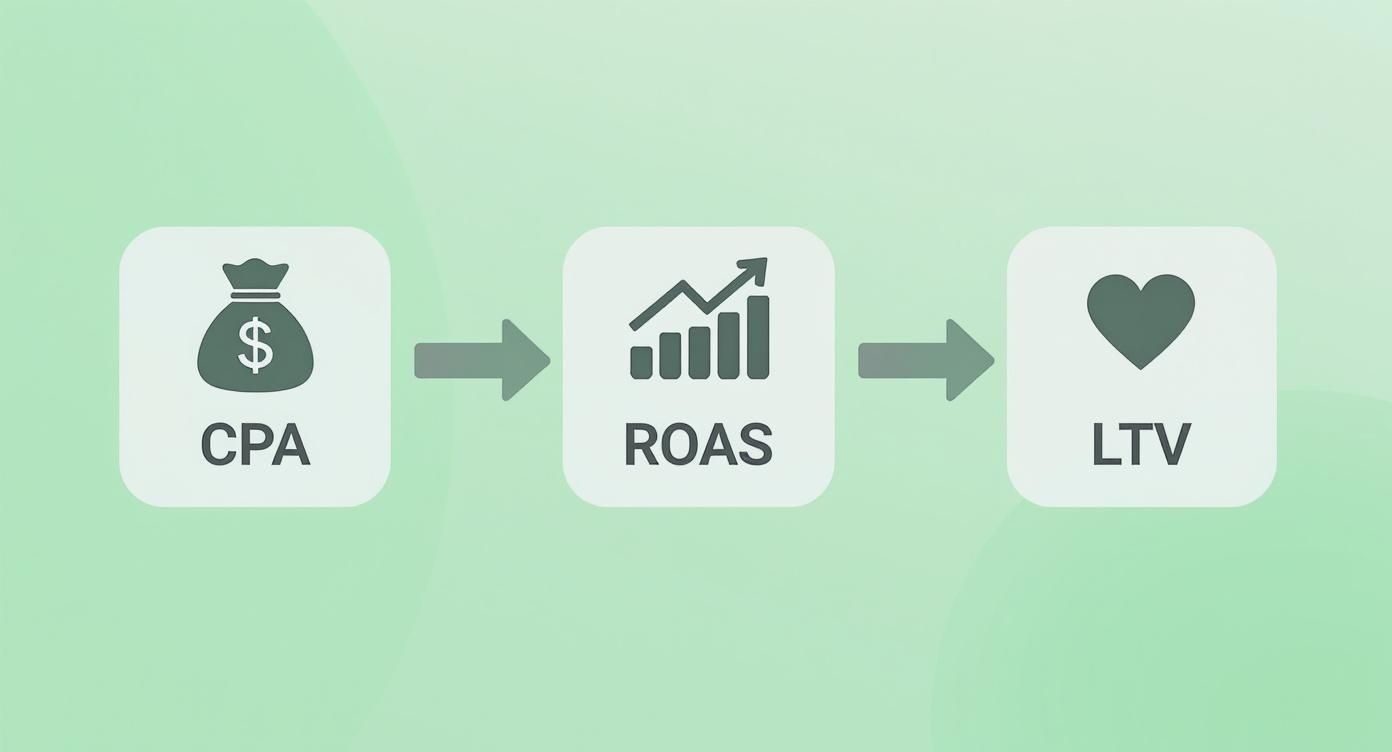
As you can see, the journey from CPA to ROAS and finally to LTV is a shift from analyzing immediate costs to understanding long-term value. This is what helps you make smarter strategic decisions down the road.
Executing Your Campaign Launch
With your strategy mapped out, it’s time for the fun part: bringing your campaign to life. This is where you create the actual ads and landing pages that your potential customers will see and interact with. The name of the game is making sure every single piece is built to convert.
Performance marketing has truly become the standard in digital advertising. Paid media, especially PPC, is a huge part of this, known for generating twice as many website visitors as organic SEO. In fact, a whopping 80% of companies using PPC focus their efforts on Google Ads, which shows just how critical it is for driving immediate, trackable traffic. You can dig into more of these marketing statistics to see how they're shaping modern strategies.
The execution phase really boils down to three key parts:
- Compelling Ads and Creatives: Your ad is your handshake. Whether it's a few lines of text for a search ad or a striking image for social media, it has to stop the scroll and clearly state your value. Always A/B test different headlines and visuals to find your winners.
- High-Converting Landing Pages: Never send ad traffic to your homepage. Your ad should point to a dedicated landing page with one clear call to action. Critically, the message on the page must match the promise you made in the ad for a smooth and trustworthy user experience.
- Implement Tracking: This is completely non-negotiable. You must install tracking pixels (like the Meta Pixel or the Google Ads tag) on your website. Without tracking, you’re flying blind. You’ll have no idea which ads are actually working, making it impossible to improve your results.
How AI and Automation Are Changing the Game
Technology has always been a performance marketer's secret weapon, but artificial intelligence (AI) and automation are taking things to a whole new level. Think of AI as your team's smartest assistant—one that can analyze data, spot trends, and make smart decisions faster than any human ever could. It’s not some far-off concept anymore; it's a real tool that top teams are using to get an edge.
The proof is in the numbers. Salesforce data shows that 63% of marketers are already using generative AI for everything from writing ad copy to building customer profiles. And it’s working. Sales teams using AI are seeing real results, with 83% reporting revenue growth in the past year. That's a big jump from the 66% of teams who aren't using it.
This isn't just about doing things faster. It's about completely rethinking how we run marketing campaigns.
Smarter Targeting and Bidding
AI is brilliant at sifting through mountains of data to find hidden patterns in customer behavior—the kind of subtle clues a human might miss. This means you can get incredibly specific with your audience targeting. Instead of just aiming for a broad demographic, AI helps you pinpoint the small, niche groups of people who are most likely to convert.
At the same time, automation takes over the tedious, non-stop job of managing ad bids. AI-driven algorithms can adjust your bids in real-time across thousands of different ad placements, squeezing every last drop of value out of your budget to get the best possible Return On Ad Spend (ROAS). For anyone managing user acquisition, this frees you up from manual tweaking so you can focus on the big picture, a topic covered in this practical guide to using AI for ads.
The true power of AI in performance marketing is its ability to move from reactive optimization to predictive execution. It doesn't just analyze what happened; it anticipates what will happen next and acts accordingly.
Personalized Journeys at Scale
The other game-changer is personalization. AI gives you the power to create unique customer journeys for thousands, or even millions, of people at once. It can dynamically swap out ad images, tweak landing page headlines, and offer different product recommendations based on what it knows about each individual user.
The result? A far more relevant and engaging experience that naturally leads to higher conversion rates. By automating these personalized touchpoints, you’re making sure every potential customer sees the right message at exactly the right moment. For areas like affiliate marketing where the customer journey is everything, this is huge. You can learn more about how AI-powered attribution is reshaping affiliate commissions for SaaS companies and leading to better partner results.
Common Pitfalls: Where Performance Marketing Goes Wrong
Diving into performance marketing without a solid plan is a recipe for wasted ad spend. It's easy to get caught up in the excitement, but a few common missteps can derail a campaign before it even has a chance to succeed. Knowing what these traps look like is the first step to building a program that actually works.
One of the biggest—and most costly—mistakes is broken or inaccurate tracking. If your tracking is off, every other decision you make is based on bad information. It’s like flying a plane with a faulty GPS; you’re burning fuel, but you have no real idea where you're headed. All the clever ad copy and beautiful landing pages in the world mean nothing if you can't trust your data.
Chasing the Wrong Numbers
It's so easy to get distracted by "vanity metrics." Big numbers for clicks and impressions look great in a report, but they don't actually tell you if you're making money. The entire point of performance marketing is to connect spending to results, so you have to focus on the metrics that matter.
A classic example is obsessing over a low Cost Per Click (CPC). A 10-cent click that never leads to a sale is infinitely more expensive than a $10 click that brings in a $500 customer.
Don't fall for it. Keep your eyes on the prize by focusing on metrics that hit the bottom line:
- Return On Ad Spend (ROAS): For every dollar you put in, how many are you getting back out?
- Cost Per Acquisition (CPA): What’s the real, all-in cost to land a paying customer?
- Customer Lifetime Value (LTV): Are you attracting one-time buyers or customers who will stick around?
The "Set It and Forget It" Mindset
Finally, a surprisingly common error is launching a campaign and just letting it run on autopilot. This is a fatal flaw in a world where things change fast. What worked last week might completely flop next week as audience behavior shifts and competitors update their own ads.
Constant testing and optimization isn't just a "nice-to-have"—it's the engine of a successful performance marketing program. You should always be running A/B tests on your ads, landing pages, and offers. It's those small, steady improvements that compound over time and create real, scalable growth. If you’re not testing, you’re not learning, and you’re definitely leaving money on the table.
Got Questions? We’ve Got Answers.
When you're first dipping your toes into performance marketing, it's natural for a few questions to pop up. Think of this as your go-to spot for clear, simple answers to the things marketers most often ask.
Let's clear the air and get you on the right track.
So, What's the Real Difference Between Performance and Brand Marketing?
It all boils down to what you pay for and why. With brand marketing, you're paying upfront to get your name out there. You buy ad space on a billboard or run a TV commercial to build awareness and a good reputation over time. You're paying for the potential to be seen.
Performance marketing is the polar opposite. You don't pay for potential; you pay for results. You only spend money when someone takes a specific action you want, like clicking a link, signing up for a newsletter, or buying a product. It’s the difference between paying for eyeballs versus paying for action.
I'm New to This. Where Should I Start?
If you're just starting out, paid search and paid social are your best friends. Think Google Ads and Meta Ads (for Facebook and Instagram).
Google is fantastic because you're catching people who are actively looking for what you sell. They're already raising their hand. Meta, on the other hand, lets you find people based on their interests and behaviors, even if they've never heard of you.
The best part? You can start with a tiny budget on both platforms. It's the perfect way to test the waters, see what messages click with people, and learn what works before you decide to go all in.
How Much Money Do I Actually Need to Get Started?
Honestly, there’s no magic number here. You can get going with just a few hundred dollars. The initial goal isn't to spend big; it's to gather data.
Your first campaigns are all about learning. Once you figure out what's working and start seeing a positive Return On Ad Spend (ROAS), that's your green light. A positive ROAS means you've found a profitable machine, and you can start feeding it more money with confidence.
Ready to launch a performance-driven affiliate program? LinkJolt makes it easy to create, manage, and scale your partnerships with zero transaction fees and powerful real-time analytics. Start growing your revenue today at https://linkjolt.io.
Watch Demo (2 min)


Trusted by 300+ SaaS companies
Start Your Affiliate Program Today
Get 30% off your first 3 months with code LINKJOLT30
✓ 7-day free trial
✓ Cancel anytime