Your Complete Pay Per Lead Marketing Guide
Your Complete Pay Per Lead Marketing Guide

Ollie Efez
January 30, 2026•21 min read

Pay-per-lead (PPL) is a performance marketing model where you only pay for qualified sales leads—not for clicks or impressions. Think of it as hiring a specialist who gets paid only when they bring a serious, pre-qualified prospect to your door. This approach completely eliminates wasted ad spend and focuses your budget directly on potential revenue.
What Is Pay Per Lead Marketing

Imagine launching a massive advertising campaign. You spend thousands on beautiful ads that drive a ton of traffic to your site, but at the end of the month, your sales numbers haven't budged. This is a common frustration with traditional ad models that chase vanity metrics like views or clicks.
The pay-per-lead model flips this script entirely. Instead of paying for the potential to reach a customer, you pay for an actual potential customer. In this world, a "lead" isn't just an email address; it's a real person who has actively shown interest in your product or service by taking a specific, meaningful action.
The Core Idea of PPL
At its heart, the PPL model is about reducing risk and aligning everyone's goals. The advertiser (that's you) and the publisher (your partner or affiliate) agree upfront on exactly what makes a lead valid and how much each one is worth.
Common actions that count as a payable lead include things like:
- Submitting a detailed contact form
- Requesting a product demo
- Signing up for a free trial
- Calling a dedicated phone number
This direct link between cost and a tangible outcome makes PPL an incredibly efficient strategy. It shifts the entire focus from broad, fuzzy brand awareness to generating real sales opportunities.
To make this concept even clearer, here's a quick breakdown of the key components.
The Pay Per Lead Model at a Glance
This table shows how PPL creates a straightforward, results-driven partnership where everyone is focused on the same thing: generating genuine business interest.Why This Model Is Gaining Traction
There's a clear reason the pay-per-lead service market is growing so fast: it just works. The global market, valued at $1,630 million in 2024, is on track to hit $2,858 million by 2032. A key driver is its undeniable performance, with PPL models showing 23% higher conversion rates compared to traditional methods for service-based businesses.
The fundamental promise of pay per lead is simple: No results, no cost. This aligns the financial incentives of both the advertiser and the lead generator, creating a true partnership focused on mutual growth.
This approach is especially powerful for businesses with a longer sales cycle, like SaaS companies, financial services, and legal firms. For these industries, a single high-quality lead can be immensely valuable, easily justifying the investment. You can learn more in our detailed guide on lead generation for affiliate marketing. By ensuring you only pay for prospects who have already raised their hand, PPL helps you build a predictable and scalable pipeline of future customers.
Choosing the Right Model for Your Goals
The pay-per-lead model doesn't exist in a vacuum. It’s one of several powerful tools in a marketer's kit, and knowing when to use it is just as critical as knowing how it works. To really grasp its value, you have to see how it stacks up against the other performance marketing models you're likely running into.
Let's imagine you're a SaaS company launching a new project management tool. Your main goal is to get your product in front of qualified buyers who are ready to talk. We’ll walk through how different models would get you there, each with its own level of focus and risk.
Starting with Clicks and Impressions
Your first instinct might be to fire up a Cost Per Click (CPC) campaign on Google or LinkedIn. In this model, you pay every single time someone clicks your ad. It's a fantastic way to drive traffic to your website and build that initial brand buzz, but it comes with zero guarantee of actual interest.
You could burn through hundreds of dollars on clicks from people who are just curious, not qualified. They land on your page, take a quick look, and bounce—but you've already paid for the visit. With CPC, all the risk is on you, the advertiser, to turn that raw traffic into something meaningful.
Moving Up to Basic Interest
Next, you might consider a Cost Per Lead (CPL) campaign. People often confuse this with PPL, but the difference is huge. In a standard CPL model, a "lead" is defined much more loosely. For example, you might pay a partner every time someone downloads your free e-book or signs up for your newsletter.
This is definitely a step up from a simple click because it shows a bit more engagement. But let's be honest, an email signup doesn't mean someone is ready to buy. That person might just want your free guide and have no immediate plan to purchase your software. You're paying for a top-of-funnel contact, not a sales-ready opportunity.
Pinpointing High Intent with Pay Per Lead
This is where the pay-per-lead model really starts to shine. Instead of paying for a click or an email, you only pay when a prospect takes a high-intent action that signals they are genuinely interested. For our SaaS company, that magic action could be filling out a form to request a personalized demo.
A demo request is a powerful buying signal. It means the prospect has done their homework, evaluated their needs, and decided your product is worth their valuable time. This is the difference between generating a contact and generating a sales conversation.
With PPL, you effectively shift the financial risk. Your partners are now incentivized to send you prospects who are actually kicking the tires and thinking about a purchase, which dramatically boosts the efficiency of your sales team.
Focusing on the Final Sale
Finally, you have the Cost Per Acquisition (CPA) model, sometimes called Cost Per Sale. Here, you pay absolutely nothing until a lead converts into a paying customer. This model offers the lowest possible risk to you as the advertiser since you only pay for confirmed revenue.
While CPA is fantastic for your bottom line, it can seriously limit your reach. Partners might be hesitant to promote your product on a CPA basis if you have a long sales cycle or if your conversion rates are still a bit of a mystery. They're carrying all the risk, which often means you'll have to offer a much higher payout per sale to make it worth their while.
To make this crystal clear, here’s a quick breakdown of how these models compare.
Marketing Models Compared: PPL vs. CPL vs. CPA vs. CPC
This table cuts through the jargon to give you a side-by-side look at the most common performance marketing models. Use it to quickly match your campaign goals with the right payment structure and risk level.
As you can see, there's no single "best" model—it all comes down to what you're trying to achieve.Ultimately, picking the right model depends entirely on your campaign goals. If you just need website traffic, CPC is your go-to. For building out your newsletter, CPL does the job. But when your mission is to fill your sales pipeline with genuinely interested buyers, the pay-per-lead model is the most direct and cost-effective way to get there.
Understanding PPL Pricing and Industry Costs
One of the first questions everyone asks about the pay-per-lead model is refreshingly direct: How much should a lead actually cost?
The honest answer? It depends. There’s no single magic number. Instead, lead pricing exists on a spectrum, and a handful of critical factors determine where a specific lead falls on that scale.
Think of it like buying ingredients. A simple pasta dinner is pretty affordable. A gourmet meal with rare truffles? That’s going to cost a whole lot more. The same logic applies to leads. A lead for a simple e-commerce product is one thing, but a lead for a complex, high-value legal service is an entirely different beast with a much higher price tag.
Key Factors That Drive Lead Costs
The price you pay for each lead is rarely pulled out of thin air. It’s a calculated figure based on supply, demand, and just how hard it is to find the right person for your offer. Getting a handle on these drivers is the first step toward setting a realistic budget and negotiating fair prices with your partners.
Three main variables shape the cost of a lead:
- Industry and Niche: Some industries are just more competitive or have much higher customer lifetime values. A lead for a B2B SaaS platform is naturally worth more than a lead for a local gym membership.
- Lead Qualification Criteria: The pickier you are, the higher the cost. A generic contact form submission is cheap. A lead from a specific job title, company size, and geographic region? That’s a premium find, and it's priced accordingly.
- Geographic Targeting: It’s simple economics. Leads from high-income regions or countries with more market competition will naturally be more expensive than those from less saturated areas.
This visual helps show where different marketing models fit in, from initial clicks all the way to qualified leads. PPL sits right in that sweet spot where interest turns into a real opportunity.
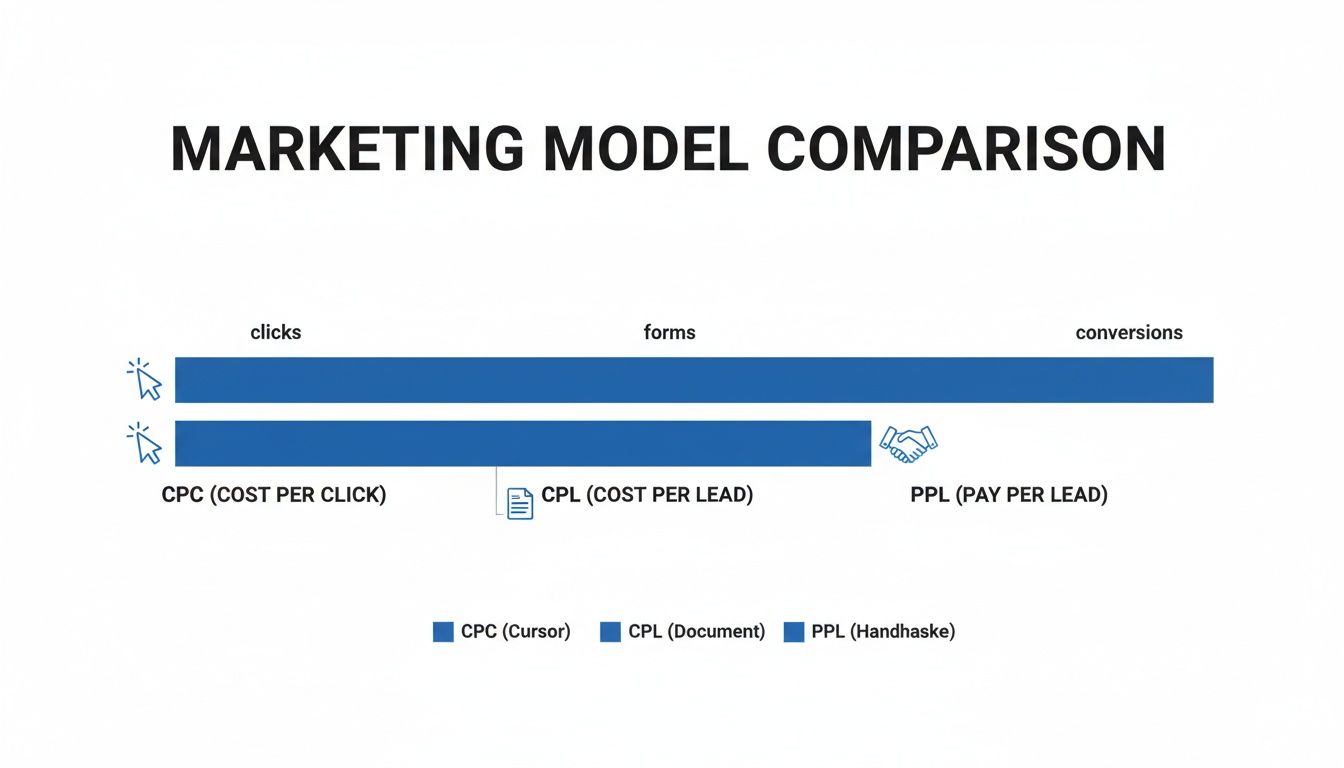
While models like CPC cover broad awareness at the top of the funnel, PPL zeros in on that crucial moment when a prospect shows genuine intent, bridging the gap between casual interest and a legitimate sales conversation.
Real-World Pay Per Lead Benchmarks
To ground all this in reality, let's look at some numbers. As you can imagine, costs swing wildly from one industry to another. For a deeper look, it's worth checking out the average Cost Per Lead by industry.
For instance, high-stakes fields like legal services can see costs balloon to around $784 per lead from paid channels. Business insurance isn't far behind at about $460.
On the other end of the spectrum, lower-ticket industries like eCommerce can acquire leads for a much more palatable $98. For B2B SaaS, the blended average sits around $237, though this can jump to $310 when focusing purely on paid advertising.
Company size also plays a massive role. Enterprise companies targeting senior decision-makers might pay an average of $349 per lead, whereas a small business with fewer than 50 employees can often acquire leads for as little as $47.
Setting Your PPL Budget and Expectations
With these benchmarks in your back pocket, you can start to piece together a sustainable PPL program. Remember, the goal isn't just to find the cheapest leads possible. It’s to find the most cost-effective path to acquiring profitable customers.
A "good" PPL cost is one that is significantly lower than the lifetime value (LTV) of the customer that lead eventually becomes.
Here’s a simple framework to get started:
- Calculate Your Customer Lifetime Value (LTV): First, know how much revenue a new customer brings in over their entire relationship with your business.
- Determine Your Target Customer Acquisition Cost (CAC): Next, decide what you're willing to spend to acquire that customer. A common rule of thumb is for the LTV to be at least three times your CAC (LTV:CAC ratio of 3:1).
- Factor in Your Sales Conversion Rate: This is key. If your sales team closes 10% of qualified leads, you'll need 10 leads to land one new customer. Your absolute maximum PPL cost should be your target CAC divided by 10.
By working backward from your revenue goals, you can set a pay-per-lead price that actually ensures profitability. This approach aligns your marketing spend directly with your bottom line, which is exactly what PPL is all about.
Launching Your First Pay Per Lead Campaign

Moving from the theory of a pay per lead model to actually building one can feel like a huge leap. But with a structured approach, you can turn this powerful concept into a tangible, results-driving machine. This section breaks it all down into a clear, actionable playbook.
Think of it like building a house. You wouldn't just start throwing up walls without a solid foundation and a clear blueprint. In the same way, a successful PPL campaign requires careful planning before you spend a single dollar.
Step 1: Define Your Ideal Lead
The entire success of your campaign hinges on one simple question: What is a qualified lead? If this definition is vague, you'll end up paying for contacts that your sales team can't possibly use.
Get your sales and marketing teams in the same room to hammer out a crystal-clear Sales Qualified Lead (SQL) definition. This is non-negotiable. Your definition needs to be precise and documented, acting as the official rulebook for your campaign.
Key criteria to define include:
- Demographics: What is the ideal job title, seniority level, or department?
- Firmographics: What industry, company size, or annual revenue are you targeting?
- Geographics: Are you focusing on specific countries, states, or regions?
- Pain Points: What specific problems must the lead be trying to solve?
A weak definition like "anyone interested in our software" is a recipe for disaster. A strong one, like "a VP of Operations at a US-based manufacturing company with 500+ employees seeking to automate their supply chain," sets everyone up for success.
Step 2: Set Up Rock-Solid Tracking
Once you know what you're looking for, you need a bulletproof way to track it. Without proper tracking, you can't accurately attribute leads to their source, measure performance, or pay your partners correctly. This is where so many campaigns fall apart.
Your goal is to create a seamless data trail from the first click to the final conversion. This involves setting up tracking pixels or server-to-server postbacks that fire the moment a lead successfully submits a form on your landing page.
A common mistake is relying on manual tracking or basic analytics. For a pay per lead program to scale, you need an automated, trustworthy system that assigns credit to the right partner the moment a qualified lead is generated.
This system ensures your partners are compensated fairly and promptly, which is absolutely essential for building long-term, profitable relationships.
Step 3: Craft High-Converting Assets
With your definition and tracking in place, it’s time to build the assets that will actually capture these valuable leads. Your landing page and lead form are the front doors of your PPL campaign; they need to be welcoming, clear, and persuasive.
Your Landing Page Checklist
- Clear Value Proposition: The headline should instantly communicate what’s in it for them.
- Compelling Copy: Focus on the prospect's pain points and exactly how your solution fixes them.
- Social Proof: Include testimonials, case studies, or logos of well-known customers to build trust.
- Minimal Distractions: Remove any extra navigation links or elements that could pull a visitor away from the main goal—filling out that form.
Your Lead Form Checklist
- Match Fields to Lead Quality: Only ask for the information you absolutely need to qualify a lead. Every extra field you add will chip away at your conversion rate.
- Use Smart or Multi-Step Forms: Break up longer forms into smaller, digestible steps to reduce friction and make it feel less overwhelming.
- Set Clear Expectations: Tell users what will happen next (e.g., "We'll email you to schedule a demo within 24 hours").
Step 4: Establish Clear Partner Agreements
Finally, before you go live, you must have a clear agreement in place with your lead providers or affiliates. This document formalizes everything you've planned out and prevents messy disputes down the road.
Your agreement should explicitly outline:
- The exact definition of a payable lead.
- The payout rate per qualified lead.
- The payment schedule and terms (e.g., Net-30).
- Lead validation and return policies (e.g., rules for rejecting invalid leads).
- Any promotional restrictions or guidelines.
This isn't just a legal formality; it's a tool for alignment. When both you and your partners operate from the same playbook, you build a foundation of trust that allows your pay per lead program to grow effectively and sustainably.
How to Improve Lead Quality and Prevent Fraud
A successful pay per lead program isn't just about volume; it’s about the actual value each lead brings to your sales pipeline. A flood of low-quality contacts can be even more damaging than getting no leads at all—it wastes your sales team's time and drains your budget.
To avoid this trap, you need to shift your focus from simply acquiring leads to attracting the right leads. This requires a much more strategic approach to filtering, qualifying, and protecting your campaigns right from the start.
Filtering Leads Before They Reach You
The best way to boost lead quality is to weed out unqualified prospects before they ever hit your CRM. Instead of using a simple, one-step contact form, think about implementing smarter techniques that make casual browsers think twice.
- Multi-Step Forms: Breaking your form into smaller, logical steps actually reduces friction and helps capture more serious prospects. Someone willing to complete two or three stages is inherently more invested than a person who just drops an email address and moves on.
- Business Email Verification: Require a professional email address (@companyname.com) instead of allowing generic providers like Gmail or Yahoo. This is a simple but incredibly powerful way to ensure you're connecting with legitimate business contacts.
- In-Form Logic: Ask qualifying questions early on. For instance, a question like "What is your company's annual revenue?" can help you segment or disqualify leads in real time, right inside the form.
Implementing a Lead Scoring System
Once a lead comes in, how does your sales team know where to start? A lead scoring system is the answer. It’s a methodology used to rank prospects on a scale that represents their perceived value to your organization.
Points are assigned based on all sorts of attributes, including the information they've submitted and how they've engaged with your brand. For example, a "VP of Marketing" might get +10 points, while a "Student" gets -20. A demo request could be worth +15 points, whereas a simple content download is only +3.
This system empowers your sales team to prioritize their efforts effectively. By focusing on leads with the highest scores, they can engage prospects who are most likely to convert, dramatically improving efficiency and morale.
Actively Preventing Lead Fraud
As you scale your pay per lead efforts, you'll inevitably run into lead fraud. This can range from automated bots filling out your forms with fake information to human click farms submitting totally invalid data. Protecting your campaign is absolutely crucial.
First, learn to spot the common red flags:
- Disposable Email Addresses: Submissions from temporary or throwaway email domains are almost always fraudulent.
- Suspicious IP Addresses: Leads coming from data centers or known proxy services are a major warning sign.
- Nonsensical Data: Gibberish names (like "asdfgh"), mismatched phone numbers, or fake company names are clear indicators of fraud.
You can also use automated tools and processes to safeguard your budget. Certain services can verify email and phone number validity in real time. For more advanced insights, you can explore comprehensive strategies on fraud detection in online payments, since many of the same principles apply directly to lead generation. By building a strong defense, you ensure every dollar you spend on your pay per lead campaign goes toward genuine opportunities.
Streamlining Your PPL Program With LinkJolt
Understanding the strategy behind a pay per lead model is one thing, but actually running it without the right tools is a different beast entirely. Trying to manually track leads, calculate partner commissions, and sniff out fraud can quickly spiral into an operational nightmare. This is exactly where a platform like LinkJolt comes in, turning a complex, high-maintenance process into a smooth, scalable system.
LinkJolt was built from the ground up to handle the specific headaches of a modern PPL program. Think of it as the command center for all your lead generation partnerships, automating the grunt work so you can focus on building relationships and driving real growth. From attribution to payouts, it provides the core infrastructure you need to run a professional and efficient campaign.
Effortless Setup And Precise Tracking
Getting started is refreshingly simple. Instead of getting bogged down in a complicated technical setup, you can define your PPL commission rules in just a few minutes. You get to decide exactly what a qualified lead means to you—whether it’s a demo request, a trial signup, or a filled-out contact form—and set the payout for it. This kind of clarity ensures you and your partners are on the same page from day one.
Of course, at the heart of any successful pay per lead program is attribution. If you can’t tell where your best leads are coming from, you’re just guessing with your budget. LinkJolt uses pixel-perfect tracking to make sure every single lead is correctly credited to the right partner, which eliminates disputes and gives you a reliable source of truth for campaign performance.
This screenshot gives you a peek into the intuitive dashboard where you can monitor key metrics in real time.
The dashboard delivers a clean, at-a-glance view of your clicks, leads, and conversion rates, making it incredibly easy to spot your top-performing partners and channels in an instant.
Built-In Fraud Protection And Partner Management
One of the biggest risks you face when scaling a PPL program is fraud. Paying out good money for bogus leads from bots or bad actors will destroy your ROI. LinkJolt tackles this head-on with built-in fraud protection that automatically flags and blocks suspicious activity, protecting your budget and ensuring the integrity of your lead data.
On top of that, managing dozens or even hundreds of partners demands a professional system. LinkJolt provides a branded affiliate portal where your partners can log in to track their own performance, grab marketing materials, and see their earnings. This self-service approach empowers your partners while cutting down your administrative load. The platform even includes a discovery marketplace to help you connect with new, pre-vetted lead generation partners to expand your reach. You can learn more about why LinkJolt is the right choice for managing these critical relationships.
The goal is to create a frictionless experience for both you and your partners. When partners have the tools and transparency they need to succeed, they are more motivated to send high-quality traffic your way.
Finally, the platform automates one of the most painful parts of the entire process: payouts. By integrating directly with payment processors, LinkJolt handles all the commission calculations and disbursements automatically. This ensures your partners are paid accurately and on time, every time—building the trust you need for long-term, profitable partnerships. It’s a true end-to-end solution designed to make your pay per lead program thrive.
Your Top Questions About Pay Per Lead, Answered
Jumping into the world of pay per lead always brings up a few key questions. It's only natural. You want to make sure you're investing wisely and can actually track what's working.
This section tackles the most common questions head-on, giving you straightforward answers to help you run a PPL program with confidence.
What Is a Good Cost Per Lead?
This is the million-dollar question, but the answer is surprisingly simple: a "good" CPL is anything that's profitable. A lead that costs you $300 is an absolute steal if it eventually turns into a $10,000 customer. The only rule that matters is that your PPL cost must be significantly lower than the lifetime value (LTV) of a customer.
Don't get too hung up on a high sticker price for a lead. A more expensive lead from a high-intent source is often worth far more than a dozen cheap, unqualified ones. Use the industry benchmarks in this guide as your starting point, but always, always measure performance against your own revenue numbers to find your sweet spot.
How Do You Measure the ROI of a PPL Campaign?
Measuring the Return on Investment (ROI) for a pay per lead campaign is all about connecting the dots between what you spend and what you earn. This is how you move from hoping a campaign is working to knowing its exact value.
The formula itself is simple:
ROI = (Revenue from PPL Leads - Total PPL Cost) / Total PPL Cost
But here’s the critical part: to calculate this, you absolutely need a CRM or tracking system that can follow a lead from the moment they fill out a form all the way to a closed-won deal. This end-to-end visibility is non-negotiable. It’s what lets you attribute real revenue back to your PPL spend and make decisions with actual data.
Without that connection, you're flying blind. You see the cost, but you have no idea about the true financial impact.
Can PPL Work for Any Type of Business?
Not quite. The pay per lead model isn't a one-size-fits-all solution. It's most powerful for businesses where a single lead holds high potential value and the sales cycle involves a bit more consideration.
It’s an almost perfect fit for:
- B2B SaaS: A demo request or trial signup is a massive buying signal, making each lead incredibly valuable.
- High-Value Services: Think financial advisors, law firms, or insurance agencies where one new client can be worth thousands.
- High-Ticket B2C: This includes industries like home renovation, solar installation, or other major purchases with a longer sales process.
On the flip side, PPL is generally a poor fit for low-cost, high-volume e-commerce products. For a business selling t-shirts, models like Cost Per Click (CPC) or Cost Per Acquisition (CPA) are almost always a more efficient use of the marketing budget.
Ready to streamline your affiliate and pay-per-lead programs? With LinkJolt, you can set up campaigns, track every lead with precision, and automate payouts, all from one intuitive platform. See how LinkJolt can scale your partnerships today.
Watch Demo (2 min)


Trusted by 300+ SaaS companies
Start Your Affiliate Program Today
Get 30% off your first 3 months with code LINKJOLT30
✓ 3-day free trial
✓ Cancel anytime