What Is Affiliate Marketing Explained A Simple Guide

Ollie Efez
January 06, 2026•22 min read

Ever wonder how your favorite blogger seems to make a living just by recommending products? The answer is almost always affiliate marketing—a simple, powerful partnership where a business pays someone a commission for sending a paying customer their way.
Think of it as having a massive, results-driven sales team you only pay after they've made a sale. It’s one of the most honest forms of advertising out there.
Your Introduction To Affiliate Marketing

At its core, affiliate marketing is about collaboration. A business partners up with outside creators, publishers, or even other companies—known as affiliates—to spread the word about what they offer. Instead of pouring money into traditional ads with no guaranteed return, the business only pays the affiliate when their promotion actually works, typically leading to a sale.
This model creates a win-win-win. The business gets new customers at a completely predictable cost. The affiliate earns an income by monetizing their audience. And the customer discovers a great product from a source they already trust. It beats shouting into the void with generic ads every single time.
The Key Players in the Affiliate Ecosystem
The whole system works because a few key players each have a distinct role. Once you see how they fit together, the entire process becomes crystal clear.
- The Merchant (or Advertiser): This is the business with a product to sell. In our world, this is usually a SaaS company looking to grow its user base.
- The Affiliate (or Publisher): This is the person or company promoting the product. They can be anyone with an audience—bloggers, YouTubers, social media influencers, or even another business.
- The Customer: This is the person who sees the affiliate's recommendation, clicks their unique link, and buys the product from the merchant.
- The Affiliate Platform: This is the tech that acts as the trusted middleman. Platforms like LinkJolt handle everything, from generating the special tracking links to making sure commissions are paid out automatically and on time.
This performance-based model has become a cornerstone of modern growth strategy. In fact, more than 80% of brands now run affiliate programs, tapping into their power to drive real revenue and build genuine brand advocacy.
The real beauty of this setup is its transparency. Every affiliate gets a unique tracking link, which means every single referral is credited back to the right person. There’s no guesswork, just trust. This makes it an incredibly reliable and scalable way to grow your business.
How Does Affiliate Marketing Actually Work?
To really get what affiliate marketing is, it helps to peek behind the curtain and see how the machinery works. The whole thing is a surprisingly smooth, automated loop connecting four key players: the business, the partner, the customer, and the tech that wires it all together. It’s far simpler than it sounds and, when set up right, runs like a well-oiled machine.
The journey kicks off when a business, often called the Merchant, wants to find new customers. Instead of just pouring money into traditional ads, they team up with content creators, bloggers, or influencers, known as Affiliates. The merchant gives each affiliate a unique, trackable link.
This special link is the heart and soul of the entire system.
The Four Key Players in Every Transaction
Every single time an affiliate earns a commission, these four parties are involved. Each one has a critical role in making sure the partnership is successful and transparent for everyone.
- The Merchant (The Business): This is the company that actually created the product or service. Think of a SaaS company like LinkJolt, which offers an affiliate management platform and wants more businesses to sign up.
- The Affiliate (The Publisher): This is the person or company promoting the merchant's product. It could be a blogger writing an in-depth review, a YouTuber creating a "how-to" video, or an influencer recommending a tool to their audience.
- The Customer (The End User): This is the person who clicks the affiliate’s unique link and makes a purchase. They're the final piece of the puzzle, turning a trusted recommendation into real revenue.
- The Affiliate Platform (The Technology): This is the software that acts as the referee and scorekeeper. A platform like LinkJolt generates the unique links, tracks every click and sale, and automates commission payouts, making sure the entire process is fair and accurate.
Demystifying the Technology Behind the Click
So, how does a business know that a specific sale came from a specific affiliate? The magic is a simple combination of tracking links and browser cookies. When a customer clicks an affiliate's unique link, a tiny file called a cookie is placed on their browser.
This cookie acts like a digital name tag. It essentially tells the merchant's website, "Hey, this visitor was sent over by Affiliate X."
Think of it like a helpful store employee who gets credit for a sale. The tracking link is the employee introducing themselves, and the cookie is the customer remembering that employee's name when they finally get to the checkout counter.
Even if the customer leaves the site and comes back a week later to buy, that cookie is still there (for a set period, like 30 or 90 days), making sure the original affiliate gets the credit they deserve. This process is fundamental, and you can dive deeper into the nuts and bolts in our guide on how to track affiliate links. This technology is what makes the entire system reliable and fair.
How Affiliates Get Paid: Commission Models
Not all affiliate programs pay out the same way. The commission model is usually designed around what the merchant wants to achieve. While there are plenty of variations, most programs use one of these common structures.
- Pay-Per-Sale (PPS): This is the most popular model by far. The affiliate earns a percentage of the sale price—or sometimes a flat fee—every time their referral results in a finished purchase. For example, if a SaaS subscription costs $100/month and the commission is 20%, the affiliate earns $20.
- Pay-Per-Lead (PPL): With this model, the affiliate gets paid when their referral completes a specific action that isn't a direct sale, like signing up for a free trial, filling out a contact form, or subscribing to a newsletter. This is a great fit for businesses with a longer sales cycle.
- Pay-Per-Click (PPC): This one is less common these days but still pops up. The affiliate earns a small amount for every single click generated from their unique link, no matter if it leads to a sale or a lead.
To see this in action, just look at how creators are monetizing content through affiliate marketing on platforms like Instagram Reels. They might use a Pay-Per-Sale link for a product they’re showing off in a video, earning a cut each time a follower clicks and buys. It’s a perfect real-world example of how seamlessly these payment models fit into modern content creation.
The Primary Types Of Affiliate Partners
Affiliate marketing isn’t just one channel. Think of it as a whole ecosystem filled with different kinds of partners, each with their own unique audience and strengths. Nailing your strategy means understanding who these partners are so you can build a well-rounded program that connects with customers at every stage of their journey.
The good news is that this diversity is your biggest advantage. Whether you’re trying to build brand awareness from scratch, get your product in front of serious buyers, or just nudge someone over the finish line, there’s an affiliate partner who specializes in exactly that.
The core process is always the same, no matter who you're working with: they share a link, a customer clicks it, and a purchase happens.
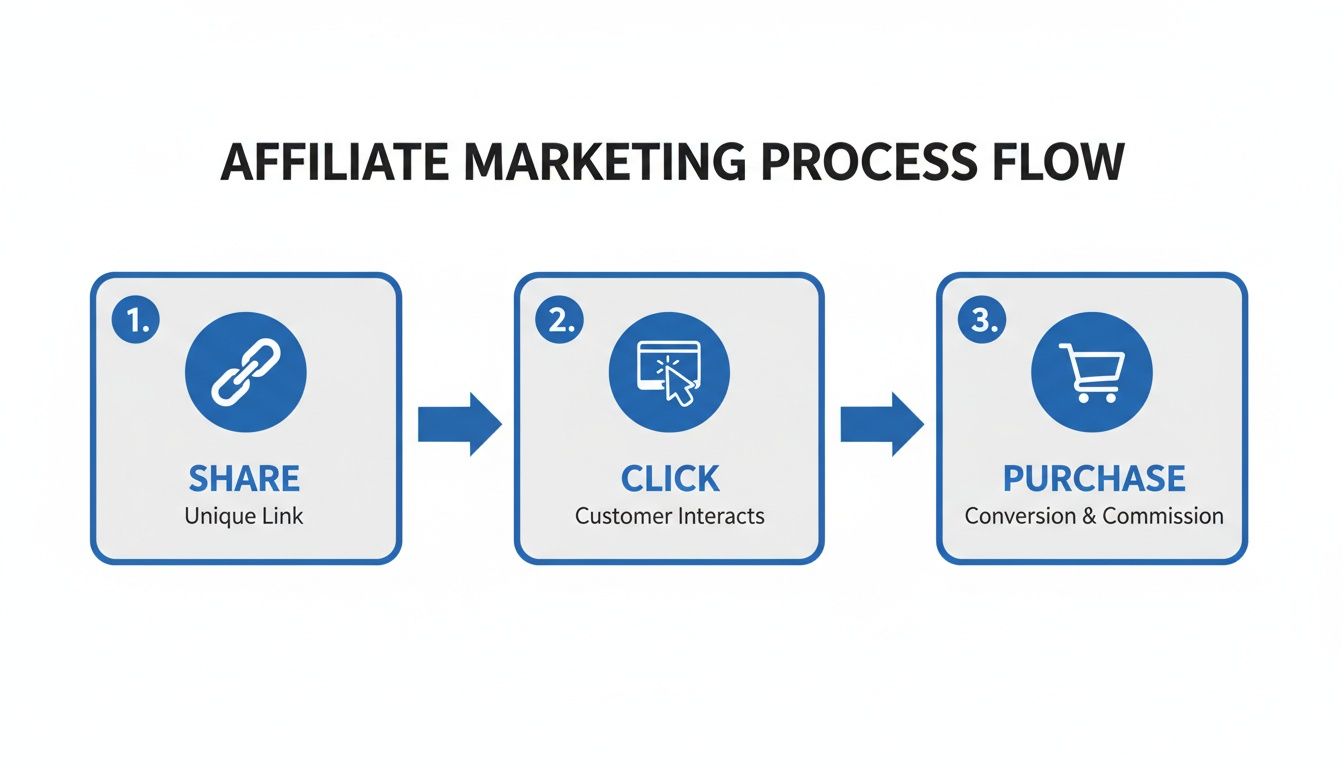
This simple Share, Click, Purchase flow is the engine that drives every partnership, from a massive media site to a niche influencer.
Content Creators And Review Sites
Content creators are often the heart of a great SaaS affiliate program. These are the bloggers, YouTubers, and niche review sites that have built deep, authentic trust with their audience by consistently providing real value. They don’t just drop a link; they create detailed tutorials, write comprehensive reviews, and publish in-depth comparison articles that genuinely help people make smarter decisions.
Think of them as the trusted experts in your field. When a respected blogger publishes a post on "The 5 Best Project Management Tools for Startups" and includes your product, that recommendation carries serious weight. This is gold for SaaS companies because it educates the market and builds credibility at the same time. A tech YouTuber might spend 15 minutes walking through your software’s best features, showing exactly how it solves a real problem.
These partners excel at driving high-quality, considered purchases. Because their audience already trusts their judgment, the leads they send are often more qualified and convert at a higher rate.
Their primary strength is generating top-of-funnel awareness and mid-funnel consideration. Platforms like LinkJolt make it incredibly simple to find and connect with these high-value creators through a discovery marketplace, so you can find partners who are a perfect fit for your brand.
Social Media Influencers
While content creators go deep, social media influencers are all about breadth and speed. They operate on platforms like Instagram, TikTok, and Twitter, where their large, engaged followings can generate a ton of brand awareness and immediate interest. Their promotions tend to be more visual, personal, and punchy.
An influencer might post a quick video showing how your software makes their day easier or share an exclusive discount code in an Instagram Story. This approach is fantastic for reaching new audiences who might not even be actively looking for a solution like yours yet.
Coupon And Deal Sites
Coupon and deal sites hold a very specific—and very powerful—spot in the affiliate world. Partners like RetailMeNot or Honey cater to customers who are at the absolute final step of the buying journey. These folks have sky-high purchase intent; they’ve usually already decided to buy and are just looking for that last little incentive to click "confirm."
For a SaaS business, offering a special discount through these sites is a great way to capture customers who are on the fence. It’s a classic bottom-of-the-funnel strategy that converts traffic that's ready to buy now. While some brands worry about devaluing their product, a smart coupon strategy can drive a surprising amount of volume.
Paid Search And Media Buyers
This last group is made up of sophisticated marketers who specialize in running paid ad campaigns on platforms like Google Ads or Facebook Ads. These affiliates, often called "media buyers," use their own money to drive traffic to your product through their affiliate links. They are experts in keyword research, ad copywriting, and campaign optimization.
In essence, you’re outsourcing a slice of your paid acquisition to specialists who only get paid when they deliver a result. This performance-based model significantly lowers your upfront risk compared to running all of your paid campaigns entirely in-house.
Before you start recruiting, it helps to understand how these different partner types typically perform.
Comparing Affiliate Partner Effectiveness For SaaS
This table breaks down common affiliate partners by their typical conversion rates, audience trust levels, and ideal use cases for SaaS businesses, helping you prioritize your outreach.
As you can see, a balanced affiliate program often includes a mix of these partner types. Content creators build the foundation of trust, influencers generate buzz, and deal sites help close sales. By understanding their individual strengths, you can build a more resilient and effective growth engine for your SaaS.Why SaaS Companies Thrive With Affiliate Marketing
For any Software-as-a-Service (SaaS) company, affiliate marketing isn't just another channel to bolt onto your strategy—it’s a growth engine that’s practically built for the subscription model. Forget traditional advertising, where you pay upfront for billboards or clicks and just hope for a decent return. Affiliate marketing completely flips the script.
It all comes down to a performance-based model. With old-school ads, you’re buying potential eyeballs. With affiliate marketing, you’re buying actual, paying customers.
The Power of Performance-Based Payouts
The single biggest advantage here is how incredibly cost-effective it is. In an affiliate program, you only pay a commission when something valuable happens—usually, a new customer signs up for a paid plan. This model wipes out wasted ad spend and can dramatically lower your customer acquisition cost (CAC).
Think about it. You could drop thousands on a digital ad campaign and have no clear idea how many new sign-ups it actually drove. An affiliate program, on the other hand, draws a straight line between your marketing spend and your revenue. If a partner drives $1,000 in new monthly recurring revenue (MRR), you pay them a commission you both agreed on. Your ROI isn't a guess; it's simple math.
Pay-for-performance is the ultimate risk reduction strategy. You invest only in what works, making every dollar of your marketing budget accountable and ensuring a predictable, positive ROI from day one.
This model is a game-changer for early-stage startups. You don't need a massive upfront budget to compete; you just need a product people love and an offer that makes sense for your partners.
Unlocking Scalable Growth and Social Proof
Beyond the cost savings, affiliate marketing offers a kind of scalability that’s hard to achieve otherwise. Your internal marketing team can only reach so many people. But an army of motivated affiliates? They can tap into countless niche communities you’d never find on your own. Each partner brings their own unique audience, voice, and—most importantly—credibility.
That leads to another huge win: social proof. When a trusted blogger, industry expert, or YouTuber recommends your software, that endorsement is infinitely more powerful than a branded ad. This kind of third-party validation builds a level of trust that money just can't buy. Customers who arrive through an affiliate link are often already convinced of your value because someone they respect has already vouched for you.
For a SaaS company trying to build its brand, that’s priceless. It’s like having hundreds of trusted advocates telling the world why your product is the right choice.
Navigating the Potential Risks
Of course, no marketing channel is a silver bullet. It's smart to be aware of the potential downsides, which include:
- Affiliate Fraud: Some bad actors might use bots or shady tactics to generate fake clicks or sign-ups.
- Brand Misrepresentation: A partner might misrepresent your product’s features or use off-brand messaging to make a quick buck.
- Commission Poaching: Unscrupulous affiliates might try to take credit for sales they didn't actually generate.
This is exactly where having a robust management platform becomes non-negotiable. For instance, LinkJolt provides sophisticated tools designed specifically for SaaS affiliate programs, offering features like fraud detection, brand monitoring, and crystal-clear attribution tracking. These safeguards keep your program secure, profitable, and perfectly aligned with your brand as you grow.
The affiliate world is booming, especially in B2B. In fact, B2B affiliate programs are projected to see 17% growth in 2025 as more companies use partners to reach key decision-makers. While retail and e-commerce currently make up 44% of affiliate revenues, SaaS is catching up fast because the ROI often crushes traditional ad channels. By choosing the right partners and the right technology, any SaaS company can build a secure, scalable, and wildly profitable new growth channel.
How To Launch Your First Affiliate Program

Alright, enough with the theory. Let's get down to actually building this thing. Launching an affiliate program is one of the most direct ways to create a powerful, performance-based growth channel for your business. This isn't about abstract marketing concepts; it's about following a clear roadmap to get from an idea to a fully functional program that drives real revenue.
We'll walk through a simple five-step framework that any company—from a bootstrapped startup to an established enterprise—can use to get moving. The whole game is about building a solid foundation, finding the right partners, and giving them the tools they need to win.
Step 1: Define Your Goals And Commission Structure
Before you do anything else, you have to know what you're aiming for. What does success actually look like? Are you trying to hit a specific number of new sign-ups each month? Or is the main goal to get your brand name out there in a new market? Your objectives will dictate the kind of program you build.
Once your goals are crystal clear, you can design a commission structure that actually motivates people to join. A compelling offer is the fuel for your entire program.
- Recurring vs. One-Time: For SaaS, a recurring commission (like 20% of the monthly subscription for the first year) is usually the most attractive. It gives affiliates a predictable income stream and aligns their success with yours.
- Flat Rate vs. Percentage: A flat rate (say, $100 per sale) is super simple to communicate. A percentage model, on the other hand, scales with your pricing, which can be a bigger incentive for partners to push higher-tier plans.
- Competitive Analysis: Take a peek at what similar companies in your space are offering. You don't necessarily have to offer the most, but your deal needs to be competitive enough to catch the eye of high-quality partners.
Get the commission structure right, and recruitment becomes infinitely easier. It sends a clear signal to potential affiliates that you're serious about building a partnership that benefits everyone.
Step 2: Choose The Right Management Platform
Trying to run an affiliate program with spreadsheets is a complete nightmare. You need a dedicated platform to act as the central nervous system for your program, handling everything from tracking links to paying commissions. This is where a tool like LinkJolt becomes absolutely essential.
The right platform automates all the tedious work so you can spend your time building relationships with your partners. It should handle:
- Unique Link Generation: Instantly creating trackable referral links for every single partner.
- Real-Time Tracking: Watching clicks, conversions, and revenue roll in as they happen.
- Automated Payouts: Making sure your affiliates get paid correctly and on time, which is crucial for building trust.
This is the kind of clean, intuitive dashboard that gives you an at-a-glance view of your program's health, letting you spot top performers and make smart decisions quickly.
Step 3: Recruit Your First High-Quality Affiliates
With your goals set and your tech in place, it’s time to find your first partners. Resist the urge to go for quantity over quality. A handful of engaged, relevant affiliates will crush the results of a hundred partners who aren't a good fit.
Start with your own network. Your happiest customers, industry contacts, and brand evangelists are often the best potential affiliates because they already know and love your product.
From there, you can start expanding your search. Look for bloggers, YouTubers, and influencers who create content for the exact audience you're trying to reach. A platform with a built-in discovery marketplace, like LinkJolt, can speed this process up dramatically by connecting you with pre-vetted partners who are actively looking for programs just like yours.
Step 4: Equip Your Partners For Success
Your job isn't over once you've signed someone up. The best programs give their partners a full suite of resources to make promoting the product as easy as possible. This is usually done through a dedicated affiliate portal.
Your resource kit should include things like:
- Brand Guidelines: Simple rules on how to use your logo and talk about your product.
- Marketing Assets: Pre-made banners, social media graphics, and email swipe copy.
- Product Information: One-pagers and talking points that highlight key benefits and features.
- Best Practices: A few tips on what messaging and strategies have worked well for others.
By arming your affiliates, you ensure brand consistency and empower them to be much more effective marketers on your behalf.
Step 5: Track Performance And Optimize For Growth
Launching is just the beginning. The final, ongoing step is to constantly monitor your program’s performance and find ways to make it better. Use your platform’s dashboard to keep an eye on key metrics like clicks, conversion rates, and the total revenue each affiliate is generating.
This data-driven approach lets you see what's working and what isn't. You can double down on your most successful partnerships, offer extra support to those who might be struggling, and tweak your overall strategy to get the best possible return. The impact is real; affiliate marketing is projected to drive over $210 billion in U.S. e-commerce sales in 2025 alone, a huge testament to its power. You can learn more about the growth of affiliate marketing from eMarketer.
Key Metrics For Measuring Affiliate Success
Getting an affiliate program off the ground is one thing, but truly understanding how it's performing is what unlocks sustainable growth. You simply can't improve what you don't measure. Tracking the right metrics transforms guesswork into a clear, data-driven strategy, showing you exactly what’s working, who your star partners are, and where you can fine-tune your efforts for better results.
Think of your affiliate dashboard as the cockpit for your program. Each metric is a gauge telling you something vital about the health of your growth engine. Ignoring these numbers is like flying blind; you might be moving, but you have no idea if you're actually headed in the right direction.
Core Performance Indicators
To get started, you’ll want to keep a close eye on a handful of foundational metrics. These Key Performance Indicators (KPIs) give you a high-level snapshot of your program's health and are essential for day-to-day management.
- Click-Through Rate (CTR): This is the percentage of people who click an affiliate's link after seeing it. A high CTR is a great sign that your affiliate’s content is compelling and their audience is genuinely curious about what you offer.
- Conversion Rate (CR): This tells you what percentage of those clicks turn into a desired action, like a free trial sign-up or a paid subscription. This is arguably the most crucial metric for gauging the quality of the traffic your affiliates are sending your way.
- Earnings Per Click (EPC): This metric calculates the average revenue generated for every single click an affiliate sends over. It's a quick and dirty way for both you and your partners to understand the monetary value of their traffic.
A real-time dashboard, like the one inside LinkJolt, makes tracking these numbers a breeze. You can instantly see which partners are driving the most clicks and—more importantly—which ones are delivering the most valuable conversions that actually move the needle.
For example, a high CTR but a low CR often signals a disconnect. Your affiliate might be a rockstar at getting clicks, but if those visitors aren't converting, it could mean their promotional message doesn't quite line up with your landing page experience.
Measuring Profitability and Long-Term Value
While immediate sign-ups feel great, the real win in SaaS is all about long-term value. You need to look beyond the initial sale to understand if your affiliate channel is truly profitable and built to last. This means digging into some more advanced financial metrics.
Two of the most critical numbers to watch are:
- Return on Investment (ROI): This is the ultimate measure of profitability. It calculates how much revenue you bring in for every dollar you spend on affiliate commissions. A positive ROI is the clearest confirmation that your program is a healthy growth driver.
- Customer Acquisition Cost (CAC): This tells you exactly how much it costs to acquire a new customer through your affiliate channel. A low CAC is a sure sign of an efficient program that’s ready to scale.
Beyond direct payouts and conversion rates, true profitability is often reflected in the Customer Lifetime Value (LTV) to Customer Acquisition Cost (CAC) ratio. A healthy ratio here shows that the customers you acquire through affiliates aren't just signing up—they're sticking around and providing lasting value to your business. By tracking both immediate and long-term metrics, you can make smarter decisions and scale your program with confidence.
Common Questions About Affiliate Marketing
As you get ready to jump into the world of affiliate marketing, a few questions always pop up. They're the same ones we hear from almost every SaaS founder.
Getting straight answers helps you build a program that actually works, right from the start. Let's tackle them head-on.
How Much Does It Really Cost To Start an Affiliate Program?
This is usually the first question on everyone's mind, and the answer is better than you think. At its core, affiliate marketing is a pay-for-performance model. You aren't burning cash on clicks or impressions; you only pay a commission after you get a paying customer. That makes it an incredibly low-risk way to grow.
Still, you’ll want to budget for two main things:
- Commissions: This is the slice of the sale you give your partners. Since you set the rate, it’s a totally predictable expense that’s directly tied to new revenue.
- Platform Fees: You'll need software to keep everything organized. A platform like LinkJolt has a simple subscription fee for all the tracking, management, and payout tools, but with zero transaction fees, so your costs stay predictable.
So yes, there's a small software cost to get started, but the lion's share of your spending is directly linked to the new business your partners bring in.
How Do You Find the Right Affiliates for a Niche SaaS Product?
This can feel like searching for a needle in a haystack, but it’s much simpler when you know where to look. Forget about casting a wide net. The goal is surgical precision—finding partners whose audience is already dealing with the exact problem your software solves.
Your best first stop? Your own backyard. Your most enthusiastic customers are often your best affiliates because their recommendation is genuine. From there, it's about smart outreach. Look for the bloggers, podcasters, and YouTubers who are the go-to experts in your specific corner of the market.
The best way to do this at scale is with a dedicated discovery marketplace. Tools like LinkJolt give you access to a pre-vetted network of SaaS-focused affiliates actively looking for new products to promote, which can save you hundreds of hours of manual searching.
What Is the Difference Between Affiliate and Referral Marketing?
This one trips a lot of people up because both programs reward people for sending you new customers. The real difference is who you're rewarding.
- Affiliate Marketing is when you partner with external marketers, publishers, and content creators. You pay them a commission to promote your product to their audiences. Think of it as building a professional, performance-based sales team.
- Referral Marketing is all about rewarding your existing customers for telling their friends and colleagues about you. It’s a way to supercharge word-of-mouth from your happiest users, usually with smaller rewards like account credits or a discount.
Here's the easiest way to think about it: affiliate marketing is about recruiting an army, while referral marketing is about empowering your fans.
Ready to build and scale your own high-performance affiliate program without the complexity? LinkJolt provides all the tools you need, from automated payouts to a partner discovery marketplace. Start your journey with LinkJolt today!
Watch Demo (2 min)


Trusted by 300+ SaaS companies
Start Your Affiliate Program Today
Get 30% off your first 3 months with code LINKJOLT30
✓ 7-day free trial
✓ Cancel anytime