Your Guide to Building Successful SaaS Affiliate Programs
Your Guide to Building Successful SaaS Affiliate Programs

Ollie Efez
December 08, 2025•21 min read

Picture this: you have a massive, global sales team working around the clock to bring you new customers. The best part? You only pay them after they make a sale. That’s the magic of a SaaS affiliate program. It’s a performance-based marketing strategy where you partner with creators, bloggers, and industry experts to grow your business in a seriously cost-effective way.
Why SaaS Affiliate Programs Are a Growth Superpower
Unlike hiring a traditional sales team and paying salaries regardless of results, affiliate programs run on a simple, powerful principle: pay for performance. You give your partners (the affiliates) a unique link to share with their audience. When someone clicks that link and signs up for your software, the affiliate gets a commission. It’s a true win-win that turns your biggest fans into an incentivized marketing army.
This model is a perfect fit for software companies because of the subscription model. While plenty of affiliate programs pay a one-time commission, the real game-changer for SaaS is recurring commissions.
This means your affiliates earn a cut of the subscription fee every single month (or year) that the customer they referred stays with you. This simple shift in structure completely changes their motivation—they’re no longer looking for quick sign-ups, but for high-quality, long-term customers who will love your product.
The Allure of Recurring Revenue
That recurring model is precisely what gets the best partners excited to work with you. It creates a predictable, compounding source of income for them, which naturally encourages them to keep promoting your software month after month. It's less of a one-off transaction and more of a genuine, long-term partnership. You can see just how powerful this is by reading about the compounding effect of strategic affiliate channels.
And the market is exploding. The global affiliate marketing industry hit an estimated $32.3 billion in 2024, with the SaaS space alone expected to grow by an incredible 15.6% every year through 2028. This growth is all thanks to how efficient and scalable these performance-based models are.
Building a Sustainable Growth Engine
A well-run affiliate program becomes a predictable and scalable engine for bringing in new customers. It lets you tap into brand new audiences through voices they already trust. After all, a recommendation from a respected expert is far more powerful than a traditional ad.

As your company grows, the affiliate channel just becomes more and more valuable. It’s not some tactic you only use in the early days; it’s a sustainable growth lever you can pull for years to come.
Designing a Commission Structure That Attracts Winners
Let's get straight to the point: your commission structure is the engine of your entire affiliate program. It’s what grabs the attention of top-tier partners and keeps them motivated to send high-quality customers your way. Get it wrong, and you'll struggle with low engagement. Get it right, and you've built a powerful, self-sustaining growth machine.
Think of it as the fuel for your affiliates' marketing fire. The better the fuel, the brighter the fire burns. Your job is to find that sweet spot—a commission that's generous enough to attract the best talent but sustainable for your business in the long run.
Choosing Your Commission Model
When it comes to SaaS, there's no single "best" commission model. The right fit really depends on your product's price point, how long customers typically stick around (your CLV), and the kind of partners you want to work with.
Most SaaS companies land on one of these three common structures.
Comparing Common SaaS Affiliate Commission Models
The table below breaks down the most popular commission structures you'll see in the SaaS world. Each has its own unique set of pros, cons, and ideal scenarios.
Ultimately, picking the right model comes down to running the numbers for your specific business. If you're feeling stuck, a little experimentation can go a long way.You can play around with different scenarios using our free commission structure builder to see what makes the most sense for your bottom line.
Key Metrics That Shape Your Structure
Before you lock in your commission rates, you absolutely have to know your numbers. These metrics will tell you what you can afford to pay and ensure your program stays profitable as you grow.
Customer Lifetime Value (CLV) This is the big one. CLV is the total amount of money you expect to make from a single customer over their entire time with you. Knowing this number is non-negotiable—it tells you exactly how much room you have to play with when it comes to acquiring a customer, commissions included.
Customer Acquisition Cost (CAC) This is what you're currently spending to get a new customer through all your other marketing and sales channels. A healthy affiliate program should have a CAC that's comfortably lower than your CLV. For instance, if your average CLV is $1,500, you can afford to offer a very attractive commission and still maintain a healthy profit margin.
Affiliate Activation Rate Getting affiliates to sign up is easy. Getting them to actually drive their first sale is the real challenge. A low activation rate—and in my experience, anything below 60% is a red flag—often points to a commission structure that just isn't exciting enough or an onboarding process that's falling flat.
Your commission structure isn't just a number; it's a message. It tells potential partners how much you value them and the customers they bring. A generous, well-thought-out model signals that you see them as true partners in your growth, not just another marketing channel.
Best Practices for a Winning Structure
Once you’ve picked a model and crunched the numbers, a few tried-and-true practices can really set your program apart.
- Be Competitive, Not Greedy: Do your homework. See what other SaaS affiliate programs in your space are offering. You don't necessarily need to be the highest payer out there, but your offer has to be compelling enough to turn the heads of experienced affiliates who have plenty of options.
- Consider Tiered Commissions: This is one of my favorite ways to motivate partners. By creating tiers, you reward your top performers with better commission rates as they hit certain sales milestones. It’s a powerful incentive that keeps your best people engaged and always pushing for that next level.
- Keep It Simple: While a complex hybrid model might look great on a spreadsheet, simplicity usually wins. This is especially true when you're just starting out. Make your structure so easy to understand that a potential partner gets it in five seconds. Clarity builds trust and makes signing up a no-brainer.
How to Launch Your Affiliate Program Step by Step
Great SaaS affiliate programs don't just appear out of thin air. They're the result of a thoughtful, step-by-step process that turns a good idea into a reliable growth engine. It’s a lot like building a house—you need a solid blueprint before you even think about laying the foundation.
This guide is that blueprint. We’ll walk through the essentials, from sketching out your initial strategy to running through the final pre-launch checks. The goal is to build a program that not only attracts top-tier partners but also delivers real, measurable results right from the start.
Define Your Goals and Ideal Partner
First things first: what does success actually look like for you? Before you do anything else, you have to define the primary goal for your program. Are you trying to drive a certain number of new trials? Maybe you want to boost your monthly recurring revenue by a specific percentage. Or perhaps the goal is to crack into a whole new market segment.
Setting clear, quantifiable goals is the most critical first step. Vague objectives like "get more sales" lead to scattered efforts. A specific goal like "acquire 50 new enterprise customers through affiliates in Q3" gives your program direction and purpose.
Once you know where you’re headed, you can figure out who you want to bring along for the ride. Your ideal affiliate profile is just a detailed description of your perfect partner. Think about:
- Audience Fit: Who is their audience? Does it overlap perfectly with your ideal customer?
- Content Style: Are they bloggers, YouTubers, industry consultants, or something else entirely? Their format will shape the kind of marketing materials you'll need to create for them.
- Values Alignment: Do they operate in a way that aligns with your brand? A strong match here leads to much more authentic and effective promotions.
Build Your Program’s Foundation
With your goals set and your ideal partner in mind, it's time to build the core of your program. This means creating the rules, resources, and technical backbone that will support your affiliates and protect your business.
Start by drafting a clear and comprehensive affiliate agreement. This is a legal document, but it shouldn't be confusing. It needs to lay out everything from commission rates and payout schedules to what's considered an acceptable promotional method. Being transparent here builds trust from day one and helps avoid headaches down the road.
Next, you need to set your partners up for success with an affiliate toolkit. This is essentially a grab-and-go package of marketing assets that makes it incredibly easy for them to promote your product. A solid toolkit should include:
- High-quality logos and brand imagery.
- Pre-written email templates and social media copy.
- Product screenshots and short video demos.
- Powerful case studies and customer testimonials.
As you map out your own program, it helps to look at what others are doing. Checking out active SaaS affiliate programs can give you some great ideas. For a real-world example, take a look at TranslateMom's Affiliate Program page to see how they present their offer and resources to potential partners.
This visual guide breaks down the simple, ongoing process for keeping your commission structure effective.
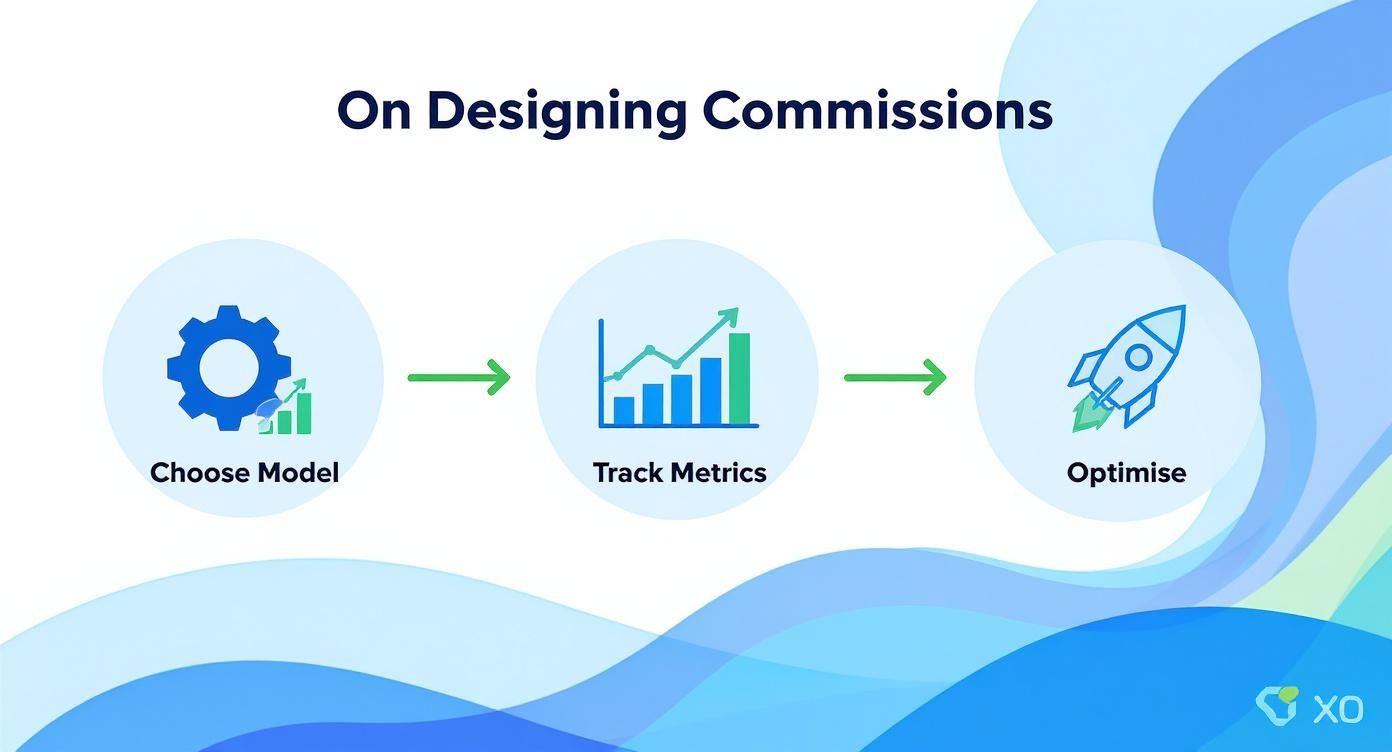
What this shows is that commission design isn't a "set it and forget it" task. It's a continuous cycle of choosing a model, measuring its impact, and tweaking it for better performance.
Choose Your Management Platform
Trying to manually track clicks, sign-ups, and payouts is a surefire way to create chaos. A solid affiliate management platform, like LinkJolt, is a non-negotiable for automating the grunt work and giving you data you can actually trust.
When you're shopping around for software, make sure these features are at the top of your list:
- Reliable Tracking: The system must be able to accurately attribute referrals, even if a customer uses multiple devices. This ensures your affiliates get paid fairly for every sale they send your way.
- Intuitive Dashboard: Both you and your affiliates need a clean, easy-to-use dashboard. It should make it simple to see key metrics like clicks, conversion rates, and earnings at a glance.
- Automated Payouts: Look for a platform that integrates with payment processors like PayPal or Stripe. Automating commission payouts will save you countless hours of manual work each month.
- Fraud Detection: Good programs attract good partners, but they can also attract bad actors. Built-in tools that flag suspicious activity will help protect your bottom line.
Your management platform is the central hub for your entire program, so this is one of the most important decisions you'll make. Take your time and choose wisely.
Recruiting and Empowering High-Impact Affiliates
A great commission structure and the right software are the skeleton of your program, but your affiliates are its heart and soul. Just launching a program and waiting for people to sign up is like opening a store without telling anyone. To build a channel that actually drives growth, you need to actively find, recruit, and empower partners who can become true advocates for your brand.

This isn’t about chasing huge numbers, either. A common mistake is the "spray and pray" approach—blasting out generic invites to hundreds of random people. The reality? A handful of highly engaged, perfectly aligned partners will outperform a hundred disengaged ones every single time.
Where to Find Your First Star Affiliates
Often, your best potential partners are hiding in plain sight. They're the people and businesses whose audiences already look just like your ideal customer. Instead of casting a wide net, start by fishing in these high-potential ponds.
- Your Own Customer Base: Who better to promote your product than your happiest customers? They already use it, love it, and can speak about it with genuine authority. Look for your power users or customers who have an existing audience and send them a personal invitation.
- Industry Bloggers and Content Creators: Find the respected voices in your niche—the bloggers, podcasters, and YouTubers who are already creating content that solves the same problems your SaaS does. A thoughtful, personalized message explaining how your tool can help their audience will get a much better response than a generic template.
- Complementary SaaS Companies: Team up with non-competing software companies that serve a similar crowd. For example, if you sell an email marketing tool, a landing page builder is a perfect partner. It's a natural, value-add recommendation for both audiences.
Onboarding That Creates True Partners
Getting someone to sign up is just step one. The real work starts with onboarding. This is where most programs fall flat, leaving new partners confused, unmotivated, and quick to churn. Your goal is to make it ridiculously easy for them to get started and see success.
An affiliate's first 30 days are critical. A smooth onboarding experience that provides clear guidance, necessary resources, and a direct point of contact can dramatically increase their chances of making that crucial first sale and becoming a long-term, active partner.
A solid onboarding process should always include:
- A Personal Welcome: An automated email is fine, but a personal note from your affiliate manager makes a world of difference in building a real relationship.
- A Guided Tour: Don't just dump them into a dashboard. A short video or a simple guide showing them where to find their links, access marketing materials, and track performance is essential.
- The Essential Toolkit: Give them everything they need to start promoting right away. This means logos, pre-written copy, product screenshots, and maybe even a few email templates.
Keeping Your Best Affiliates Engaged
Once your partners are up and running, your job shifts to motivation and support. Remember, your top affiliates have other options. You need to give them compelling reasons to keep promoting your product over others.
This is where consistent communication and smart incentives come into play. Well-managed SaaS affiliate programs in specialized fields like AI and B2B enterprise often see affiliates contribute 15-25% of the company's MRR. Some fast-growing companies have built affiliate networks thousands strong in just a few years, with these channels eventually driving over half their total revenue. You can dig into the numbers and see how companies like Aragon grew their network by checking out these SaaS affiliate program benchmarks.
To keep your own top performers fired up, try these strategies:
- Tiered Commissions: Reward your best partners by bumping up their commission rate when they hit certain sales milestones. This gamifies the process and gives them a clear goal to work toward.
- Performance Bonuses: Nothing motivates like cash. Offer one-time bonuses for hitting specific targets, like "an extra $500 for driving 20 sales this month."
- Regular Communication: A simple monthly newsletter with product updates, promotion tips, and a shout-out to your top performers can work wonders. It keeps your program top-of-mind and shows you genuinely appreciate their effort.
Protecting Your Program from Fraud and Legal Risks
In any good partnership, trust is everything. While it's easy to get caught up in the excitement of launching a SaaS affiliate program, ignoring the potential for fraud and legal headaches is like building a house without a solid foundation. Getting ahead of security and compliance isn't just about protecting your business—it’s about creating a transparent, long-lasting program that top-tier partners will want to join.
Your first line of defense is always a rock-solid affiliate agreement. This document is more than just legal jargon; it's the official rulebook for your program. It needs to spell out everything from commission structures and payment schedules to, most importantly, the do's and don'ts of promotion. Laying out the rules clearly from the start prevents confusion and gives you firm ground to stand on if a problem ever pops up.
Navigating the Legal Landscape
Beyond your own rules, you have to play by the law. In the U.S., for instance, the Federal Trade Commission (FTC) has very clear guidelines about endorsements. Affiliates must disclose that they have a financial relationship with you when they recommend your product. This is non-negotiable. Failing to enforce this can land both you and your affiliate in hot water.
The big idea behind the FTC guidelines is simple: transparency. An affiliate's audience deserves to know if a recommendation is backed by a potential commission. A simple hashtag like “#ad” or “#sponsored” usually does the trick.
Data privacy is another huge piece of the puzzle. Laws like GDPR in Europe and CCPA in California dictate how you can collect and manage user data. You need to make sure your tracking methods are fully compliant and that everyone involved respects user privacy.
Identifying and Preventing Common Fraud Tactics
The vast majority of affiliates are great partners, but it only takes a few bad apples to waste your budget and tarnish your brand. Fraud often starts with fake sign-ups or multiple accounts, so understanding the risks associated with disposable email addresses is a crucial first step. You have to stay vigilant for the most common schemes.
Here are a few tactics to watch out for:
- Cookie Stuffing: A sneaky trick where a fraudster forces multiple affiliate cookies onto a user's browser without them knowing, essentially stealing credit from another affiliate’s hard work.
- Ad Hijacking: This happens when a shady affiliate bids on your company’s branded keywords in paid search ads and funnels that traffic through their own affiliate link, which is a major violation of most program terms.
- Fake Leads: Some fraudsters will fill out trial or demo forms with bogus information, hoping to get paid for leads that are completely worthless.
The good news is, you don't have to go it alone. Modern affiliate management platforms like LinkJolt come equipped with fraud detection tools that automatically flag sketchy behavior. These systems can spot weird click patterns, detect when someone is hiding behind a VPN, or flag self-referrals. This gives you the power to shut down bad actors before they do any real damage. For a closer look at this, check out our guide on identifying and preventing common affiliate marketing scams.
By combining a strong legal agreement, a commitment to compliance, and the right technology, you create a secure environment where genuine partnerships can thrive. This frees you up to focus on what really matters: building profitable relationships with legitimate partners who will help your SaaS business grow.
Succeeding with Affiliates in Global Markets
https://www.youtube.com/embed/JVq6rnoDheg
Taking your SaaS affiliate program global is a huge opportunity, but it’s not as simple as just translating your website. What works for an affiliate in North America could completely miss the mark in Asia-Pacific. If you try a one-size-fits-all approach, you're setting yourself up for a lot of wasted time and lost revenue.
You have to think of each new market as its own unique ecosystem. It has its own culture, its own laws, and its own ways of doing business. Your success hinges on how well you adapt. For instance, the influencer and content creator scene in the United States is well-established, with clear rules for things like disclosures and brand deals.
Adapting to Regional Differences
That's not the case everywhere. In Europe, you have to navigate strict data privacy laws like GDPR, which changes how you and your affiliates can track conversions and manage customer information. Your affiliate agreement and promotional rules have to be built around these local laws to avoid some pretty hefty fines.
The same goes for your marketing message. A direct, features-first pitch that resonates in the U.S. might come across as too pushy in Japan, where building trust and showing long-term value is more important. Your outreach to potential partners and the marketing assets you provide them need to feel local to actually connect.
A global strategy isn't about being everywhere at once. It's about being effective where you are. Focus on one or two key international markets first, learn their unique dynamics, and build a localized playbook before expanding further.
When you look at the affiliate world, you see a clear regional breakdown. North America is the biggest player, responsible for 40-45% of global affiliate revenue, largely because of its massive creator economy and mature e-commerce market. Europe comes in next, making up about 30-31%, while the Asia-Pacific region contributes between 23-33%. If you're curious about the numbers, you can explore more statistics on the global affiliate market to get a better sense of the landscape.
Tailoring Your Program for International Success
To really make it work internationally, you have to get into the details and customize your program. A flat commission rate doesn't make sense when you're dealing with different currencies and wildly different costs of living.
Here are a few practical things you should do for every new region you enter:
- Localized Payouts: Pay your partners in their local currency. It’s a small thing that makes a big difference and removes a major headache for them.
- Region-Specific Assets: Don't just translate your marketing materials. Create new ones with images, case studies, and testimonials that actually reflect the local culture.
- Adapted Commission Tiers: What motivates someone in Silicon Valley might not be the same for someone in São Paulo. Adjust your performance bonuses to match the local economy so they stay attractive.
- Communication Channels: Email is king in some places, but in others, business gets done on WhatsApp or WeChat. Meet your partners where they are.
By putting in the effort to adapt, you can turn a successful domestic affiliate program into a true global growth machine. It just means treating each new market with the strategic focus it deserves.
Common Questions About SaaS Affiliate Programs
Thinking about starting a SaaS affiliate program? It's natural to have questions about the cost, how long it takes to get going, and how it stacks up against other marketing channels. Let's break down some of the most common questions I hear from founders.
How Much Does It Cost To Start an Affiliate Program?
The good news is that starting an affiliate program is probably more affordable than you think. Your main fixed cost is usually the software you use to manage everything—an affiliate management platform. These can run anywhere from under a hundred to several hundred dollars a month, depending on what you need.
The other major cost is, of course, the commissions you pay your affiliates. But here’s the beauty of it: it's a performance-based model. You only pay out when an affiliate actually brings you a paying customer, making it an incredibly efficient way to spend your marketing dollars.
How Long Does It Take To See Results?
This is a long-term play, so patience is a virtue. While you might get a few quick wins in the first few weeks, it realistically takes three to six months to build real, sustainable momentum. That initial stretch is all about finding the right partners and helping them get up to speed.
Don't mistake a slow start for failure. The first year is about building a foundation. Consistent effort in recruiting, onboarding, and supporting your affiliates is what creates a program that delivers significant, compounding revenue over the long term.
Success really boils down to finding partners who genuinely align with your brand and giving them the tools they need to succeed.
Is an Affiliate Program Better Than Running Ads?
This isn’t an either/or situation. It's more about understanding how each channel fits into your broader growth plan. They serve different roles and often complement each other perfectly.
- Paid Ads: Ads are fantastic for getting immediate, predictable traffic. They're great for testing out messaging and building brand awareness quickly. The catch? The moment you turn off the spend, the traffic disappears.
- Affiliate Programs: Think of this as building a long-term asset. It’s all based on relationships and trust, which often leads to a lower customer acquisition cost over time and high-quality referrals from voices your audience already listens to.
Most of the fastest-growing SaaS companies I've seen use a mix of both to create a really balanced and resilient marketing engine.
How Do You Handle Affiliate Payouts?
Trying to track sales and pay affiliates one-by-one with a spreadsheet is a surefire way to create headaches and make mistakes. This is exactly why modern affiliate management software is a must-have.
A good platform automates the entire payout process. It tracks every sale, calculates the correct commissions, and lets you pay everyone in one go through services like PayPal or direct bank transfers. This automation not only saves you a ton of time but also ensures your partners get paid accurately and on schedule, which is crucial for keeping them happy and motivated.
Ready to launch and manage a world-class SaaS affiliate program without the complexity? LinkJolt provides the tools you need to automate tracking, manage payouts, and empower your partners for success. Start building your affiliate program today.
Watch Demo (2 min)


Trusted by 300+ SaaS companies
Start Your Affiliate Program Today
Get 30% off your first 3 months with code LINKJOLT30
✓ 3-day free trial
✓ Cancel anytime
Frequently Asked Questions
Why are SaaS affiliate programs a powerful growth strategy?
A SaaS affiliate program is a performance-based model where you only pay partners after they deliver a sale. This eliminates the fixed salary cost of a traditional sales team and taps into audiences the brand could not reach alone. The subscription model amplifies the benefit further: recurring commissions motivate affiliates to find and retain high-quality customers rather than chasing one-off conversions.
What is the benefit of recurring commissions for SaaS affiliates?
Recurring commissions pay affiliates a percentage of every subscription renewal, not just the first payment, creating a compounding income stream that grows as their referred customers stay active. This structure completely changes affiliate motivation: instead of optimizing for raw sign-up volume, partners focus on finding users who are a genuine product fit and who will remain subscribers long-term, directly aligning their incentives with yours.
How should a SaaS company design its affiliate commission structure?
The commission structure is the engine of the entire program and must be compelling enough to attract high-quality partners. Offering recurring commissions on subscription revenue is the most effective hook for serious SaaS affiliates. Commission rates, payout thresholds, and cookie windows should be competitive with similar programs in your category, because top-tier partners evaluate multiple opportunities and will prioritize programs with the strongest economics.
How large is the affiliate marketing market for SaaS?
The global affiliate marketing industry reached an estimated 32.3 billion dollars in 2024, with the SaaS segment expected to grow by 15.6 percent annually through 2028. This growth is driven by the efficiency and scalability of performance-based models, which let software companies expand into new audiences without proportionally increasing marketing headcount or fixed spend.