Referral Program Tracking: Measure, Optimize & Grow
Referral Program Tracking: Measure, Optimize & Grow

Ollie Efez
November 28, 2025•23 min read

At its heart, referral program tracking is all about connecting the dots. It’s the system you build to monitor, measure, and give credit where it’s due—tying a new customer back to the exact person who sent them your way. Without it, you're just hoping for the best, not engineering growth.
This system is what answers the most important questions: Who sent this new customer? What channel did they come from? When did they finally convert? Getting this right turns your referral program from a costly guessing game into a measurable, predictable engine for your business.
Why Your Growth Depends on Accurate Referral Tracking

Let's be real for a moment. A referral program without solid tracking isn't a strategy—it's just wishful thinking. It’s the one thing that separates a random trickle of sign-ups from a truly scalable acquisition channel. When you can’t track effectively, you’re flying blind and have no real way to know what's working and what’s a waste of time and money.
Sloppy tracking creates more than just messy spreadsheets; it introduces real business risks. You could end up overpaying for low-quality traffic, frustrating your best brand advocates with missed rewards, or worse, making big strategic decisions based on completely flawed data.
The Power of Attribution Data
Good tracking gives you clean attribution data. Think of it like a detective piecing together clues. The referral link is the starting point, a unique code acts as the fingerprint, and the final conversion is the conclusive piece of evidence. This data trail lets you confidently connect a sale directly to the person who made it happen.
With that kind of clarity, you can:
- Invest with confidence by putting more resources into the channels and advocates that actually deliver.
- Optimize your incentives because you understand what truly motivates your customers to share.
- Prove the ROI to your team and stakeholders with hard numbers, showing exactly how the program impacts revenue.
- Create a better advocate experience with timely, accurate payouts, which builds trust and keeps the referrals coming.
The numbers back this up. The referral marketing space is on track to hit $7.24 billion by 2031, largely because it works so well when done right. Customers who come from referrals have a 16% higher lifetime value and stick around longer, with a 37% higher retention rate. These referral marketing statistics highlight why a rock-solid tracking system isn't just a nice-to-have—it's non-negotiable for real growth.
How the Core Tracking Methods Work Together
To get this clear picture, you’ll likely use a few different tracking methods that work together. It usually starts with a unique referral link embedded with parameters that identify the referrer. When their friend clicks it, a cookie is often dropped on their browser to remember who sent them for a specific window of time. Finally, a unique referral code they enter at checkout serves as the final, undeniable link back to the advocate.
To help you visualize how these pieces fit together, here's a quick breakdown of the most common tracking methods.
Core Referral Tracking Methods at a Glance
Each of these methods solves a piece of the puzzle. Links are great for direct shares, codes work perfectly for word-of-mouth, and cookies ensure you don't lose track of someone who needs a little more time to decide.A referral program without tracking is like a sales team without a commission structure. It lacks the fundamental motivation and measurement needed for success. When you can see exactly where your best customers are coming from, you can build a system that reliably replicates that success.
By getting a handle on these fundamentals, you can see why precise referral program tracking isn't just some technical busywork. It's the strategic foundation that makes your growth engine run.
What to Track: The Metrics That Actually Matter
Once you launch a referral program, it's easy to get overwhelmed by data. You'll see clicks, impressions, and shares piling up. While these numbers look great on a dashboard, they're often vanity metrics—they don't tell you if the program is actually making you money.
Good referral tracking is all about focusing on the numbers that tie directly to your bottom line. These are the metrics that answer the big questions: Is this thing working? Where should we put more effort? What's the real ROI?
The Core Funnel: From Advocate to New Customer
Think of your referral program as a simple funnel. Your existing customers go in the top, and new, paying customers come out the bottom. Your job is to measure how efficiently people move through each stage.
Three metrics give you a clear, top-to-bottom view of your program's health:
- Participation Rate: What percentage of your customers have actually signed up to be advocates? A low number here is your first red flag. It might mean the program is buried somewhere on your site or the incentive to join isn't grabbing anyone's attention.
- Share Rate: Of the people who signed up, how many are actually sharing their link? If you have plenty of participants but very few shares, the sharing process itself might be clunky or confusing.
- Conversion Rate: This is the big one. It's the percentage of people who clicked a referral link and then completed the goal—making a purchase, signing up for a trial, whatever you've defined as a "conversion." This metric tells you if the offer is compelling and if your advocates are sending you quality leads.
Let's say you have 10,000 customers. If 1,000 join the program, your participation rate is 10%. If 500 of them share their link, your share rate is 50%. If those shares bring in 50 new customers, your referral conversion rate is 10%. Now you have a baseline for every stage of your funnel.
Moving Beyond Activity to Real Business Impact
Funnel metrics are great for diagnosing problems, but the C-suite wants to see the financial impact. To really prove your program's worth, you have to connect referral activity to dollars and cents.
This is where your referral program tracking goes from a simple marketing report to a powerful business case. You need to focus on two key metrics: Customer Acquisition Cost (CAC) and Customer Lifetime Value (LTV).
The ultimate test of your program’s profitability is comparing the LTV of a referred customer to their acquisition cost. If your LTV is multiples higher than your CAC, you've built a sustainable growth engine.
Start by comparing your referral CAC to other channels. If you're spending $150 to get a customer from paid ads, but your referral program only costs you $40 per customer (including rewards and any platform fees), you’ve found a winner.
But it gets even better. Referred customers almost always have a higher LTV. They show up with a built-in layer of trust, so they tend to stick around longer and spend more. The data backs this up: research shows that consumers are four times more likely to buy when referred by a friend, with 86% of consumers saying recommendations are a huge influence, while only 2% feel the same about traditional ads.
A Real-World Scenario
Let's put this into practice. Imagine you run a SaaS company with a $50/month subscription. You dig into the numbers and find:
- Referral CAC: $75 (this includes a $50 reward to the advocate and a $25 credit for the new user).
- Referred Customer LTV: $900 (they stick around for an average of 18 months).
- Paid Ad CAC: $200.
- Paid Ad Customer LTV: $600.
This simple breakdown tells a powerful story. Your referral program isn't just 62.5% cheaper for acquiring customers—the customers it brings in are 50% more valuable over their lifetime.
This is the kind of insight that gets you more budget. It's the proof you need to double down on your program, maybe by boosting the rewards or running a dedicated campaign to get more customers participating.
Building a Bulletproof Technical Tracking System
Once you know what you’re measuring, it’s time to build the engine that actually does the work. Your technical tracking system is the foundation for the entire program—get this wrong, and you'll be making decisions based on shaky data. A solid setup ensures every single share, click, and conversion is properly credited.
At its core, great referral tracking creates an unbroken chain of evidence from your advocate to their friend, the new customer. This whole process kicks off by giving every advocate a unique way to share.
Generating Unique Referral Links and Codes
Every advocate needs their own unique referral link. This is their primary tool for sharing. A typical link might look something like yourwebsite.com/signup?ref=johnsmith123. That little bit at the end, the ?ref=johnsmith123, is a query parameter that instantly tells your system who sent this new visitor. It’s simple, but it’s the cornerstone of the whole operation.
You should also give them unique referral codes, like JOHNS15. These are far more flexible than links. People can mention them in a podcast, share them verbally, or drop them in a social media bio where a link might be clunky. When a new customer punches that code in at checkout, you know exactly who to thank.
The real magic happens when you combine them. A referral link can be set up to automatically apply the advocate's discount code at checkout. This creates a buttery-smooth experience for the new customer and gives you a reliable tracking backup.
Using UTM Parameters for Granular Insights
A basic referral ID tells you who sent the traffic, but UTM parameters tell you the how and where. These are just simple tags you add to a URL, but they feed incredibly rich data into your analytics.
Think of it this way: the referral ID is the person's name; the UTMs are their travel log.
Here are the essential UTMs to use:
-
utmsource: Pinpoints the platform where the link was shared (e.g.,facebook,email,twitter). -
utmmedium: Specifies the kind of link it is (e.g.,referral,social,cpc). -
utmcampaign: Names the specific promotion (e.g.,summerpromo2024,q3contest).
A fully loaded link would look like this: yourwebsite.com/?ref=johnsmith123&utmsource=twitter&utmmedium=social&utmcampaign=q3contest. With one glance, you know John Smith sent this lead from a Twitter post as part of your Q3 contest. This level of detail is gold when you're trying to figure out what's working and what isn't. For a deeper look, our guide on tracking affiliate links has some great strategies that apply perfectly here.
Choosing the Right Attribution Model
Okay, so a sale happens. Who gets the credit? This is where attribution models come into play. For referral programs, it usually boils down to two main options: First-Touch and Last-Touch.
- First-Touch Attribution: This model gives 100% of the credit to the very first interaction a customer had with your brand. If a friend's referral link was their first-ever visit to your site, that friend gets the reward—even if the customer later clicked a paid ad before buying. It’s great for understanding what initially brings people to your door.
- Last-Touch Attribution: This one gives 100% of the credit to the final touchpoint right before the conversion. If someone clicks a referral link, browses, leaves, and then comes back a week later through a Google ad to buy something, the Google ad gets the credit. This model is much simpler to implement and tells you what’s closing deals.
For most referral programs, I’ve found that a Last-Touch model with a specific cookie window (say, 30 or 90 days) is the way to go. It means that if the referral link was the last thing clicked within that time frame, the advocate gets credit. It’s clean, easy to explain to your advocates, and avoids messy attribution arguments.
Key Takeaway: Your attribution model determines who gets paid. For referral programs, a Last-Touch model is usually the most straightforward and fair way to reward the person who actually prompted the purchase.
Client-Side vs. Server-Side Tracking
The final technical piece of the puzzle is deciding how you'll actually record all this data. You have two primary methods, and each comes with its own set of pros and cons.
Client-side tracking is the classic method. It relies on cookies stored in the user's browser. When someone clicks a referral link, a cookie with the advocate's ID is dropped onto their device. It's relatively easy to set up, but it's becoming less reliable. Ad blockers, browser privacy settings like Apple's ITP, and people just clearing their cookies can make your data disappear.
Server-side tracking is the modern, more robust solution. Instead of relying on the user's browser, the tracking happens directly between your server and your tracking platform's server through API calls. It’s immune to ad blockers and browser quirks, making it far more accurate. For example, when a new customer uses a code at checkout, your server validates it and pings the referral software's API to confirm the conversion.
This flow diagram shows how these metrics connect, from the initial share all the way to the long-term value of the new customer.
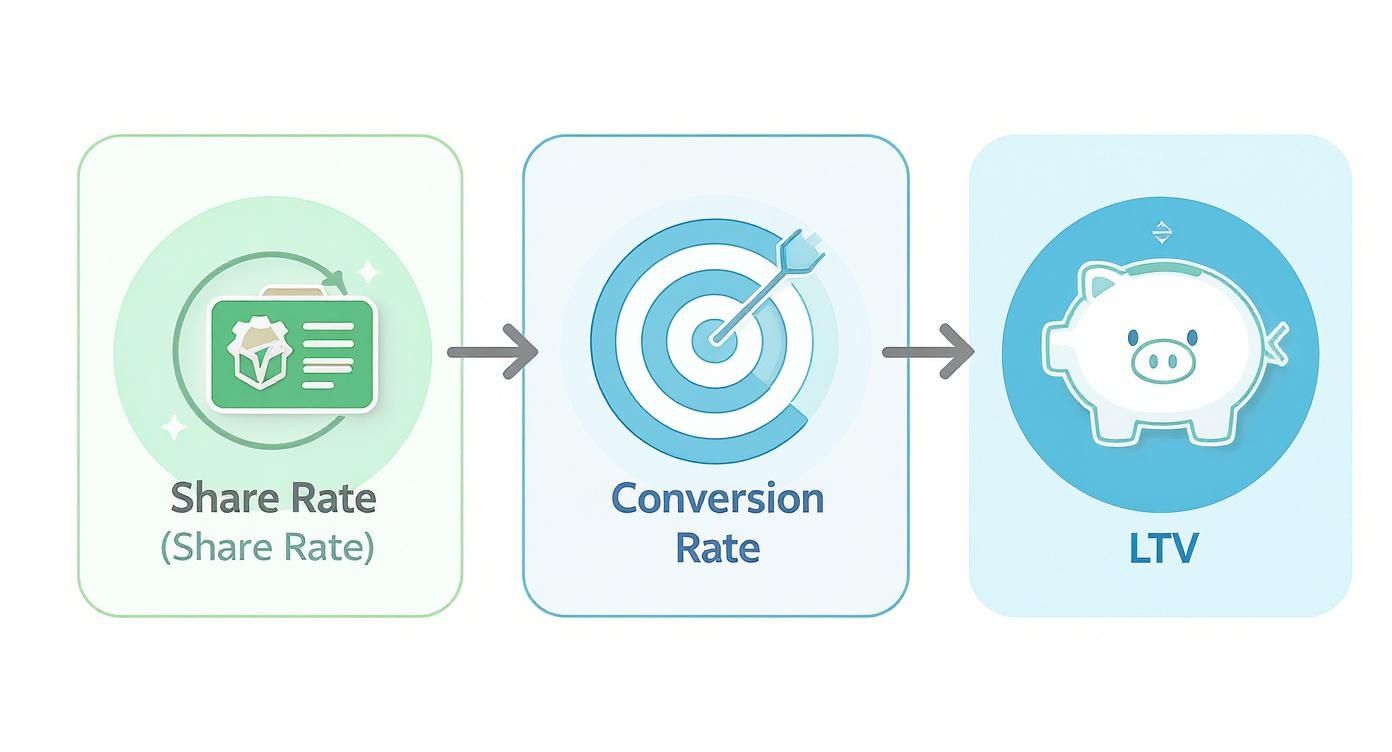
As you can see, a high share rate is great, but it needs to lead to a solid conversion rate to generate customers with a high Lifetime Value (LTV).
To help you decide which technical path is right for you, here’s a quick comparison.
Client-Side vs Server-Side Tracking Comparison
So what’s the verdict? For maximum accuracy, a hybrid approach is your best bet. Use cookies for initial tracking and session attribution, but always rely on server-side events (like a code redemption or an API call after payment) as the ultimate source of truth.When you're piecing together your technical stack, checking out a guide to referral programs software can be incredibly helpful. It'll show you how different platforms handle these challenges right out of the box.
Automating Rewards and Preventing Program Abuse
A great referral program is about more than just tracking clicks and conversions. It’s about creating a seamless experience that feels rewarding for your partners and, just as importantly, protects your business from being taken advantage of.
If you get two things right—delivering rewards instantly and keeping the program clean—you’ll build a system that people trust and that actually delivers a solid return.
Trying to handle payouts manually is just asking for trouble. It’s painfully slow, introduces a ton of human error, and frankly, it’s a bad look for your brand. The whole point is to make a reward feel like a genuine, immediate "thank you," not some administrative task that gets processed weeks later.
Streamlining Payouts with Webhooks and Integrations
Automation is your best friend here. The goal is to connect your referral program tracking system directly to your payment processor, like Stripe or Paddle, so commissions get triggered the instant a sale is confirmed. This is where webhooks come in.
A webhook is basically an automated message sent from one app to another. When a referred customer’s payment successfully goes through, your payment system sends a quick ping to your referral software. That ping triggers the software to calculate the commission and credit the advocate's account, all in a matter of seconds.
Setting this up pays off big time:
- Instant Gratification: Your advocates see their rewards almost immediately, which feels great and encourages them to keep sharing.
- Less Admin Headaches: Your team can stop wasting time on the mind-numbing task of manually calculating and sending out dozens (or hundreds) of individual payments.
- Fewer Mistakes: Automation gets rid of the risk of missing a payment or sending the wrong amount, which is crucial for building long-term trust.
Imagine a new user signs up for your SaaS product. Their first subscription payment goes through in Stripe. Instantly, a webhook fires, telling your referral platform to log the commission. Your advocate gets an automated email, and the money is ready for the next payout cycle. No one on your team had to lift a finger.
The speed and reliability of your reward system directly impact how engaged your advocates are. An automated, transparent process shows you actually value their efforts, making them far more likely to stick around.
Identifying and Preventing Common Referral Fraud
Here’s the thing: as your program gets bigger, it will attract people trying to game the system. You have to be proactive about fraud prevention to protect your budget and make sure you’re only rewarding real, legitimate customers. Waiting to react after fraud happens means the money is already gone.
To build a solid defense, you first need to know what you’re up against.
These are the most common schemes we see:
- Self-Referrals: People signing up through their own links, often with a different email, just to snag both the new-customer discount and the referral reward.
- Link/Code Farming: Scammers who post referral links all over coupon sites and forums. They’re not actually recommending your product; they’re just collecting commissions from strangers hunting for a deal.
- Duplicate or Fake Accounts: Creating tons of fake accounts to trigger referral bonuses without ever bringing in a single real, paying customer.
- Commission Theft: Using sketchy browser extensions or malware to hijack and overwrite another person’s referral cookie with their own, literally stealing the commission.
Every one of these tactics drains your marketing budget and messes up your data, making it impossible to see what’s truly driving growth. For any serious program, getting a handle on affiliate fraud prevention is non-negotiable.
Your Action Plan for Program Protection
The best defense is a layered one. Don't rely on a single check. Instead, set up a series of rules that work together to flag suspicious activity before you pay out a single dollar.
Here are a few proven strategies you can put in place right away:
- Set Clear Validation Rules: Start by automatically blocking self-referrals. You can do this by flagging conversions that come from the same IP address or device fingerprint as the referrer. It's a simple but effective first line of defense.
- Implement a Payout Delay: Don't pay commissions instantly. Hold them in a "pending" status for a set period, like 30 days. This gives you a buffer to account for customer refunds or credit card chargebacks, ensuring you only pay for legitimate, lasting sales.
- Monitor Your Referral Sources: Keep a close eye on where your referral traffic is coming from. If you suddenly see a massive spike from one random website, it could be a sign your referral code was leaked onto a coupon aggregator.
- Manually Review Top Earners: Automation is fantastic, but it's still smart to do a quick manual spot-check on your top-performing advocates. This helps you catch weird patterns and also gives you a chance to build real relationships with your true brand champions.
Turning Raw Data Into Actionable Insights

All this data collection is great, but it’s just noise until you can make sense of it. The real magic happens in your referral tracking dashboard, which turns a spreadsheet of numbers into a clear roadmap for growth.
A good dashboard does more than just show you clicks and conversions. It should tell a story. At a glance, you should be able to see what’s working, what’s falling flat, and where your next big win is hiding. It’s about visualizing the entire referral journey, not just the finish line.
Designing a Dashboard That Drives Action
Let's move beyond basic KPIs. Your goal is to build a command center for your referral program—a tool that reports performance and helps you spot opportunities you would have otherwise missed.
Here are a few things I always build into my dashboards to make them truly useful:
- Visual Funnel Analysis: This is non-negotiable. Map out the entire journey from the initial share to the final sale. It instantly shows you where the leaks are. Are tons of advocates sharing but nobody's clicking? Or are you getting clicks but no one is signing up? A funnel visual points you right to the problem area.
- Top Referrers Leaderboard: A little friendly competition goes a long way. By creating a leaderboard that shows off your top-performing advocates, you gamify the whole experience. It motivates everyone to climb the ranks and gives your superstars the recognition they deserve.
- Performance by Channel: Remember those UTM parameters we set up? Here's where they pay off. Break down your referral traffic by source—email, Twitter, Facebook, etc. This tells you exactly where your advocates are having the most success, so you can double down on those channels.
A dashboard should be a strategic tool, not just a report. If a metric doesn't help you make a decision, it's clutter. Always prioritize clarity and actionable insights.
When you present the data this way, it’s much easier to get buy-in from the rest of your team. You’re not just showing activity; you’re connecting the dots between your referral program and real business results like revenue and new customers.
Choosing Your Reporting Tools
So, how do you actually build this thing? You’ve really got two options: use the built-in analytics from a referral platform or build a custom setup with a business intelligence (BI) tool.
Dedicated Referral Software Platforms like LinkJolt are designed specifically for this. Their dashboards are pre-configured with all the key referral metrics right out of the box. If you need to get up and running quickly without a lot of technical overhead, this is almost always the best bet. You can find a good breakdown of the best referral marketing software to see what's out there.
Business Intelligence (BI) Tools If you need more control and want to blend data from multiple sources, a BI tool like Looker Studio (formerly Google Data Studio) or Tableau is the way to go. You can pull data from your referral platform, your CRM, and your payment processor into one unified dashboard. It takes more work to set up, but the depth of analysis is unbeatable.
For those who really want to get ahead of the curve, you can even apply techniques from predictive analysis and machine learning to forecast performance and identify high-potential advocates before they even take off.
Ultimately, the right tool comes down to your team's technical skills and specific needs. Whether you pick a specialized tool or a flexible BI platform, the mission is the same: use your referral program tracking data to make smarter decisions and grow your business.
Using Referral Tracking to Supercharge Your Hiring
Think referral tracking is just for landing new customers? Think again. The same ideas can completely change how you hire, turning a slow, expensive process into a lean, mean talent-finding machine.
When you shift this model internally, your key metrics change. Instead of watching sign-ups, you’re now focused on what really matters for building a great team.
Here's what you should be keeping an eye on:
- Time-to-Hire: Are referred candidates sailing through the interview process faster than people from other channels? You need to know by how much.
- Cost-per-Hire: This one is huge. Pit the cost of a referral bonus against what you'd pay a recruiter or spend on job ads. The savings are often staggering.
- Retention Rate of Referrals: Do referred employees stick around longer? They usually do, because they're a better culture fit from the start. Tracking this proves the long-term value.
Keep Your Team Engaged and Informed
An employee referral program really takes off when there's transparency and a little friendly competition. Just like you would for a customer program, set up an internal leaderboard to show who's bringing in the best people. It’s a simple way to gamify the process and get everyone excited to participate.
Nothing kills motivation faster than a black box. Your team needs a simple way to submit referrals and a clear view of where their candidates are in the pipeline. That real-time feedback builds trust and keeps them digging into their networks for your next great hire.
Your most powerful hiring tool isn't a job board; it's the collective network of your current team. A well-tracked referral program doesn't just find candidates—it finds future colleagues who come pre-vetted by people you already trust.
The data backs this up in a big way. Employee referrals typically make up 34% of all hires. Compare that to the paltry 2-5% you get from most job boards, and the difference is clear. Plus, modern tracking systems that use AI to screen for culture fit can boost retention by as much as 25%. If you're curious, you can dig into more employee referral stats for 2025 that really drive home how critical these programs are.
Ultimately, solid tracking gives you the cold, hard data to prove that investing in a smart, data-driven hiring strategy is one of the best moves your company can make.
A Few Lingering Questions on Referral Tracking
Even with the best tracking system in place, some questions always seem to surface. Let's tackle a few of the most common ones I hear from teams just getting their programs off the ground.
Is It Possible to Track Referrals Without Cookies?
Yes, and it's actually the most reliable way to do it. The answer is server-to-server tracking.
Instead of relying on a cookie that can be blocked or deleted, this method works by giving each advocate a unique referral code. When a new customer signs up or makes a purchase, they enter that code. Your server then talks directly to your referral platform's database to validate it—no browser involvement needed.
This approach sidesteps all the common roadblocks:
- Ad blockers that kill tracking scripts before they can even run.
- Tough browser privacy settings (like Safari's ITP) that limit cookie life.
- People who regularly clear their browser data.
It's the closest you'll get to bulletproof attribution and the gold standard for tracking you can trust.
How Often Should I Be Looking at the Data?
I recommend a two-tiered approach. A quick, weekly check-in on your main dashboard is great for catching any sudden spikes or dips. Think of it as a quick health check.
But the real magic happens during a deeper analysis, which you should plan to do monthly or quarterly. This is where you zoom out and look at the program's overall impact on the business.
During these deep dives, you're not just looking at signups. You're comparing the lifetime value (LTV) of customers who came from referrals against their customer acquisition cost (CAC). This is how you'll figure out your true ROI and find opportunities to tweak your rewards for maximum impact.
How Do I Track Referrals from Social Media or Email?
You absolutely can, and you should. The trick is to use unique tracking links that have been properly tagged with UTM parameters.
For every channel, you'll create a specific link. For example, a link shared on Facebook might have utmsource=facebook appended to it, while an email campaign link could use utmcampaign=q4_promo. When someone clicks, that data gets passed along, and you can see exactly where every single conversion came from.
This gives you a crystal-clear picture of which channels are actually working. You’ll quickly see where your best advocates are sharing and what messages are resonating, which is pure gold for optimizing future campaigns.
Ready to stop guessing and start growing with a referral program you can actually trust? LinkJolt gives you the powerful tracking, automation, and fraud prevention tools you need to build a scalable revenue engine. Get started with LinkJolt today and see what a difference accurate data makes.
Watch Demo (2 min)


Trusted by 300+ SaaS companies
Start Your Affiliate Program Today
Get 30% off your first 3 months with code LINKJOLT30
✓ 3-day free trial
✓ Cancel anytime