What is Click Fraud: what is click fraud and how to prevent it
Ollie Efez
December 28, 2025•19 min read
Imagine your marketing budget is a bucket of water you're carrying to grow your business. Now, picture someone poking tiny holes in the bottom. Every single drip is a dollar wasted on a click that was never real.
That, in a nutshell, is click fraud. It's any click on your paid ads that comes from a source with absolutely no interest in your product, designed for the sole purpose of generating a fake charge.
Understanding the Hidden Drain on Your Marketing Budget

Click fraud is a silent saboteur that chips away at your ad spend behind the scenes. To really get a handle on it, it helps to understand what Pay Per Click (PPC) advertising is at its core. In a PPC model, you pay a platform like Google or Meta a small fee each time someone clicks your ad.
This system works beautifully when those clicks come from genuine, potential customers. But click fraud completely exploits this model by generating clicks from bad actors who have zero intention of ever buying from you. This creates a direct financial leak, as every fraudulent click drains your budget without delivering any real value.
Who Commits Click Fraud and Why
The culprits behind this activity are a mixed bag, and their motivations are just as varied. Knowing who they are is the first step toward building a solid defense.
This drain on marketing budgets isn't some minor issue; it's a massive global problem. Projections show that advertisers could lose up to $172 billion annually by 2028, largely thanks to sophisticated bot networks. One report even found that a staggering 21.3% of all web traffic was invalid, with bots driving nearly 15% of ad impressions.
The real danger of click fraud isn't just the money you lose today. It's the corrupted data that leads to poor marketing decisions tomorrow, poisoning your entire growth strategy.
The Motivations Behind the Clicks
So why do people do it? The reasons range from direct financial gain to malicious competition. It's not a single-faceted problem but a complex web of incentives driving all those invalid clicks.
To make sense of it all, let's break down the primary groups and what they're after.
The Who and Why of Click Fraud
Here’s a quick summary of the main players committing click fraud and what drives them to do it.
Ultimately, whether it's a competitor trying to gain an edge or a publisher looking to inflate their earnings, the result is the same: your marketing budget gets spent on clicks that will never, ever convert. It's an attack that undermines the very foundation of your paid acquisition channels.The Most Common Types of Click Fraud

Not all fraudulent clicks are the same. The methods behind them range from crude, manual schemes to incredibly complex automated attacks. Understanding the playbook is the first step in building an effective defense.
Think of it this way: some thieves pick pockets in a crowd, while others orchestrate elaborate digital heists. Both will cost you, but stopping them requires different security measures. The same is true for click fraud.
Manual Click Fraud: The Human Element
The most straightforward type of click fraud involves actual people repeatedly clicking on ads. It might sound simple, but it can be surprisingly effective on a small scale and often acts as the foundation for larger, more organized scams.
One of the most notorious examples is the click farm. These are organized operations, often in regions with low labor costs, where workers are paid to manually click on ads, links, or social media posts all day long. Their goal is to mimic genuine user activity to drain a competitor’s budget or inflate engagement metrics.
Real-World Scenario: Picture a local law firm running a competitive PPC campaign. A rival firm could hire a click farm to search for their ads and click them nonstop. By lunchtime, the targeted firm's daily ad budget is completely exhausted on fake traffic. Their ads vanish for the rest of the day, while the competitor’s ads get all the attention.
While manual fraud is damaging, its true threat lies in its ability to blend in. A single human click is nearly indistinguishable from a real one, forcing defense systems to look for broader patterns of behavior rather than individual actions.
Automated Click Fraud: Armies of Bots
Automated click fraud is where the real damage happens at scale. This method relies on software programs called bots to do the dirty work, generating thousands or even millions of fraudulent clicks in a fraction of the time it would take a human.
One of the most potent forms of this is the botnet. A botnet is a massive network of compromised computers, often infected with malware without their owners' knowledge. Fraudsters command this "zombie army" of devices to visit websites and click on ads, making the traffic appear to come from legitimate home IP addresses all over the world.
This technique is incredibly difficult to detect because the clicks originate from real, everyday devices—not a single, suspicious server.
Specialized Fraud in Affiliate Marketing
Affiliate marketing, a world built on paying commissions for conversions, has its own unique playbook of fraud tactics. Here, the goal isn't just to generate a click but to illegitimately take credit for a sale or lead you never actually influenced.
Here are a few common affiliate fraud techniques:
- Cookie Stuffing: A fraudster drops multiple affiliate cookies onto a user's browser without their knowledge. If that person later makes a purchase from one of those merchants, the fraudster gets the commission, even if their link had nothing to do with the sale.
- Link Stuffing: This tactic involves hiding affiliate links where users will never see them, like in tiny 1x1 pixels or behind other images. When a page loads, the hidden link is "clicked" automatically, attributing any future purchase to the fraudster.
- Ad Stacking: Multiple ads are layered on top of each other in a single ad slot. Only the top ad is visible, but when a user clicks it, a click is registered for every single ad in the stack, draining multiple budgets at once.
Each of these methods exploits the trust baked into digital advertising. They can turn a powerful growth channel into a significant financial liability if you're not paying attention.
How Fraudulent Clicks Quietly Poison Your Business
Click fraud isn't just about wasted ad spend showing up on an expense report. Think of it more like a slow-acting poison that seeps into your entire marketing ecosystem. The immediate hit to your wallet is obvious, but the long-term damage corrupting your data and gutting your strategy can be far more destructive.
Imagine trying to navigate a ship with a broken compass. That's exactly what happens when fraudulent clicks contaminate your analytics. You might spot a campaign with a fantastic click-through rate (CTR) and decide to double down, pouring more budget into what looks like a winner. In reality, you could be rewarding a bot network, starving the real channels that bring you actual customers.
The True Cost of Corrupted Data
When your analytics are skewed, every decision you make is based on a funhouse mirror version of reality. This kicks off a domino effect of costly mistakes that go way beyond the initial bad clicks.
You might find yourself making terrible strategic calls based on this garbage data, like:
- Chasing Ghost Audiences: You could start optimizing your campaigns for a "high-performing" demographic that's nothing more than a cluster of bots, all while ignoring the real people who want to buy from you.
- Running Bogus A/B Tests: Your test results become completely useless. An ad variation that looks like a clear winner might just be better at attracting bots, leading you to adopt weaker messaging and creative across the board.
- Calculating Imaginary ROI: Without clean data, you can't possibly measure your true return on investment. This makes it impossible to justify your marketing spend or prove your value to the rest of the company.
This isn’t a small problem—it’s a massive drain on the global economy. Within the booming $1.16 trillion global ad market, click fraud is expected to steal as much as $84 billion every single year. Some data suggests that nearly one in six PPC clicks is fraudulent. In high-stakes industries like legal and finance, that number can skyrocket to a staggering 30%. You can get a deeper look at these global trends in this detailed report on PPCShield.io.
Ruined Partnerships and Eroding Trust
The fallout from click fraud doesn't stop at your internal metrics. It spills over and damages your external relationships, especially within your affiliate program. When fraudsters weasel their way in, they steal commissions that should be going to your legitimate, hard-working partners. This not only costs you money but also crushes morale and pushes your best affiliates away.
An affiliate program riddled with fraud quickly loses its credibility. Honest partners will leave for more secure programs, making it nearly impossible to attract top-tier talent and scale your partnerships effectively.
Worse yet, persistent fraudulent activity can put you in bad standing with the ad platforms themselves, like Google or Meta. If your account is repeatedly flagged for low-quality or invalid traffic, you risk suspension. That could shut down one of your most critical customer acquisition channels overnight. Proactive fraud prevention isn't just about saving a few bucks—it's about protecting the entire operational integrity and reputation of your business.
How to Detect Click Fraud in Your Campaigns
Spotting click fraud is a bit like being a detective for your marketing budget. The good news is you don’t need a forensics lab—just the ability to read the clues hidden in the data you already have. By learning to recognize the tell-tale signs of suspicious activity, you can stop being a victim and start actively defending your campaigns.
The key is to look for patterns that just don't make sense. A single strange click isn’t proof of anything, but a series of anomalies starts to paint a very clear picture. Fraudsters, especially the automated kind, leave behind distinct digital footprints that look nothing like genuine human behavior.
Uncovering Red Flags in Your Analytics
Your analytics platform, whether it's Google Analytics or an internal dashboard, is your primary investigation tool. It holds all the evidence you need to tell the difference between healthy traffic and fraudulent clicks. The trick is knowing exactly where to look.
Here are some of the most common red flags that scream "click fraud":
- Unusually High Click-Through Rate (CTR): If your CTR suddenly skyrockets without a matching lift in conversions, it’s a major warning sign. Bots are fantastic at clicking but terrible at buying.
- Suspiciously Low Conversion Rate: A flood of clicks that leads to almost zero sales, sign-ups, or leads is a classic sign your ads are attracting non-human traffic with zero intent.
- Sudden Traffic Surges: Be wary of abrupt spikes in traffic, especially from weird geographic locations or at odd hours, like 3 AM in your target market. These patterns often point to automated bot activity.
- Extremely Low Time on Site: When clicks result in immediate bounces or sessions lasting just a second or two, it’s a strong hint the "visitor" wasn't a real person exploring your site.
This decision tree breaks down the core questions you should ask when you're trying to figure out if a click is legitimate or fraudulent.
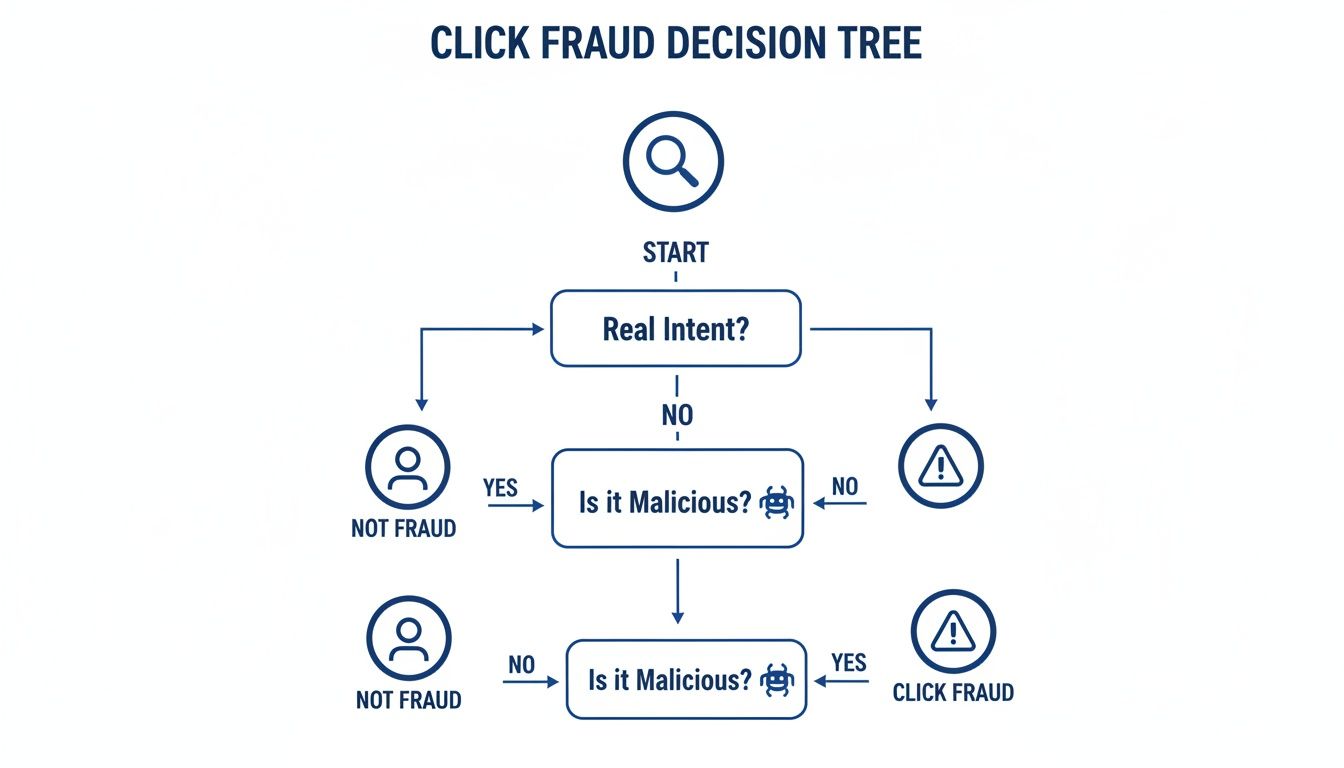
As the diagram shows, the moment genuine intent is missing, you have to figure out if the action was malicious to classify it as fraud.
Digging Deeper into the Data
Beyond those high-level metrics, you can dig deeper for more conclusive proof. One of the most revealing things you can do is analyze click patterns from a single source.
Look for multiple, rapid-fire clicks coming from the same IP address in a short window of time. No real user clicks like that.
Similarly, an abnormally high pageview count per session with near-zero engagement is another dead giveaway. This might be a bot programmed to crawl multiple pages to look more human, but it fails to perform any meaningful actions. These granular insights help you build a much stronger case against a fraudulent source.
Click fraud detection is all about pattern recognition. A healthy campaign has a predictable rhythm. When those patterns are violently disrupted without a clear marketing reason, it's time to put on your detective hat.
The principles of spotting these anomalies go beyond just ad clicks. To learn more about protecting your revenue, our guide on fraud detection in online payments offers valuable strategies that work hand-in-hand with your ad security.
Fraudulent Activity vs Healthy Traffic
To make this even clearer, it helps to see what fraudulent and healthy traffic look like side-by-side. This comparison table highlights the subtle but critical differences in user behavior, making it easier to spot trouble.
By regularly monitoring these metrics, you’ll establish a baseline for what "normal" looks like in your campaigns. This makes it far easier to spot when things go off the rails and take action before your budget gets drained.Your Action Plan to Prevent Click Fraud
Knowing how to spot click fraud is half the battle; the other half is building your defenses. Moving from detection to prevention means shifting your mindset from reactive to proactive and putting a solid playbook in place. These are the concrete steps you can take right now to harden your campaigns and make sure every dollar you spend is on real, potential customers.
The goal isn't just to block a few bad clicks. It’s to create an environment where fraud is too difficult and unprofitable for bad actors to even bother. This takes a combination of hands-on oversight and smart policy-setting, especially if you’re running an affiliate program.
Start with Manual Campaign Hygiene
Before you even think about fancy tools, you can slash your risk by simply tightening up your campaign settings. These foundational steps are your first line of defense, filtering out the most obvious, low-effort fraud. Think of it as locking your doors and windows before installing a high-tech security system.
One of the most direct tactics is building and maintaining an IP exclusion list. When your analytics show a pattern of sketchy clicks all coming from the same IP address, you can manually block that source right inside your ad platform. This instantly cuts off that specific attacker from burning through more of your budget.
Refining your campaign targeting is just as critical. Take a hard look at your geographic data. If you’re seeing a flood of clicks but zero conversions from a country you don’t even serve, exclude it. Tightening your targeting to specific, relevant locations makes your campaigns a much less appealing target for global bot networks.
Fortifying Your Affiliate Program
Affiliate programs are incredible growth engines, but without careful management, they can be prime targets for fraud. The stakes are high; affiliate marketing often has to deal with 17% fraudulent traffic, costing advertisers $3.4 billion and making up to a quarter of all leads completely fake. These problems are amplified by tactics like cookie stuffing, which taints 5-10% of all transactions.
To protect your program, it all starts with your policies. A clear, comprehensive affiliate agreement is non-negotiable.
- Establish Clear Terms of Service: Be explicit. Forbid fraudulent methods like cookie stuffing, ad stacking, and shady brand bidding. Make the consequences for breaking the rules—like immediate termination and forfeiting all commissions—impossible to misunderstand.
- Set Realistic Conversion Validation Rules: Don't approve commissions instantly. Implement a validation or "pending" period that gives you time to review leads and sales for quality before a payout is locked in. This buffer lets you spot anomalies, like a sudden batch of sign-ups from the same IP range or using similar fake names.
- Demand Transparency from Partners: Require affiliates to disclose how they plan to promote you. Understanding their methods helps you vet their legitimacy and ensure their approach aligns with your brand. A partner who’s secretive about their traffic sources is a massive red flag.
A strong affiliate program is built on trust and transparency. By setting clear rules and actively monitoring for compliance, you create a secure environment that attracts high-quality partners and deters fraudsters.
The Importance of Proactive Monitoring
Putting these strategies in place isn't a "set it and forget it" job. Consistent monitoring is the only way to adapt to new threats and keep your defenses strong. By regularly auditing your campaign performance and affiliate activities, you can catch suspicious patterns long before they cause serious financial damage.
This hands-on approach also helps you understand the nuances of your own traffic, making it easier to tell the difference between a genuine market trend and a coordinated fraud attack. For anyone managing an affiliate program, getting the technical side right is also a must. To really sharpen your oversight, you need to learn how to track affiliate links properly—it’s a core skill for any program manager. By combining strong policies with diligent oversight, you can build a truly resilient defense against click fraud.
Using LinkJolt for Automated Fraud Protection
Trying to fight click fraud manually is like trying to catch rain in a thimble. It’s exhausting, inefficient, and you’ll never keep up. While manual checks like IP blacklists have their place, they simply can't match the speed and scale of modern automated attacks. This is where you need an automated shield working around the clock to protect your campaigns.
Think of an automated system as a vigilant gatekeeper for your affiliate program. It inspects every single click the moment it arrives, spotting the tell-tale signs of fraud that a human could never catch fast enough. This pulls you out of the endless cycle of damage control and lets you focus on actually growing your program.
Real-Time Detection and Blocking
LinkJolt’s built-in fraud protection is designed to be that automated shield. It automatically detects and blocks suspicious clicks and invalid referrals as they happen. This real-time defense is everything—it stops fraudsters before they can burn through your budget, not weeks later when the damage is already done.
The system is constantly on the lookout for common red flags, including:
- Repetitive Clicks: Instantly flagging multiple clicks from a single IP in a short window.
- Proxy or VPN Usage: Identifying traffic that’s deliberately hiding its origin, a classic fraudster tactic.
- Known Bot Signatures: Checking traffic against a massive database of known fraudulent sources to block them before they even reach you.
This proactive approach saves you countless hours. More importantly, it safeguards your revenue by making sure you only pay for clicks from genuine potential customers.
Gaining Clarity with Intuitive Dashboards
Blocking threats is half the battle; the other half is having clear visibility into what’s happening in your program. LinkJolt’s dashboards give you the clarity you need to monitor affiliate performance and spot weird patterns instantly. No more digging through spreadsheets.
You can see at a glance which partners are driving quality traffic and which ones might need a closer look.
This visual-first approach turns complex data into simple, actionable insights. You can immediately identify an unusual spike in clicks from one affiliate or a sudden drop in their conversion rate.
A secure affiliate program is a profitable one. By removing the financial incentive for fraudsters with automated validation and secure payouts, you build a sustainable, scalable engine for growth that attracts top-tier partners.
Ensuring Payout Integrity and Partner Trust
At the end of the day, most affiliate fraud is about one thing: getting an unearned commission. LinkJolt tackles this head-on with secure, automated payouts that ensure commissions only go to legitimate, validated conversions. This completely removes the financial incentive for fraudsters, making your program a much less attractive target.
When you automate the validation process, you also create a fair and transparent system that builds trust with your legitimate partners. They know they're competing on a level playing field, and your brand earns a reputation for running a high-integrity program. This is fundamental for anyone looking to master affiliate fraud prevention and build profitable, long-term partnerships.
Answering Your Questions About Click Fraud
When you're running digital ad campaigns or an affiliate program, you're bound to run into some tough questions about security. Let's clear up a few of the most common ones.
Is One Click From a Competitor Considered Fraud?
Honestly, a single, isolated click from a competitor is nearly impossible to prove as malicious and probably won't get flagged. Think of it as a one-off anomaly.
What systems do look for is a clear, repeated pattern of clicks coming from a competitor's IP address. That’s when a one-off incident turns into abusive behavior, and that is absolutely considered click fraud.
Can I Get a Refund for Fraudulent Clicks?
Yes, you often can. The major ad platforms like Google Ads have automated systems that filter out a ton of invalid traffic behind the scenes. In many cases, they’ll issue refunds for this activity without you even having to ask.
For the fraudulent clicks that manage to sneak past these initial defenses, you can file a claim yourself. You'll need to provide supporting evidence from your analytics and server logs to make your case. It can be a bit of a process, which is why preventing the fraud in the first place is always the smarter strategy.
While refunds are a possibility, they are a reactive measure. A proactive defense that prevents fraudulent clicks in the first place is far more effective at protecting your budget and data integrity than chasing reimbursements after the fact.
How Does Fraud Hurt My Affiliate Program?
Widespread fraud can absolutely destroy an affiliate program's reputation and effectiveness. For starters, it directly frustrates your honest, high-performing partners. They end up losing commissions that are rightfully theirs to fraudsters, making it harder for them to earn a fair living promoting your brand.
Over time, your program can get a reputation for being poorly managed or full of low-quality traffic. When that happens, attracting top-tier affiliates becomes incredibly difficult. A secure platform is about protecting the integrity of your program and, most importantly, the trust you've built with your best partners.
What Is the Difference Between Invalid Traffic and Click Fraud?
This is a really important distinction to understand.
Invalid traffic is the broad, umbrella term for any click that wasn't generated by a human with genuine interest. This can include things that aren't malicious, like accidental clicks from real users or traffic from search engine crawlers indexing your site.
Click fraud, on the other hand, is a specific, malicious subset of invalid traffic. It refers to clicks made with the deliberate intent to deceive—whether it's to drain a competitor's ad budget or to illegitimately generate revenue for a dishonest publisher.
So, all click fraud is invalid traffic, but not all invalid traffic is click fraud.
Protecting your campaigns from invalid clicks and bad actors isn't just a defensive move; it's crucial for sustainable growth. LinkJolt provides automated fraud protection to safeguard your affiliate program, ensuring you only pay for real results and build a network of trusted partners. Learn how to fortify your affiliate program today.
Watch Demo (2 min)


Trusted by 300+ SaaS companies
Start Your Affiliate Program Today
Get 30% off your first 3 months with code LINKJOLT30
✓ 7-day free trial
✓ Cancel anytime