How to Set Up a Referral Program for Sustainable SaaS Growth

Ollie Efez
January 13, 2026•20 min read•Updated Sep 14, 2026
Setting up a referral program is really about one thing: turning your happiest customers into your best marketers. The whole process starts with figuring out what you want to achieve and picking rewards that actually motivate people. From there, you use the right tools to handle all the tedious stuff—the tracking, the payouts, and finding new partners.
Done right, this approach transforms word-of-mouth from a lucky break into a predictable, scalable way to grow your business.
Why a Referral Program Is Your Untapped Growth Channel
<img src="https://cdn.outrank.so/e2b9b79c-0a6e-4908-abd4-26760ca3a652/42549148-0efb-46a9-adb4-f67eada670a1/how-to-set-up-a-referral-program-business-collaboration.jpg" alt="Two smiling business professionals, a man and a woman, collaborating on a laptop with text "Untapped Growth"." loading="lazy" style="max-width: 100%; height: auto; border-radius: 8px; margin: 1.5rem 0; display: block;" />
Before we get into the nuts and bolts of how to set up a program, let's talk about why it's worth your time. A well-built referral program is much more than another item on your marketing to-do list; it’s a powerful growth engine, fueled by the people who already love your product. This is especially true for SaaS companies, where trust and social proof are everything.
Attracting Higher-Quality Customers
Think about it: referrals bring in users who are already sold on your product. They show up with a built-in layer of trust because someone they know vouched for you, which almost always means they convert faster and are a better fit from the start.
Unlike cold leads you get from paid ads, referred customers usually have a much clearer picture of what you offer. This natural pre-qualification process leads to a higher-caliber user base right out of the gate.
The numbers back this up in a big way. For SaaS, referral rates average a whopping 4.75%—the highest of any industry. A staggering 84% of B2B SaaS conversions start with a referral, and these customers typically spend 13% more while sticking around 37% longer.
Key Takeaway: Referral marketing isn't just about getting more customers. It's about getting the right customers—the ones who stay longer, spend more, and eventually become advocates themselves.
Building a Sustainable Growth Loop
A referral program creates a growth cycle that feeds itself. Every happy new customer you sign up has the potential to bring in another one, which starts to reduce how much you have to rely on expensive and unpredictable paid ad channels.
This creates a powerful feedback loop where your success compounds over time. Just look at the benefits:
- Lower Customer Acquisition Cost (CAC): Instead of paying for clicks or impressions, you only pay for what you actually want—a new paying customer. Simple as that.
- Increased Customer Lifetime Value (CLV): Referred customers have higher retention rates, which means their lifetime value is naturally higher. This is a huge win for your overall unit economics.
- A Stronger Community: When you reward users for spreading the word, it builds a real sense of partnership and community around your brand.
Modern tools like LinkJolt are designed to make this strategy a breeze. They handle all the messy backend work—generating links, tracking conversions, and managing payouts—so you can focus on building relationships with your partners. This turns what used to be a resource-heavy headache into one of the most efficient SaaS growth strategies you can implement.
A successful referral program isn’t something you just switch on. The best ones are carefully designed, and that design process starts long before you ever look at software. The very first step is getting brutally honest about what you're trying to achieve. "Get more customers" is a wish, not a goal. You have to get specific.
What’s the one metric you want this program to move? Are you trying to juice up your free trial sign-ups? Maybe the real bottleneck is improving your free-to-paid conversion rate. Or perhaps your sales team is starving for a steady stream of qualified enterprise leads.
Each of these goals demands a completely different program structure. If you’re chasing trial sign-ups, you might reward advocates for every single verified trial, even if they don't convert right away. But if a signed enterprise contract is the prize, a much larger, one-time payout makes way more sense.
Key Takeaway: Define one primary, measurable goal for your program. This single point of clarity will guide every decision you make, from the commissions you offer to the way you talk to your partners.
Nailing Your Commission Structure
With a clear goal in mind, it's time to tackle the heart of your program: the commission structure. This is the engine that drives motivation, so getting it right is non-negotiable. You need a model that excites your partners without wrecking your profit margins. To get some inspiration, it's worth exploring some top customer referral program ideas to see what's working for others.
The right model is entirely dependent on your business. For SaaS, there are a few tried-and-true approaches:
- Recurring Percentage: This is the gold standard for subscription businesses. You give partners a percentage (typically 20-30%) of the monthly recurring revenue (MRR) for a set period, like the first 12 months. Affiliates love this because their income grows as the customer sticks around.
- Flat-Rate Payout: Simple and predictable. You offer a fixed cash reward for a specific action, like a new customer signing an annual plan. This works beautifully for products where calculating monthly commissions is messy or less impactful.
- Tiered Commissions: This is how you reward your heavy hitters. For example, a partner might earn 20% on their first 10 referrals, but that rate jumps to 30% once they pass that milestone. It creates a powerful incentive for your best advocates to keep pushing.
Before you lock anything in, run the numbers against your Customer Lifetime Value (CLV) and Customer Acquisition Cost (CAC). A commission that looks generous but leaves you with no profit is a fast track to an unsustainable program.
Here's a quick breakdown to help you compare the most common SaaS commission models.
SaaS Referral Commission Model Comparison
A comparison of common commission models to help you decide which is best for your SaaS business. Ultimately, the best structure is one that feels like a true partnership—fair, motivating, and sustainable for everyone involved.The Power of Double-Sided Incentives
Don't forget the other person in this transaction: the referred friend. A double-sided incentive, where both the referrer and the new customer get a reward, can skyrocket your conversion rates. People are far more willing to share an offer when they can give their friends a genuine benefit, not just pocket a commission.
This "give a little, get a little" approach creates a perfect win-win-win scenario.
- The Referrer gets a commission for bringing in business.
- The New Customer gets a discount or special offer, making it easier to say yes.
- Your Business acquires a new, high-quality customer at a predictable cost.
A classic example for a SaaS product could be offering the referrer a $50 reward while giving the new customer 15% off their first year. This structure feels less like a sales pitch and more like a genuine recommendation from a friend, which is exactly the vibe you want. The trick is finding a balance that feels generous without sinking your financial model. Start simple, watch the data, and don't be afraid to tweak the offer as you learn what clicks with your audience.
Choosing the Right Tech to Automate Your Program
Your program's design is the blueprint, but technology is the engine that brings it to life. Without the right platform, even the best-laid plans for incentives and goals can fall flat, buried under a mountain of manual tracking and payout headaches. The right tech stack isn't just about convenience; it's about finding a system that does the heavy lifting so you can focus on building relationships with your partners.
For any SaaS business, a few features are completely non-negotiable. You absolutely need a platform that integrates seamlessly with your payment processor, whether it's Stripe or Paddle. This connection is the bedrock of accurate, real-time conversion tracking—without it, you're just flying blind.
The end goal is to automate everything possible. Think generating unique referral links, tracking new subscriptions, and processing monthly commission payouts, all without you lifting a finger. A great tool turns what could be a complex, developer-heavy project into a simple setup process that a marketer can knock out in an afternoon.
What to Look for in a Referral Platform
Not all referral software is created equal, especially when it comes to the unique needs of a subscription-based business. As you start looking at different options, make sure you prioritize tools built specifically with SaaS in mind. This means keeping an eye out for specific functionalities that support a recurring revenue model.
Here are the essential features that should be on your checklist:
- Direct Payment Integration: This is mission-critical. The platform must connect directly with Stripe or Paddle. This is how you automatically track new subscriptions and attribute them to the correct affiliate. Manual tracking is just a recipe for errors and angry partners.
- Automated Payouts: Look for a system that can handle all the commission calculations and pay your affiliates on a set schedule without your intervention. This builds trust and ensures your partners get paid accurately and on time, every time.
- Branded Affiliate Portal: Your partners need a professional, easy-to-use dashboard. This is where they’ll grab their referral link, find marketing materials, and track how they're doing. A white-labeled portal that reflects your brand is a huge win.
- Flexible Commission Structures: The software should easily support the commission models that work best for SaaS. That includes recurring percentage-based rewards, one-time flat-rate payouts, and tiered incentives to really motivate your top performers.
This simple diagram breaks down the core flow of designing a program—something you should map out long before you touch any technology.
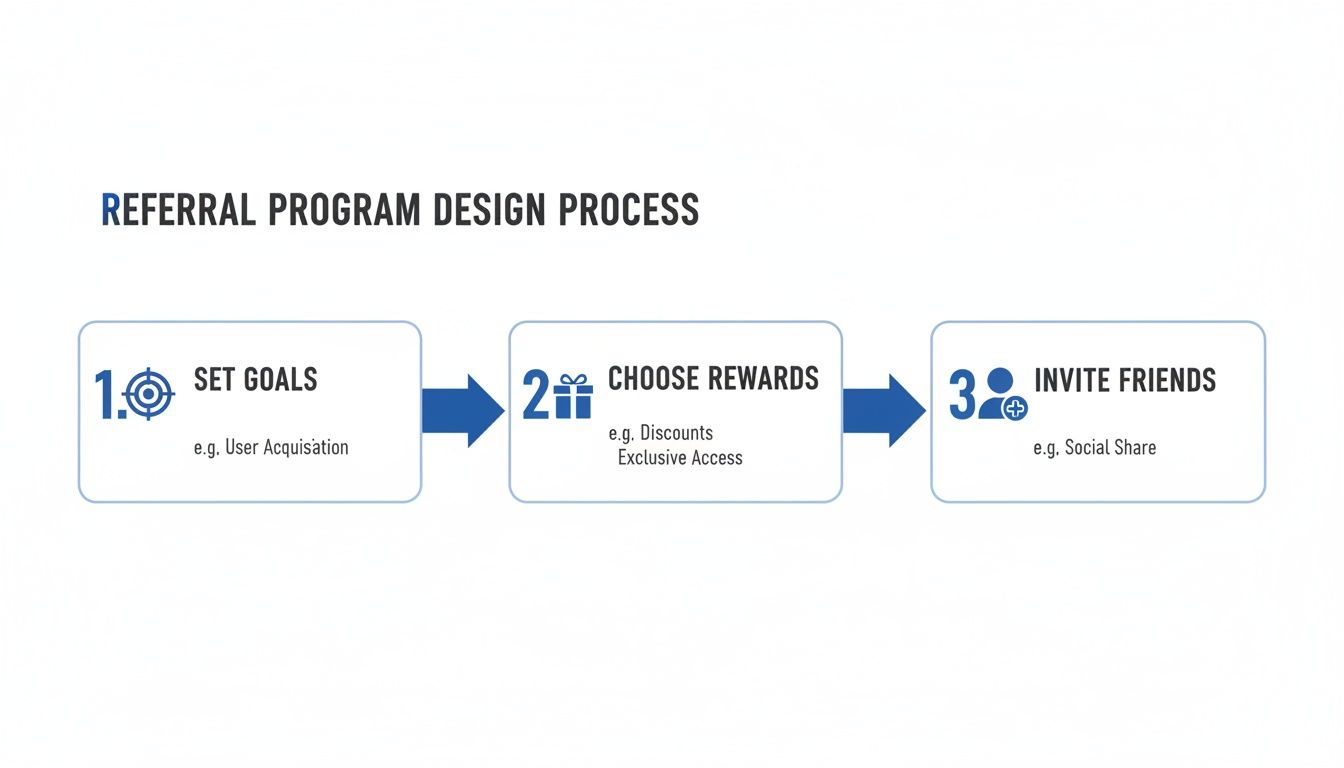
As you can see, a successful referral program always starts with clear goals and appealing rewards, well before you ever invite the first person.
Setting Up Your Program with LinkJolt
Let's make this practical. We'll walk through what this setup actually looks like using a tool like LinkJolt, which is built from the ground up for SaaS. The whole initial configuration is designed to be dead simple, getting you from zero to a fully functional program without needing to write a single line of code.
First things first, you connect your Stripe, Paddle or Polar account. This is usually just a simple authentication process that gives the platform permission to see your subscription data. Once that's done, LinkJolt can automatically detect when a new customer signs up through a referral link and starts their subscription.
Next, you'll create your first "campaign." This is where you lay down the rules of engagement. You'll set your commission structure—for instance, a 25% recurring commission for the first 12 months of a customer's subscription. You can also define the cookie duration, which is how long a referral is tracked after someone clicks an affiliate's link.
A crucial step here is customizing the affiliate portal. This is your partners' home base, so make it look good. You can upload your logo, set your brand colors, and add marketing assets like banners, email copy, and product screenshots they can grab and use.
Finally, you generate a unique sign-up link for your affiliate program. This is the link you'll share to invite potential partners to join. When someone signs up through it, they're automatically added to your campaign and get instant access to their own dashboard and unique referral link. The whole process removes the headache of manual onboarding and lets you scale recruitment effortlessly.
For a deeper look, you can explore our guide on the best referral marketing software to compare different platforms and their features.
Recruiting and Empowering Your First Advocates
So, you’ve designed your program and the tech is humming along. You’ve officially built the car. Now, it's time to find the drivers.
It's a classic mistake to assume that just because you've built a referral program, advocates will magically show up. They won't. Real success comes from a proactive, deliberate strategy to find and motivate your very first partners.
Your initial goal isn't to sign up thousands of affiliates. That comes later. Right now, it’s all about building a core group of enthusiastic advocates who genuinely love what you do. These first partners are gold—they'll provide priceless feedback and generate the initial momentum that proves your program has legs.
And the best place to start looking? It's right in your own backyard.
Identifying Your Ideal First Partners
Your most passionate customers are your single greatest recruiting asset. Period. They're already using your product, they get the value, and they’ve probably already told a few friends about it anyway. This is the lowest-hanging fruit you'll ever find.
Start by digging into your own user data. Look for the customers with sky-high usage rates, those who have had positive support chats, or the ones who left you a glowing review. These are your power users. A personal invitation from you can make them feel like a VIP and instantly turn them into a powerful advocate.
Once you've tapped your user base, here are a few other channels to explore:
- Industry Influencers: Find the bloggers, YouTubers, and consultants in your niche who already have the ear of your target audience. A personalized outreach—not a generic template—explaining why your product is a perfect fit for their followers can work wonders.
- Complementary SaaS Companies: Think about other non-competing SaaS tools your customers use. Partner up and promote each other's affiliate programs. It’s a simple way to get access to a brand new, highly relevant audience.
- Affiliate Marketplaces: Platforms like LinkJolt often have discovery marketplaces where professional affiliates are actively looking for new SaaS products to promote. Listing your program there can put you on the radar of experienced marketers.
Building a strong foundation for your referral program is all about quality over quantity. A handful of engaged, high-performing partners will always drive more results than a hundred who signed up and then did nothing.
Onboarding Advocates for Success
Once you have their attention, a smooth, empowering onboarding process is absolutely critical. Your job is to eliminate every bit of friction and give your new partners everything they need to start promoting you effectively from day one.
The welcome email is your first—and most important—shot at getting this right.
This isn't just a transactional "thanks for signing up" message. It's your chance to get them genuinely excited. Instead of a bland "Welcome," your email should clearly map out the next steps and set the right expectations from the jump.
Here's a snippet of what that might look like:
"We’re thrilled to have you join the [Your Company] Partner Program! To help you get your first referral, we've put together a quick-start checklist:
- Grab Your Unique Link: Log into your dashboard to find your personal referral link.
- Explore Your Resources: We've loaded your portal with email templates and social media graphics.
- Learn the Product: Check out our partner-exclusive demo video.
We’re here to help you succeed. Let’s grow together!"
This simple structure gives them clear, actionable things to do right now. An onboarding checklist takes this a step further, ensuring new partners don't miss key steps like following your social media accounts, joining a partner-only Slack channel, or reading your brand guidelines.
For more in-depth strategies, check out our complete guide on how to recruit affiliates and turn them into long-term partners.
Keeping Your Partners Engaged Long-Term
Getting partners signed up is just the beginning. The real work is keeping them motivated and engaged for the long haul. This means shifting your mindset from just managing affiliates to building genuine, lasting partnerships.
Consistent communication is everything. Don't let that welcome email be the last they hear from you for six months. Send out regular updates with product news, performance highlights, and fresh marketing materials.
Running friendly competitions with leaderboards and special prizes for top performers can also inject a sense of fun and urgency into the program.
At the end of the day, your advocates are an extension of your marketing team. Treat them like it. Give them the right tools, consistent support, and genuine appreciation, and you'll empower them to become a sustainable, powerful driver of your company's growth.
Tracking What Matters and Protecting Your Program

If you aren't measuring your referral program, you can't improve it. Simple as that. A well-designed program generates a steady stream of data, and your ability to interpret it is what separates a program that merely exists from one that drives real, predictable growth.
The key is to look past vanity metrics. You need a clear, real-time view of how your program is performing. Platforms like LinkJolt give you a central dashboard where you can see every click, sign-up, and conversion as it happens. This immediate feedback is essential for making smart, timely decisions instead of waiting weeks for a report.
The Metrics That Drive Growth
To get a true feel for your program's performance, you need to monitor a handful of core KPIs. These numbers give you the complete picture, from initial partner engagement to the revenue hitting your bank account, helping you pinpoint exactly what’s working and what isn't.
Here are the essential KPIs you should be tracking from day one:
- Participation Rate: This is the percentage of your customers or invited partners who actually sign up. A low rate might mean you need to promote the program more actively or that the initial offer isn't compelling enough.
- Share Rate: Of those who sign up, how many are actively sharing their unique referral link? This metric tells you how engaged your advocates are. If participation is high but sharing is low, your partners might need more resources or motivation.
- Click-Through Rate (CTR): This measures how many clicks each shared link generates. A strong CTR shows that your partners are sharing their links with a relevant audience and that their messaging is hitting the mark.
- Conversion Rate: This is the big one—the percentage of clicks that result in a new paying customer. A high conversion rate is the ultimate sign of a healthy program, proving you're attracting quality leads who are ready to buy.
Key Takeaway: Your program's conversion rate is its most important health metric. It directly reflects the quality of the referrals being sent your way and the effectiveness of your landing pages and onboarding flow.
Ultimately, these metrics all feed into the most important calculation: your Return on Investment (ROI). By comparing new revenue against the commissions you've paid out, you can definitively prove the program's value. A well-structured program also boosts customer loyalty, so it's worth looking into effective strategies to reduce churn rate and boost retention.
Protecting Your Program from Referral Fraud
As your referral program gains traction, it will inevitably attract some unwanted attention. Referral fraud, where people try to game the system to earn commissions they don't deserve, can drain your budget and pollute your data if you let it.
The good news is that a proactive approach can stop most of it cold. You don't need to be a security expert; modern referral platforms come with built-in tools designed to automatically flag and block suspicious activity. These systems are your first line of defense.
Common Fraud Schemes and How to Stop Them
Most referral fraud falls into a few common categories. Understanding these schemes is the first step to preventing them. Here’s what you're likely to see:
- Self-Referrals: This is the most common trick in the book. Someone signs up for your product through their own referral link just to get a discount or a commission. Many platforms can automatically block commissions on referrals that share the same IP address or payment details as the referrer.
- Attribution Theft: This is where bad actors use shady tactics like cookie stuffing to overwrite a legitimate affiliate's cookie and steal their commission. A robust tracking platform is critical here to ensure credit always goes to the right source.
- Fake Sign-ups: Fraudsters might use bots or fake info to create tons of trial accounts, hoping to trigger commission payouts for sign-ups even if they never intend to become paying customers.
Your best defense is a combination of technology and clear policies. Use the fraud detection tools built into your platform, like those in LinkJolt, which can automatically identify suspicious patterns.
Beyond the tech, your program's Terms of Service is a powerful tool. Be explicit about what constitutes fraud and make it clear that it will result in immediate removal from the program and forfeiture of all commissions. This simple step creates a clear boundary and gives you the authority to act decisively when you spot a problem, ensuring your program rewards only genuine, valuable referrals.
Answering Your SaaS Referral Program Questions
Even with a perfect plan on paper, you're bound to hit a few questions once you start getting your hands dirty building the program. Let's tackle some of the most common ones that come up for SaaS founders and marketers setting up a referral program for the first time.
How Much Should I Pay in Commission?
There's no single magic number here, but for recurring SaaS subscriptions, a commission of 20-30% of the monthly recurring revenue (MRR) is a solid and competitive starting point. Typically, this recurring payout has a time limit, often for the first 12 months of the new customer's subscription.
Another popular and effective route, especially for annual plans, is offering a one-time flat fee. This is usually equal to one or two months of the subscription value.
Ultimately, your decision has to be grounded in your own financial metrics. It all boils down to two critical numbers:
- Customer Lifetime Value (CLV): How much total revenue does a customer bring in over their entire relationship with you?
- Customer Acquisition Cost (CAC): What do you already spend, on average, to bring in a new customer?
Your commission needs to be juicy enough to actually motivate your partners, but it can't be so high that it sinks your profit margins. Run the numbers and find that sweet spot where everyone wins.
What's the Difference Between an Affiliate Program and a Referral Program?
You'll hear these terms thrown around interchangeably all the time, but there's a classic distinction worth knowing.
Traditionally, a referral program is about your existing, happy customers telling their friends and colleagues about you. Think word-of-mouth on steroids. The rewards are often non-cash perks like account credits, a free month of service, or an upgrade to a higher plan.
An affiliate program, on the other hand, is usually a more formal marketing partnership. The partners might not even be customers themselves—they're bloggers, influencers, or content creators who promote your SaaS to their audience in exchange for a cash commission.
The good news? Modern tools have completely blurred this line. A platform like LinkJolt is built to handle both models under one roof, so you can easily manage your customer advocates and professional marketers in a single, unified system.
How Do I Get My First Affiliates to Join?
Start with your lowest-hanging fruit: your happy, loyal customers. They already know, use, and love your product, which makes them the most authentic and powerful advocates you could ask for.
Once you've tapped into that initial base, it's time to expand. Here’s a simple game plan:
- Announce It Everywhere: Don't be shy. Blast it out in your email newsletter, use in-app notifications, and put a banner right on your website. Make sure no one can miss the news that you've launched a partner program.
- Send Personal Invites: Dig into your analytics and identify your "power users"—the people who are most engaged with your platform. A personal, one-on-one email inviting them to be a founding member of the program goes a long way.
- Tap into a Marketplace: If your platform has a built-in marketplace, like LinkJolt does, list your program there. This puts your offer in front of a pre-vetted network of professional affiliates who are actively searching for new SaaS products to promote.
- Connect with Niche Creators: Find bloggers or YouTubers creating content in your specific niche. Send them a personalized email showing you've actually watched their stuff and explain exactly why your product is a perfect fit for their audience.
What Are the Most Important Metrics to Track?
It’s easy to get lost in a sea of data. To keep your sanity, focus on a handful of key metrics that actually tell you if the program is healthy and making an impact.
Here are the five essentials to start with:
- Participation Rate: Of all the customers or partners you invite, how many actually sign up?
- Share Rate: Of those who join, how many are actively sharing their referral link?
- Click-Through Rate (CTR): Are the shared links actually generating clicks?
- Conversion Rate: What percentage of those clicks are turning into new, paying customers?
- Revenue from Referrals: What's the total new MRR being driven directly by the program?
Once you have this data, you can calculate the program's overall Return on Investment (ROI). Just compare the revenue you're generating to the commissions you're paying out plus any platform costs. This gives you the clear, bottom-line number you need to prove its value.
Ready to turn your happiest customers into your most effective growth channel? LinkJolt makes it easy to create, manage, and scale a powerful referral program for your SaaS business. Get started in minutes and see how simple growth can be.
Watch Demo (2 min)


Trusted by 300+ SaaS companies
Start Your Affiliate Program Today
Get 30% off your first 3 months with code LINKJOLT30
✓ 7-day free trial
✓ Cancel anytime