How to Create an Affiliate Program That Drives SaaS Growth
How to Create an Affiliate Program That Drives SaaS Growth

Ollie Efez
January 07, 2026•23 min read

Setting up an affiliate program boils down to four key parts: figuring out your goals and commission structure, picking the right management software, recruiting partners who actually fit your brand, and then giving them the tools they need to win.
This performance-based model is all about turning your biggest fans into a scalable sales force you only pay for actual results.
Why an Affiliate Program Is Your Next Growth Engine
Before we get into the nuts and bolts, let's talk about the why. A well-built affiliate program isn't just another marketing channel; it's a powerful, cost-effective sales team that works entirely on a pay-for-performance basis.
This model is a game-changer because it fundamentally de-risks your marketing spend. Every single dollar you invest is tied directly to a real outcome, like a new paying customer or a trial signup.
Imagine turning your most passionate users, industry bloggers, and content creators into an extension of your sales team. That’s the core idea here. Instead of pouring money into paid ads with their wild cost fluctuations and uncertain returns, you’re building a network of trusted voices who are financially motivated to promote your SaaS.
Fueling Scalable and Predictable Revenue
The real beauty of affiliate marketing is how well it scales. As your network of partners grows, so does your market reach—often into niche audiences you could never access efficiently with traditional ads. This isn't just about adding another revenue stream; it's about creating a predictable and sustainable growth loop.
Here’s what that looks like in practice:
- Cost-Effective Customer Acquisition: You only pay commissions after a sale happens. This makes your customer acquisition cost (CAC) incredibly predictable and easy to manage.
- Expanded Market Reach: Affiliates bring their own unique audiences, introducing your brand to new segments without you needing to spend a fortune upfront.
- Enhanced Social Proof: A recommendation from a trusted influencer or industry expert carries far more weight than a branded ad. This kind of authentic endorsement builds credibility and can seriously shorten the sales cycle.
A common myth is that affiliate marketing is just for B2C e-commerce. The truth is, for SaaS, it’s an incredibly effective way to reach decision-makers through trusted content like software reviews, tutorials, and comparison articles. It’s word-of-mouth marketing, supercharged.
The Proven ROI of Partnership Marketing
The numbers don't lie. The global affiliate marketing industry isn't just growing; it's exploding. On average, businesses generate $6.50 in revenue for every $1 spent on affiliate marketing, a powerful testament to its efficiency.
With over 80% of brands already running affiliate programs, it’s a proven, recession-resistant channel for driving leads and sales.
To really get the most out of this, you'll want to combine your affiliate efforts with a smart social media marketing for SaaS strategy. And when you're ready to look at tools built specifically for this, you can learn more about specialized SaaS affiliate programs that make the whole process a lot simpler.
Laying the Strategic Groundwork for Your Program
It’s tempting to jump straight into picking affiliate software, but that’s a classic rookie mistake. A profitable, long-lasting partnership channel isn't built on tech—it's built on a solid plan. Before you even think about tracking links or designing affiliate portals, you need to lay the strategic foundation that will support everything else.
This means getting ruthlessly clear on what you’re trying to accomplish. Vague goals like "get more sales" are useless. You need sharp, specific objectives you can actually measure. A weak goal is hoping for more revenue; a strong goal is, "Increase new trial sign-ups by 20% in Q3 through our top 10 affiliate partners."
This kind of specific target forces you to think strategically. It dictates who you recruit, what you ask them to promote, and how you'll define success. Without this clarity, your program will drift aimlessly, and you’ll have a tough time proving its value to anyone.
When done right, you create a powerful growth engine that moves prospects from initial awareness all the way to revenue.
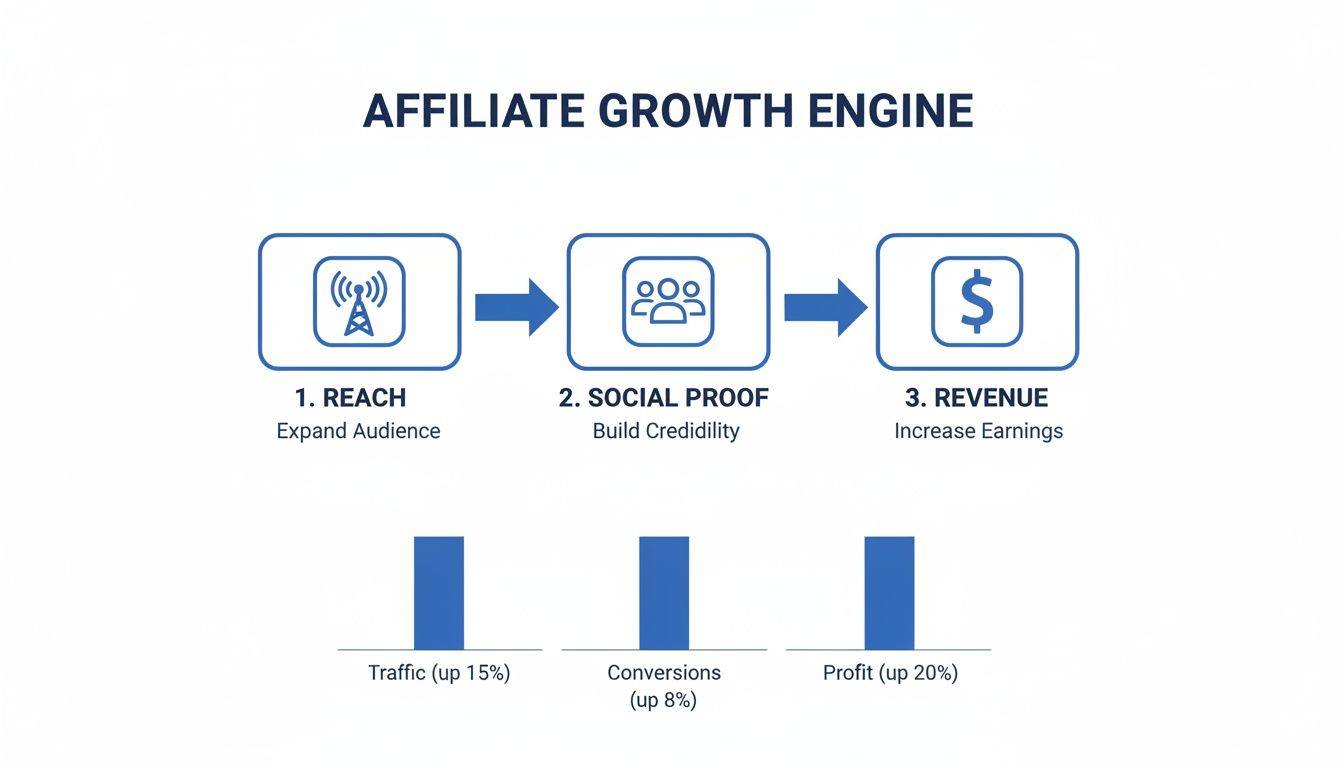
This flow shows exactly how affiliates expand your reach, build critical social proof, and directly drive revenue growth for your SaaS.
Defining Your Key Performance Indicators
With your goals locked in, the next step is picking the right Key Performance Indicators (KPIs) to track your progress. Think of these as the vital signs of your program's health. They tell you what's working and what's bleeding money.
Don't get distracted by vanity metrics like link clicks. Focus on KPIs that tie directly back to your business goals.
- Conversion Rate: What percentage of clicks on affiliate links actually turn into something valuable, like a trial sign-up or a paid subscription?
- Affiliate-Driven Revenue: How much new monthly recurring revenue (MRR) can you directly attribute to your partners? This is the big one.
- Customer Lifetime Value (CLV) by Affiliate: Are customers from certain partners sticking around longer and spending more? This tells you who is bringing you quality customers.
- Average Order Value (AOV): Are affiliates successfully promoting your higher-tier plans or valuable add-ons?
- Active Affiliate Rate: What percentage of your signed-up affiliates are actually driving traffic and sales? A high number of dormant partners is a red flag.
Watching these KPIs gives you the actionable intel you need to optimize your program, whether that means doubling down on your top performers or figuring out why certain promotional assets are falling flat.
Choosing the Right Commission Structure
Your commission structure is the heart of your program. It’s what motivates your partners, so it needs to be attractive enough to recruit top talent while being sustainable for your business. For SaaS, a few models are industry standard, each with its own pros and cons.
Here’s a breakdown of the most common SaaS affiliate commission models to help you decide which structure makes the most sense for your business goals and product pricing.
Choosing Your SaaS Affiliate Commission Model
Ultimately, there isn't a single "best" model—it all comes down to what you want to incentivize. Recurring commissions are fantastic for aligning everyone on long-term value, which is why they’re so popular in SaaS. A one-time payout can be a powerful recruitment tool, especially when promoting annual plans where you get the cash upfront.Pro Tip: Don't be afraid to start with one model and test another with a select group of partners. You might find that a hybrid model—like a flat $50 bounty for a new trial plus 15% recurring—is the sweet spot for motivating your affiliates.
The financial upside here is massive. Today, 81% of advertisers and 84% of publishers rely on affiliate revenue. A recent PMA study found that affiliate marketing drove $113 billion in US e-commerce sales in 2024. It’s a powerful channel when you get the incentives right. You can discover more insights about these affiliate marketing stats to see the full picture.
Drafting Clear and Fair Program Terms
Finally, every good program needs clear rules of engagement. A comprehensive Terms of Service agreement protects you and your partners by setting expectations from day one. This isn't just legal boilerplate; it's a foundational document for building trust.
Your terms should clearly spell out:
- Commission details: Your rates, when affiliates get paid, and the cookie duration (how long their referral link is valid after a click).
- Promotion guidelines: What affiliates can and cannot do. For example, are they allowed to bid on your brand name in paid search ads? Be specific.
- Reversal conditions: The reasons a commission might be voided, like customer refunds or fraudulent activity.
- Termination clauses: The conditions under which either party can end the partnership.
Getting this documented upfront prevents future headaches and ensures you're building a professional, transparent relationship with every partner you bring on board.
Setting Up Your Technical Infrastructure and Tracking
Alright, with your strategy locked in, it’s time to build the engine that makes your affiliate program run. This is the technical foundation—the plumbing that connects everything from generating unique referral links to making sure your partners get paid accurately and on time.
For SaaS businesses, this used to be a massive engineering headache, often requiring custom code and complicated database work. Thankfully, those days are over. Modern affiliate management platforms have turned this into a much simpler, plug-and-play process.
These platforms are built to talk directly to the payment processors you’re already using. Integrating a reliable payment gateway is non-negotiable for handling transactions smoothly and securely, which affects both how customers pay you and how you pay your affiliates. If you want to go deeper on this topic, you can consult this ultimate guide to payment gateway API integration for all the details.
Integrating with Stripe or Paddle
The heart of any SaaS affiliate program is its connection to your payment processor. For most of us, that means a seamless integration with either Stripe or Paddle. This is the single most critical piece of the technical puzzle, as it’s how your system knows a sale has actually happened.
An affiliate platform like LinkJolt connects to your Stripe account using secure APIs. When a customer clicks an affiliate's link and subscribes, the platform automatically sees the conversion through the payment processor and gives the right partner credit. This completely eliminates the need for manual tracking, which is not only a huge time sink but also a recipe for errors.
This direct integration takes care of a few crucial things:
- Accuracy: Commissions are tied directly to real payments, so there’s no guesswork involved.
- Automation: New sales, recurring payments, refunds, and even cancellations are all tracked automatically.
- Trust: Affiliates can see their referred sales pop up in their dashboard in near real-time, which builds immense confidence in your program.
Demystifying Affiliate Tracking and Attribution
The magic behind affiliate marketing is tracking. It’s how you connect a click on a partner's blog to a sale on your site. The most common way this is done is through cookie-based tracking.
Here’s a simple breakdown of how it works:
- An affiliate shares their unique referral link.
- A potential customer clicks that link, and a tiny text file (a cookie) gets stored in their web browser.
- This cookie contains the affiliate’s unique ID and has an expiration date.
- If the customer buys something before the cookie expires, your affiliate software reads the cookie and credits the sale to that partner.
The reliability of this system is everything. If your affiliates even suspect that their referrals aren't being tracked correctly, they’ll lose motivation and walk away. Investing in a robust platform is a direct investment in partner trust.
A key part of your setup is defining the attribution window, also known as the cookie duration. This is the length of time an affiliate has to get credit for a sale after someone clicks their link. For SaaS, a 30 to 90-day window is a fair and common standard. It gives potential customers plenty of time to check out your product, start a trial, and finally become a paying customer. You can learn more by checking out our in-depth guide to affiliate link tracking.
Defining Your Conversion Events
What specific action actually triggers a commission? In the SaaS world, it’s not always a straightforward, one-time purchase. You need to clearly define your "conversion events" inside your affiliate software.
Here are some common conversion events for SaaS:
- New Trial Sign-Up: Some programs offer a small, one-time bounty for a qualified lead, even if they don’t convert right away.
- First Paid Subscription: This is the most common one. The commission is paid out after the customer’s first successful payment.
- Subscription Renewal: For recurring commission models, every single successful monthly or annual renewal counts as a trackable conversion.
- Plan Upgrade: You could offer a bonus commission when an affiliate’s referral moves up to a more expensive plan.
Getting these events defined correctly in your platform ensures your commission structure runs on autopilot, exactly as you designed it.
Creating a Branded Affiliate Portal
Finally, your technical setup needs to include a professional, branded portal for your partners. Think of this as their home base—a central dashboard where they can manage their activity and feel like a real extension of your team.
This portal should give affiliates easy access to all the essentials:
- Unique Link Generation: A simple way to grab their main referral link or create deep links to specific pages on your site.
- Performance Analytics: Real-time data on their clicks, conversions, and commissions. No smoke and mirrors.
- Marketing Assets: A library packed with approved logos, banners, email copy, and other promotional materials.
- Payout Information: A clear overview of their payment history and what’s coming up next.
A clean, user-friendly portal shows that you’re serious about your program and invested in your partners' success. It elevates the relationship from a simple link-sharing deal into a genuine professional partnership.
Recruiting and Onboarding Your First Partners
Alright, the technical foundation is set, and your affiliate program is officially live. Now comes the fun part: filling it with the right people—partners who genuinely vibe with your brand and, more importantly, have the trust of your ideal customers.
It’s tempting to go for a big splash right away. Many new programs make the classic mistake of blasting an email to their entire customer list, crossing their fingers for signups. While your happy customers are an incredible asset, a truly killer recruitment strategy is far more proactive and targeted.
Finding High-Quality Affiliate Partners
The real goal here is to build a diverse, high-impact team of partners, not just a long list of names. This means you need to think like a talent scout, moving beyond your immediate network to find individuals and companies who are already influential in your space.
Here are the best pools to fish from:
- Your Power Users: Start here. Your most loyal and successful customers are your best advocates. They already get your product’s value inside and out, which makes their recommendations incredibly authentic.
- Niche Content Creators: Hunt down the bloggers, YouTubers, and podcasters who create content for your target audience. A creator who has reviewed a competitor's product is an especially warm lead because you know their audience is a perfect fit.
- Industry Consultants and Agencies: These pros are gold. They recommend solutions to their clients every single day. Getting your SaaS on that shortlist is a high-trust referral that can drive serious revenue.
- Partner Marketplaces: Don't sleep on the marketplaces built into many affiliate platforms like LinkJolt. These are directories filled with experienced affiliates who are actively looking for new programs to promote.
One great partner can completely change your program’s trajectory. The creator economy is booming, with research showing that affiliate programs driven by micro-influencers are growing by 25% annually. Why? Authentic audience engagement.
Crafting Your Outreach Message
Once you’ve scouted your top prospects, your outreach needs to be on point. Generic, copy-paste emails get deleted in seconds. Your message has to show you’ve actually done your homework and see a real, mutual fit.
A successful outreach email always includes these four things:
- A Personalized Opening: Mention something specific. "I loved your recent article on project management workflows" crushes "I'm a fan of your blog" every time. It shows you're not just spamming.
- The "Why You" Statement: Clearly explain why you think your product is a perfect match for their audience. Connect the dots between their content and your solution.
- The Core Offer: Get straight to the point. Briefly outline the key benefits of your program, like the commission rate (e.g., "30% recurring commission"), cookie duration, and any special launch incentives.
- A Clear Call to Action: End with a simple, low-friction next step. Something like, "If this sounds interesting, you can learn more and sign up here," is perfect.
For a much deeper dive into crafting messages that actually get replies, check out our full guide on how to recruit affiliates.
Creating a Seamless Onboarding Experience
Getting a partner to sign up is only half the battle. Now you need to deliver a stellar onboarding experience that sets them up for success from the minute they join. A confused or unsupported affiliate is an inactive one. Period.
Your mission is to eliminate all friction and make it dead simple for them to start promoting. A great onboarding process turns an interested partner into a motivated, commission-earning machine.
Key Takeaway: The first 48 hours after an affiliate signs up are the most critical. This is your window to make a great impression, build momentum, and provide the clarity and tools they need to get their first click and, ultimately, their first commission.
Your onboarding should include a "Welcome Kit," which can be an automated email sequence or a dedicated page in their affiliate dashboard.
This kit absolutely must contain:
- A Personal Welcome: A short message from you or the partner manager. It reinforces that you're genuinely excited to have them on board.
- Getting Started Checklist: A simple, step-by-step guide on what to do first—grab their link, check out the creative assets, and review the program terms.
- Link to their Dashboard: A direct, can't-miss-it link to their affiliate portal where everything they need lives.
- Asset Library Access: Point them straight to your library of logos, banners, social media templates, and pre-written copy. The easier you make it for them to promote, the more they will.
By investing in a thoughtful recruitment and onboarding process, you're not just activating affiliates; you're building the foundation for lasting, profitable partnerships that will fuel your growth for years to come.
Keeping Your Program Healthy: Payouts, Performance, and Fraud Prevention
Once your first referrals start trickling in, the real work begins. The initial setup is just the foundation; now, your focus has to shift to active, day-to-day management. Running a healthy affiliate program really comes down to three things: paying your partners on time, protecting your program from abuse, and proving its value with solid data.
Get any of these wrong, and the trust you’ve worked so hard to build can evaporate overnight. A single late payout can sour a great relationship, while unchecked fraud can quietly drain your budget and completely corrupt your performance metrics.
Build a Rock-Solid Payout Workflow
Paying your affiliates accurately and on schedule is the absolute bedrock of a good program. It's the most tangible way you show respect and prove you're a reliable partner, which is exactly what keeps your top performers motivated and sending you high-quality traffic. A messy or unpredictable payout process is one of the fastest ways to lose great people.
To get this right, you need to set clear rules from the start and automate as much as you possibly can.
- Set a Consistent Payout Schedule: Monthly payouts are the standard for a reason. Pick a specific day—like the 15th of every month—so partners know exactly when to expect their earnings. No guesswork.
- Define a "Locking" Period: This is crucial. Implement a delay between when a commission is earned and when it becomes payable. A 30-45 day window is typical, as it covers your refund period and protects you from paying out commissions on sales that get reversed.
- Establish a Payment Threshold: Set a minimum payout amount, like $50 or $100. This saves you the administrative headache of processing a bunch of tiny payments for just a few dollars.
This is where a good affiliate platform becomes your best friend. A system like LinkJolt can handle all of this automatically. It calculates commissions, accounts for refunds, and queues up payments based on your rules, so all you have to do is hit "approve." That automation is what saves you from countless hours of manual work and costly human error.
Get Proactive About Preventing Affiliate Fraud
Look, the vast majority of your affiliates will be honest partners. But fraud is an unfortunate reality in this space, and you absolutely must prepare for it. Being proactive here is infinitely better than trying to claw back commissions after they've already been paid out. Affiliate fraud is estimated to cost businesses $1.4 billion a year, so you can't afford to ignore it.
Don't think of fraud prevention as a sign of distrust. It’s about protecting the integrity of the program for the honest majority. Clear rules and automated monitoring ensure your commissions are rewarding legitimate, value-driven referrals.
You need to be on the lookout for a few common schemes:
- Cookie Stuffing: This is when an affiliate drops their tracking cookie onto a user's browser without their knowledge, often through shady pop-ups or hidden scripts. They’re trying to claim credit for sales they had nothing to do with.
- Typo Squatting: Fraudsters register domain names that are common misspellings of your brand (e.g., "LinkJolt" becomes "LinkJolt"). They then redirect that accidental traffic through their affiliate link to steal commissions.
- Self-Referrals: This one is super common. It's just partners signing up for your service through their own link to get a kickback. It’s essentially a discount, not a real referral, and should be explicitly banned in your terms.
Modern affiliate software comes with built-in fraud detection that can automatically flag or block this kind of suspicious activity. These tools monitor for weird click patterns, IP address anomalies, and conversion rates that are just too good to be true. This automated first line of defense is absolutely essential for keeping your program clean and profitable.
Dig Into Your Data to Drive Real Growth
Finally, you have to know what's working and what isn't. Your affiliate dashboard is a goldmine of data. It tells you who your star players are, which campaigns are hitting the mark, and where you should be focusing your energy. Just tracking total revenue isn't enough—you need to dig deeper to find insights you can actually act on.
Zero in on these key reports:
- Top-Performing Affiliates: This is your VIP list. Identify your top 5-10 partners and pour your energy into those relationships. Reach out to them personally. Ask them what they need to be even more successful. Explore co-marketing opportunities.
- Conversion Rate by Partner: See a partner with tons of clicks but a low conversion rate? That could signal a mismatch between their audience and your product. It’s an opportunity to reach out, offer some coaching, or provide them with better marketing assets that speak more directly to their followers.
- Revenue by Channel: Are your best customers coming from YouTubers or bloggers? Knowing this helps you refine your recruitment strategy so you can go out and find more of the right kind of partners.
Use this data to actively guide your affiliates. If you see a blogger's in-depth review is converting like crazy, share that success story with your other affiliates as a case study. If a specific webinar is driving a ton of sign-ups, package it up into a promo kit for everyone to use. This kind of data-driven management turns running your program from a reactive chore into a proactive growth engine.
Scaling Your Program for Long-Term Growth
A successful affiliate program doesn’t just run on autopilot; it evolves. Once you've got a solid foundation and partners are driving consistent referrals, the real opportunity begins. It's time to shift from just managing the program to actively optimizing it, turning your affiliate channel into a major, predictable revenue engine for your SaaS.
This is where you move beyond the day-to-day metrics and start focusing on strategic moves that motivate, engage, and empower your best partners. The goal isn't just to grow the program, but to deepen its impact on your bottom line over time.
Motivate Your Top Performers
A one-size-fits-all commission structure is great for getting started, but it does little to reward excellence. Let's be honest, your top partners—the 5-10% who likely drive 80% of your results—deserve special attention. This is where tiered commissions come into play.
Creating tiers gives your entire affiliate base clear, achievable goals to strive for. It’s a powerful incentive that turns good partners into great ones.
Here’s a simple, effective structure you can adapt:
- Bronze Tier (Default): Everyone starts here, maybe earning a 20% recurring commission.
- Silver Tier (> $1,000 in monthly revenue): Affiliates who hit this milestone get a bump to 25% commission.
- Gold Tier (> $5,000 in monthly revenue): Your elite partners get rewarded with a 30% commission and maybe some other perks.
This structure gamifies performance and gives your most valuable partners a compelling reason to push your product over the competition.
Drive Engagement with Strategic Promotions
Keep things fresh by running seasonal or time-sensitive campaigns. These promotions inject a burst of energy into the program and give affiliates a new reason to reach out to their audience. Instead of just pushing the same offer year-round, you create moments of high engagement.
For example, you could run a "Summer of SaaS" promotion, temporarily boosting the commission rate by 10% for all new sign-ups in July and August. Another powerful tactic is offering a straight-up cash bonus, like a $200 bonus for any affiliate who drives 10 new paid customers in a single month.
Don't just announce a promotion; equip your partners to win. Give them a full campaign kit with themed banners, email swipe copy, and social media templates tailored to the offer. The less work they have to do, the more likely they are to jump on it.
The affiliate channel itself is proving its scalability on a massive scale. Affiliate spending in the US is projected to hit $13.62 billion in 2024, a huge 49.8% jump from 2021. This rapid expansion shows why learning to create and scale an affiliate program is a core marketing function today. You can explore more affiliate marketing statistics to see just how important this channel has become.
Got Questions? We Have Answers
How Much Does It Really Cost to Start a SaaS Affiliate Program?
You're looking at two main costs: the software you use to run the program and the commissions you pay out to partners.
The software side can run you anywhere from $50 to over $500 a month, depending on how fancy you need to get with features. But the beautiful part is the commission side—unlike dumping money into ads, you only pay your affiliates after they’ve made you a sale. It’s a purely performance-based channel, which makes it incredibly cost-effective.
What's a Good Commission Rate for a SaaS Product?
Most SaaS companies land somewhere between a 20% to 40% recurring commission for the lifetime of the customer. The right number for you boils down to your own customer lifetime value (CLV) and profit margins.
Some brands prefer a larger one-time payout instead of a recurring one. This can be a great way to motivate affiliates who are really good at driving sign-ups for annual plans.
A recurring commission is often the smarter play. It gets your affiliates invested in the same goal you are: keeping customers happy and subscribed. When they know their income depends on bringing in high-quality users who stick around, they're incentivized to promote your product to the right audience. It's a true win-win.
How Do I Find My First Few Affiliates?
Don't overcomplicate it. Start with the goldmine you're already sitting on: your happiest customers. They're your best and most genuine advocates.
Once you've tapped into that, start looking for influential bloggers, YouTubers, and consultants in your specific niche who are already reviewing products like yours. And finally, take a look at the marketplaces built into most affiliate software platforms—they're full of experienced partners actively searching for new programs to promote.
Ready to launch and scale your SaaS affiliate program without the headache? LinkJolt gives you everything from seamless Stripe integration to automated payouts and a powerful partner marketplace. Start your affiliate program in minutes.
Watch Demo (2 min)


Trusted by 300+ SaaS companies
Start Your Affiliate Program Today
Get 30% off your first 3 months with code LINKJOLT30
✓ 3-day free trial
✓ Cancel anytime