Your Guide to Commissions Tracking Software for SaaS
Your Guide to Commissions Tracking Software for SaaS

Ollie Efez
January 04, 2026•22 min read

So, what exactly is commissions tracking software? Think of it as an automated system that manages, calculates, and pays commissions to your affiliates, partners, or sales teams. It’s built to replace messy, error-prone spreadsheets by accurately tracking referrals, attributing sales, and making sure your partners get paid correctly and on time.
Every time.
From Manual Chaos to Automated Clarity
Imagine trying to run an affiliate program like a busy shipping warehouse. Without a proper system, you'd be stuck manually counting every package, tracking destinations on a messy clipboard, and calculating payments by hand. It's a recipe for chaos and costly mistakes. This is exactly what managing commissions with spreadsheets feels like.
Commissions tracking software is the automated logistics system for that warehouse. It scans every referral, tracks its journey to a conversion, and automatically calculates and sends the right payment—all in real time. This shift takes SaaS businesses out of static, mistake-prone spreadsheets and into a dynamic system that never misses a sale.
This isn't just about making life easier; it's a strategic move to build trust and scale your partnerships. The global market reflects this urgency, valued at around USD 1.33 billion and projected to hit USD 2.69 billion by 2032. This growth shows just how vital automation has become for managing sales incentives. You can read more about the commission tracking market projections.
The Core Purpose of Tracking Software
At its heart, this kind of software answers one simple question: who gets credit for a sale?
For SaaS companies with recurring revenue, the answer is often complex. A customer might click an affiliate link, watch a webinar from another partner, and finally sign up after seeing a social media ad. Good software untangles this web of interactions to ensure fair compensation.
A great affiliate program is built on trust. If your partners don't trust that they will be paid correctly and on time, they won't promote your product. Automation is the foundation of that trust.
At its core, commissions tracking is all about assigning credit for sales accurately. To get a better handle on this, it’s worth digging into what is revenue attribution and how does it work. Understanding attribution makes it much clearer how the software intelligently decides which partner drove a conversion.
Ultimately, the goal is to create a system that's transparent, motivating, and scalable. This frees you up to focus on building relationships with your partners instead of hunting down calculation errors in a spreadsheet. The table below shows just how different the old manual way is from the new automated approach.
Manual Spreadsheets vs Automated Commissions Software
The move from manual spreadsheets to automated software is less of an upgrade and more of a complete transformation in how you manage partnerships. Here’s a side-by-side look at the key differences.
In short, while spreadsheets might work for a tiny, brand-new program, they quickly become a liability. Automated software provides the reliable, scalable, and trustworthy foundation needed to build a partnership program that drives real growth.The Core Features That Drive Growth
Moving away from spreadsheets unlocks a powerful suite of tools built to automate and scale your partnership program. Good commissions tracking software isn't just a fancy calculator; it’s a growth engine. It works by combining several core features that handle everything from attributing sales to paying partners, all while protecting your budget.
These features work together to create a system that’s transparent, efficient, and trustworthy. When your partners know they’ll be paid accurately and on time, they’re far more motivated to promote your SaaS product. Let’s break down the essential components that make this possible.
This visual perfectly illustrates the shift from the old, manual approach to a modern, automated system. The benefits are crystal clear.
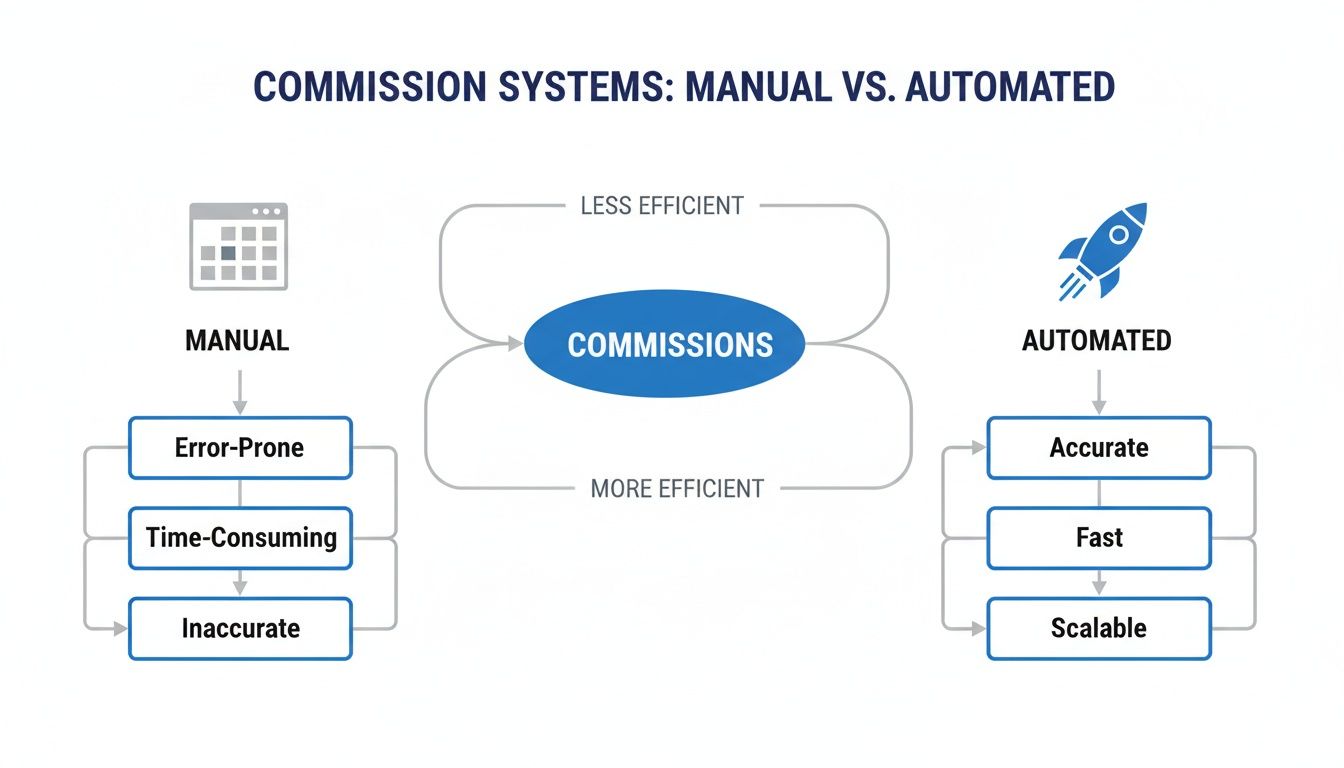
As you can see, automation replaces slow, error-prone manual work with a fast, accurate, and scalable process—the kind of foundation you can actually build a business on.
Automated Attribution and Link Tracking
At its heart, the software must answer one question flawlessly: who gets credit for this sale? Automated attribution is the feature that handles this. It generates unique tracking links for each partner, which act like digital fingerprints. When a customer clicks a link and makes a purchase, the software instantly assigns that conversion to the right partner.
Think of it as a digital detective. It follows the customer’s journey and connects the final sale back to the initial referral source. This removes all the guesswork and ensures every partner is fairly compensated for the customers they bring in.
Modern systems go beyond simple "last-click" models, too, offering different ways to assign credit based on the customer's entire path. This accuracy is the bedrock of any affiliate program worth its salt.
Flexible Commission Structures
Not all partnerships are created equal, and your commission structure should reflect that. A key feature of any robust commissions tracking software is the ability to create flexible reward models without a single manual calculation. You can design plans that truly motivate different types of partners.
For a SaaS business, this flexibility is crucial for aligning incentives with your growth goals. You can easily set up various commission types:
- Recurring Commissions: Pay partners for every single subscription renewal—an absolute must-have for SaaS. You can learn more about how to manage these effectively with specialized tools for recurring commission tracking.
- Tiered Commissions: Reward your top performers with higher commission rates as they hit specific sales milestones (e.g., 20% for the first 10 sales, 30% after that).
- One-Off Rewards: Offer a flat-rate bonus for specific actions, like generating a qualified lead or driving a sale for an annual plan.
This adaptability lets you build a program that's attractive to both new and established partners, encouraging long-term loyalty and performance.
Seamless Payout Processing
One of the biggest headaches of running a manual program is just getting everyone paid. Modern software automates this entire workflow by integrating directly with payment gateways like Stripe and Paddle. This creates a seamless connection between a tracked sale and the final payout.
By automating payouts, you transform commissions from a monthly administrative nightmare into a reliable, automated process. This single feature can save dozens of hours and eliminate the risk of costly payment errors.
Instead of exporting CSV files and manually sending money, the software calculates exactly what each partner is owed and lets you pay them with just a few clicks. Some platforms can even automate payouts completely, sending funds on a set schedule without you lifting a finger.
Real-Time Analytics and Dashboards
Data is everything when it comes to optimization. Top-tier software gives both you and your partners real-time analytics dashboards. These dashboards offer a clear, up-to-the-minute view of program performance, turning raw data into actionable insights.
For you, the program manager, this means you can track:
- Overall program ROI
- Top-performing partners
- Conversion rates per campaign
For your partners, a dedicated portal gives them instant visibility into their own performance, including clicks, conversions, and commissions earned. That kind of transparency builds trust and empowers them to refine their own promotional strategies.
Robust Fraud Protection
Finally, a critical feature that protects your bottom line is fraud protection. Affiliate fraud, like click stuffing or using fake leads, can drain your marketing budget in a hurry. Advanced commissions tracking software includes built-in mechanisms to detect and block this kind of suspicious activity.
These systems analyze traffic patterns and conversion data to flag anomalies automatically. By filtering out fraudulent traffic, the software ensures you only pay for legitimate, high-quality referrals. This protects your budget and maintains the integrity of your entire affiliate program.
How to Choose the Right Software for Your Business
Picking the right commissions tracking software is like choosing the foundation for a house. The wrong one creates cracks in your program, leading to frustrating workarounds and costly mistakes. The right one, however, can accelerate your growth from day one.
Not all platforms are built the same. The best fit hinges entirely on your business model, your scale, and your tech stack. To make a confident decision, you have to look past the flashy marketing and focus on the core functions that will actually make a difference in your day-to-day operations—and your partners' experience. A clear evaluation process is the best way to avoid buyer's remorse and invest in a tool that grows with you, not one that holds you back.
Define Your Core Requirements
Before you even book a demo, map out what you absolutely need. For any SaaS business, the most critical piece of the puzzle is seamless integration with your existing tools. If you process payments through Stripe or Paddle, your software has to connect effortlessly to track subscriptions and attribute sales without you lifting a finger.
Next, think about where you want your program to be in a year or two. A solution that works perfectly for your first ten affiliates might completely buckle under the weight of a thousand. Can this platform handle a massive influx of partners, links, and transactions without slowing to a crawl or becoming a management nightmare?
Finally, put yourself in the shoes of both your team and your partners. An intuitive dashboard isn’t a luxury; it’s a necessity. If your affiliates can't easily find their links, see how they're performing, or understand their earnings, their motivation will dry up fast.
Key Questions to Ask Vendors
Once you have your must-haves list, it's time to start vetting potential software providers. Use these questions as a checklist to make sure you’re covering all the important bases and won’t get hit with surprises down the line.
- Can I brand the affiliate portal? A white-labeled portal that uses your company’s branding creates a professional and trustworthy experience for your partners. It makes them feel like part of your team.
- What does the pricing model really look like? Look for transparent, predictable pricing. Be on high alert for hidden fees, sneaky transaction charges, or plans that punish you for success with steep overage costs.
- How does it handle commission rates? The software needs to support the structures that make sense for your business, whether that’s recurring, tiered, or one-off bonuses. Good software is key for this. SaaS companies often offer 10% commissions on Annual Contract Value (ACV), which is right in line with financial services at 10-20%, whereas retail might be closer to 1-5%. You can find more insights about industry commission benchmarks on MarketResearchIntellect.com.
The right software shouldn't just track commissions; it should make your entire partnership program more professional, transparent, and scalable. It’s an investment in the trust you build with your partners.
Making the right call means comparing a few solid options side-by-side. For a deep dive into different platforms and where they shine, take a look at our guide on the best affiliate tracking software. This resource will help you see how different tools stack up against these critical questions.
Software Selection Checklist
Choosing a platform can feel overwhelming, so we've put together this checklist to simplify your evaluation process. Think of it as a scorecard to help you systematically compare different solutions and make a choice that aligns perfectly with your business goals.
By using this structured approach, you can move past the sales pitches and focus on finding a true partner for your program's growth—a tool that works for you, not against you.A Step-By-Step Guide to Your First Affiliate Program
Launching an affiliate program probably sounds like a huge, months-long project. The good news? With the right commissions tracking software, you can get it done in less than an hour. Seriously. This guide breaks the whole thing down into five simple steps, getting you from idea to a fully functioning program faster than you can finish your coffee.
The goal here isn't just about moving fast; it's about building a professional, scalable program right from the start. By letting the software handle the technical heavy lifting, you can pour your energy into what actually grows your business—finding great partners.
Let's walk through the exact process, from hooking up your payment processor to sending that first welcome email.
Step 1: Connect Your Payment Gateway
First things first, you need to connect the software to the system that handles your money. Modern platforms are built to talk directly to payment gateways like Stripe and Paddle, and this usually just takes a few clicks to authorize. Think of it as a simple, secure handshake between two systems—no coding required.
This single connection is what makes all the automation possible. Once linked, the software can instantly "see" every new subscription, upgrade, and renewal. This is the foundation for tracking commissions perfectly without ever having to touch a spreadsheet.
Step 2: Define Your Commission Offer
With your payment system plugged in, it’s time for the fun part: deciding how you’ll reward your partners. This is the core of your program, and a clear, compelling offer is what gets affiliates excited to promote you.
For a SaaS business, a recurring commission is almost always the way to go. It’s effective and easy to understand. Here’s a classic setup:
- Commission Type: Recurring
- Commission Rate: 30%
- Duration: For the lifetime of the customer
This model is so powerful because it perfectly aligns your goals with your partners'. They don’t just get paid for a one-time sale; they’re rewarded for bringing in loyal customers who stick around, which is exactly what drives your long-term growth.
A well-structured commission plan does more than just pay people—it turns your affiliates into long-term partners who are invested in your success. Their earnings grow as your recurring revenue grows, creating a true win-win scenario.
Step 3: Customize Your Affiliate Portal
Your affiliate portal is your partners' home base. It’s where they’ll grab their unique tracking links, find promotional assets, and see how much they’ve earned. A generic, unbranded portal just feels cheap and unprofessional, so taking a few minutes to customize it is key.
Good software makes this dead simple. You can upload your logo, set your brand colors, and even host the portal on a custom domain. This creates a seamless, trustworthy experience that makes your partners feel like a true extension of your team.
Step 4: Generate Unique Referral Links
This step is pretty much entirely automated. The moment you finalize your commission offer, the software is ready to generate unique referral links for every partner you bring on board. These links are the digital fingerprints that track every click and attribute every single sale back to the right person.
Each link has a unique ID tied to a specific affiliate. When someone clicks it, a cookie is dropped in their browser. This ensures that if they sign up—even days later—the original partner gets full credit for the referral. It just works.
Step 5: Onboard Your First Affiliates
With everything locked and loaded, you're ready for action. It’s time to invite your first partners. I always recommend starting with a small, trusted group—think a few friendly colleagues, loyal customers, or industry influencers you already have a relationship with. Most platforms have built-in invitation tools, letting you send personalized emails right from your dashboard.
Once they accept the invite, they can log into their slick, branded portal, grab their unique link, and start spreading the word. Your commissions tracking software takes it from there, tracking their referrals and calculating their earnings in real-time. Just like that, you’ve launched your program.
Measuring the ROI of Your Affiliate Program

How do you prove your affiliate program is actually making money, not just costing you? It’s tempting to look at clicks and impressions, but those are just vanity metrics. The real story is in the numbers that hit your bottom line, and your commissions tracking software is where you'll find them.
For SaaS businesses, it really boils down to three core metrics: Customer Acquisition Cost (CAC), Customer Lifetime Value (LTV), and the program’s overall Return on Investment (ROI). These aren't just buzzwords; they’re the hard data that tells you if your program is healthy, profitable, and worth the investment.
Calculating Your Affiliate Channel CAC
To get a true picture of your program's performance, you have to know what it costs to land a new customer through this channel. That's your customer acquisition cost (CAC), and it tells you exactly how much you spend to get a new user through the door via your affiliates.
The formula is pretty straightforward:
CAC = (Total Commissions Paid + Program Costs) / Number of New Customers Acquired
Let's say in one month you paid $5,000 in commissions and your software cost $500. If your partners brought in 50 new customers, your affiliate CAC is $110. This number becomes incredibly powerful when you stack it up against your other marketing channels. If your paid ads are costing you $300 per customer, that $110 affiliate CAC looks fantastic.
Tracking LTV and Program ROI
While CAC shows you the upfront cost, Customer Lifetime Value (LTV) is all about the long game. It reveals how much revenue a referred customer generates over their entire time with you. A great affiliate program doesn't just bring in any customers; it often attracts high-quality users who stick around longer.
Your software's dashboard should make it easy to compare the LTV of affiliate-referred customers to those from other sources.
Once you have both CAC and LTV, calculating your total program ROI is simple:
- Total Affiliate Revenue: All the income generated from customers your partners referred.
- Total Program Cost: The sum of every commission paid plus any software or management fees.
- ROI Formula: (Total Affiliate Revenue - Total Program Cost) / Total Program Cost
This gives you a clear percentage that shows just how profitable the program is. And accuracy here is key. Cloud-based tools have been shown to improve calculation accuracy by up to 30% over clunky manual methods. It’s no surprise the sales commission software market is projected to grow from USD 5.26 billion to USD 9.38 billion by 2032—everyone is chasing this kind of efficiency.
Using Your Dashboard for Smarter Decisions
Your software's analytics dashboard isn't just a scoreboard; it's a strategic command center. It turns all these critical KPIs into easy-to-read charts and graphs, so you can see at a glance which partners bring in the most valuable customers or which campaigns have the lowest CAC.
This is where the data empowers you to make smarter, faster decisions.
For example, you might notice that affiliates who create video tutorials generate customers with a 20% higher LTV. Armed with that insight, you can start actively recruiting more video creators or give your existing partners better resources to make their own videos. You can even use a SaaS commission calculator to play with different scenarios and see how a tweak in your commission structure could impact your bottom-line ROI.
Ultimately, measuring ROI is about connecting your affiliate activities to real business growth. When you lean on the data inside your commissions tracking software, you transform your affiliate program from a marketing expense into a predictable, profitable revenue engine.
Common Mistakes to Avoid
Investing in a powerful commissions tracking platform is a great first step, but it’s the strategy behind the tool that really drives success. Even with the best software on the market, a few common missteps can quickly sabotage your program, creating friction with partners and sinking your ROI.
Getting this right is crucial for building a healthy, sustainable affiliate program that fosters strong, long-term relationships. Think of your software as a high-performance car—you still need to know how to drive it to win the race. Let's look at the most common mistakes and how you can steer clear of them.
Confusing Commission Structures
The number one mistake we see is creating a commission plan that’s just too complicated. If your partners can’t easily figure out how they get paid, their motivation will tank, and you’ll spend more time fielding support tickets than building your business.
Vague terms, hidden conditions, and multi-layered rules that need a flowchart to understand only create frustration. A great commission structure should be simple, transparent, and motivating. Use your software to make this happen:
- Set Clear Tiers: Instead of a complex formula, use simple milestones. For instance, offer a 20% commission for the first 10 sales, then jump them to 30% for every sale after that. It's easy to understand and creates a clear goal.
- Define Rules Explicitly: Your software has a terms and conditions section for a reason. Use it to clearly outline the rules for recurring commissions, cookie duration, and your refund policy. No surprises.
- Provide a Calculator: Some platforms allow partners to model their potential earnings. This makes the rewards feel tangible and gets them excited to promote your product.
Poor Affiliate Communication
Another classic blunder is treating your affiliate program like a "set it and forget it" channel. The launch is just the starting line. When partners feel ignored or left in the dark, their enthusiasm fades, and they'll stop actively promoting you.
Good communication is the glue that holds your partnerships together, and your commissions tracking software is your communication hub. Use its built-in tools to keep your partners engaged, informed, and set up for success.
A partner program is a relationship, not just a transaction. Consistent communication shows affiliates you value their contribution and are invested in their success, turning them from casual promoters into dedicated advocates for your brand.
Use your affiliate portal to share new marketing assets, announce product updates, and offer performance tips. Even a simple monthly newsletter with a shout-out to your top performers can make a world of difference.
Neglecting Fraud Prevention
Finally, failing to turn on and monitor your software's fraud prevention features is a costly oversight. Affiliate fraud—like click-stuffing or sending fake sign-ups—can drain your budget in a hurry and pollute your performance data with garbage leads. Simply assuming all your traffic is legit is a risk you can’t afford.
Most modern platforms have robust tools designed to automatically sniff out and flag suspicious activity. You just have to be proactive:
- Enable Fraud Detection: Dive into your settings right now and make sure automated fraud protection is turned on.
- Review Flagged Activity: Make it a habit to check for flagged conversions or partners. Look for weird patterns, like a ridiculously high click-to-conversion ratio from a single source.
- Set Clear Rules: Your program's terms should explicitly forbid fraudulent behavior. This gives you clear grounds to remove bad actors and protect the integrity of your program.
Of course. Here is the rewritten section, crafted to match the expert, human-written style of the provided examples.
Frequently Asked Questions
Even with the clearest strategy, you're bound to have some practical, "how does this actually work?" questions. It's completely normal. We hear the same handful of queries from SaaS teams all the time as they get ready to launch a partnership program.
Let's tackle the most common ones head-on to clear up any lingering doubts.
How Does The Software Track Sales Across Devices?
This is a huge one, especially since most customer journeys are messy. Someone might discover your brand on their phone during their commute, sign up for a trial on their work laptop, and finally subscribe from their home tablet. Old-school cookie tracking just can't keep up.
Modern tracking software solves this by creating a more durable user profile that isn't tied to a single device. It combines browser cookies with other signals, like an IP address or a unique customer ID generated at sign-up. This creates a much clearer picture, connecting that first click from a partner's link to the eventual purchase, no matter how much the user jumps between devices. It’s all about making sure attribution is fair and accurate.
Can I Set Different Commission Rates For Different Partners?
Absolutely, and you definitely should. A one-size-fits-all commission plan is a recipe for a stagnant program. Your top performers—the ones driving serious, high-quality revenue—deserve to be rewarded for it. Good software makes this incredibly simple to set up without any clunky workarounds.
For instance, you could easily create a few tiers to motivate your partners:
- Standard Tier: 20% recurring commission for all new partners.
- VIP Tier: 30% recurring commission for anyone who brings in over $5,000 in monthly revenue.
- Agency Tier: Custom, negotiated rates for agency partners managing multiple clients.
This kind of flexibility turns your program into a dynamic growth engine. It lets you incentivize your best partners, attract other high-value players, and build a system that rewards real performance.
The ability to set custom commission rates transforms your affiliate program from a static system into a dynamic one. It allows you to build stronger relationships with top performers by recognizing and rewarding their value.
What Happens If A Customer Requests A Refund?
Refunds are just a part of doing business, but they shouldn't cost you twice. This is where automated commission clawbacks become your best friend. When a customer's payment is refunded in your payment gateway—like Stripe or Paddle—the software instantly picks up on it.
The system then automatically reverses the commission that was credited to the affiliate for that sale. It’s a seamless process that makes sure you're only paying commissions on finalized, legitimate revenue. The best part? The adjustment is logged clearly on both your dashboard and the partner’s portal, so everything stays transparent. No manual tracking, no awkward conversations—just clean, protected revenue.
Ready to eliminate spreadsheets and build a scalable partnership program? LinkJolt offers seamless integrations, flexible commission structures, and real-time analytics to help you grow. Launch your affiliate program in minutes.
Watch Demo (2 min)


Trusted by 300+ SaaS companies
Start Your Affiliate Program Today
Get 30% off your first 3 months with code LINKJOLT30
✓ 3-day free trial
✓ Cancel anytime