How to Obtain Referrals for Your SaaS Business
How to Obtain Referrals for Your SaaS Business

Ollie Efez
December 31, 2025•19 min read•Updated Apr 16, 2026
Getting referrals for your SaaS business isn't about just asking nicely. It’s about building a well-oiled machine that turns your happiest customers and partners into a powerful sales force. Think of it as a systematic approach: you offer compelling rewards, give people dead-simple tools to share your product, and then you make sure everyone knows about it.
Why Referrals Are Your Untapped Growth Engine
Before we get into the nitty-gritty, let's talk about why this matters so much. A referral program isn’t just another line item in your marketing budget; it's a growth engine that runs on the most powerful fuel out there: trust.
When a customer who loves your product tells a friend, that recommendation carries more weight than a thousand ads. It's genuine social proof, and it's the secret sauce behind some of the most explosive growth stories in SaaS.
The impact on your bottom line is real and measurable. These aren't just cold leads you're getting; they're pre-qualified prospects who arrive with a built-in trust for your brand.
- Higher Conversion Rates: A lead from a trusted source is already halfway to becoming a customer. They convert at a much higher clip because the initial skepticism is gone.
- Lower Customer Acquisition Cost (CAC): Instead of pouring money into the ever-escalating costs of paid ads, you're rewarding your existing customers. It’s a far more efficient and sustainable way to grow.
- Increased Lifetime Value (LTV): We’ve seen it time and time again—referred customers are stickier. They tend to be more loyal, have lower churn rates, and ultimately deliver a higher LTV.
This diagram breaks down the beautiful simplicity of the process. It's a clear chain reaction that directly impacts your most important metrics.
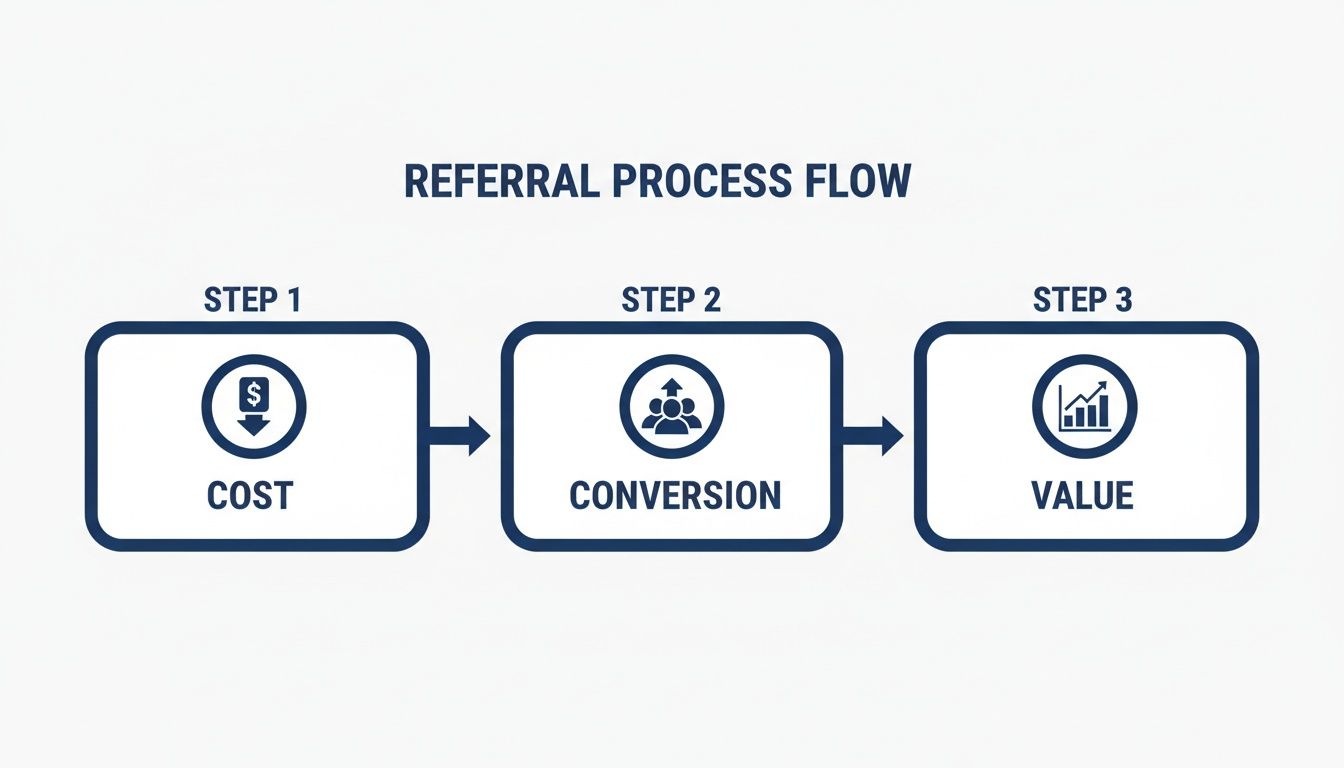
As you can see, it's a straightforward flow: lower the cost to get a customer, increase the rate at which they convert, and you naturally end up with a more valuable customer base over the long haul.
The Exploding Referral Landscape
If you’ve been on the fence about this, now is the time to act. The entire referral and affiliate marketing world is on a massive upward trajectory. Projections show the global market hitting $17-18.5 billion in 2025, with some forecasts even suggesting it could rocket past $31.7 billion by 2031.
That’s a compound annual growth rate of around 14-15%. This isn’t a fleeting trend; it’s a fundamental shift in how businesses and creators are choosing to grow. For a deeper look, check out these affiliate marketing statistics to grasp the full scale of the opportunity.
A well-structured referral program moves marketing from an expense to an investment. You're not just buying clicks; you're building a network of advocates who are financially and emotionally invested in your success.
This explosive growth is all the proof you need. Learning how to obtain referrals is one of the most valuable skills you can develop for sustainable growth. It’s a strategy that builds on itself, creating a powerful flywheel where every new, happy customer becomes a potential source for the next one.
Designing a Referral Program People Actually Use
A referral program that looks great on paper but doesn't actually get anyone to sign up is just a waste of time and code. The real secret to getting referrals isn't just asking for them; it's building a system that makes sharing your SaaS feel both rewarding and completely effortless. This all starts with a smart design that considers who you're asking and what truly gets them excited.

The foundation of any program that gets results is a compelling offer. You need an incentive structure that clicks with the people you want referring you, and they usually fall into a few distinct groups. Each one needs a slightly different touch.
Crafting the Right Incentives
Let's be honest, one-size-fits-all rewards just don't work. A happy customer who casually shares your tool has very different motivations than a professional affiliate whose rent depends on commissions. Tailoring your incentives is the first, most critical step toward building a program people actually want to be a part of.
Here’s a quick breakdown of the most effective reward structures I've seen:
- Service Credits: This is the perfect play for your loyal customers. Offering a discount or a free month of your service is a fantastic way to reward them for spreading the word. It's incredibly cost-effective for you and feels like a huge win for them, making them even stickier.
- Cash Rewards: Cash is the universal motivator. This is the gold standard for professional affiliates, partners, and creators who treat referrals as a business. A recurring commission, usually 20-30% of the subscription value for the first year, is a powerful hook because it creates a predictable income stream for them.
- Tiered Commissions: This is how you light a fire under your top performers. This structure rewards partners with a higher commission rate as they bring in more business. For example, they might start at 20% for their first 10 referrals but jump to 30% after hitting that milestone, giving them a clear reason to double down on their efforts.
The best incentive isn't always the biggest. It's the one that feels fair, achievable, and directly connected to the effort someone puts in. A small, instant reward can often be more motivating than a huge, far-off one.
For a much deeper dive into structuring these offers, our guide on how to create a referral program is your detailed roadmap. Thinking through these options upfront saves a ton of confusion later and ensures your offer is both sustainable for you and exciting for your partners.
Defining Clear Rules and Eligibility
Ambiguity kills action. If people are confused about who can join, how they get credit, or when they get paid, they’ll simply ignore your program. Your terms need to be simple, clear, and easy to find.
Start by nailing down the answers to these core questions:
- Who is eligible to join? Is this program open to every customer, or only those on premium plans? What about agencies, affiliates, and partners? Spell it out.
- What counts as a successful referral? Does the new user just need to sign up for a trial, or do they have to become a paying customer? Define the exact event that triggers a reward.
- How and when are rewards paid out? Be specific about the payment method (like PayPal or bank transfer) and the payout schedule (e.g., net-30, net-60). For service credits, clarify exactly when they'll hit the account.
Getting this right builds trust from day one. A simple, one-page summary of your terms can make your program look way more professional and appealing.
Complying with Legal Guidelines
Finally, don't sleep on the legal stuff. Being transparent isn't just good for business; it's often the law. In the United States, the Federal Trade Commission (FTC) has crystal-clear guidelines about disclosures for endorsements.
This is non-negotiable: your referrers must disclose that they might earn a commission if someone signs up through their link. You can make this easy for them by providing pre-written text they can just copy and paste into their content. A simple line like, "Heads up: I may earn a commission if you sign up through my link" is often all it takes.
Building these best practices into your program from the very beginning protects both you and the partners you've worked so hard to recruit.
Finding the Right People to Refer Your SaaS
So you’ve designed a killer referral program. The incentives are solid, the terms are clear, and you’re ready to go. Now comes the real challenge: finding the right people to actually drive those referrals.
This isn’t about just blasting an invitation into the void and hoping for the best. Smart recruitment is a targeted effort. It means identifying distinct groups of potential advocates—your happiest customers, strategic partners, and trusted creators—and tailoring your outreach to what truly motivates them. Building an army of authentic promoters is how you get real traction.
Turning Happy Customers into Vocal Advocates
Your most valuable source of referrals is probably hiding in plain sight. It’s your existing customer base—the people who already use, understand, and genuinely love your product. The trick is to make it incredibly easy and rewarding for them to share that positive experience.
Don't just wait for them to stumble upon your program. You need to be proactive. Pinpoint your power users and biggest fans. These are the folks with high usage rates, positive support tickets, or high Net Promoter Scores (NPS). Once you know who they are, give them a gentle, personal nudge.
A personalized in-app notification or email can work wonders. Forget the generic marketing blast. Segment your list and speak directly to their experience with your product.
Example In-App Notification Copy
Subject: Loving [Your SaaS Name]? Share it and get a free month!
Body: Hey [First Name],
Looks like you've been crushing it with [feature they use often]. We love seeing our users succeed!
Did you know you can get a free month of [Your SaaS Name] just for telling a friend? Our new referral program makes it easy.
[Get Your Referral Link]
This approach feels less like a marketing campaign and more like a personal thank you. That small shift dramatically increases the odds they'll actually take action.
Identifying Synergistic Partners and Affiliates
While customers provide authentic social proof, partners and affiliates are all about scale. These are the businesses, agencies, and consultants whose audiences perfectly overlap with your ideal customer profile.
The key is to look for non-competitive companies that serve the same market. For example, if you sell an email marketing SaaS, your ideal partners could be:
- Marketing agencies that build campaigns for their clients.
- SEO consultants whose clients need a way to nurture all that new traffic.
- Business coaches who advise startups on growth strategies.
The goal here is a true win-win. You provide them with a reliable new revenue stream and a vetted tool they can confidently recommend to their clients. In return, they introduce you to a warm, highly relevant audience. This is how you obtain referrals at a much larger scale.
Your best partners are those who would recommend a tool like yours anyway. Your program simply formalizes the relationship and rewards them for the value they're already creating.
Recruiting Content Creators and Niche Influencers
In the creator economy, trust is everything. Bloggers, YouTubers, and podcasters have spent years building dedicated followings by providing valuable, honest content. A single recommendation from a respected creator can drive more high-quality sign-ups than almost any other channel.
The secret to successful outreach is personalization and genuine respect for their work. Generic, copy-pasted emails get deleted on sight. You have to show them you’ve actually engaged with their content and truly understand their audience.
Example Outreach Email Template
Subject: Collaboration idea for your audience
Hi [Creator's Name],
I'm a big fan of your [YouTube channel/blog]—your recent video on [Specific Topic] was incredibly insightful. The way you explained [Concept] really clarified it for me.
Because you focus on helping [Their Audience Description], I thought our tool, [Your SaaS Name], might be a great fit for your community. It helps them solve [Specific Problem] by [Key Benefit].
We have a partner program that offers a recurring 30% commission, and I'd be happy to set you up with a free extended trial to see if it’s a good match.
No pressure at all, but I thought it could be a win-win.
Best, [Your Name]
This kind of email proves you’ve done your homework. It immediately highlights the value for them and their audience, turning a cold outreach into a warm invitation for a partnership that actually makes sense.
Getting Your Referrers Engaged and Active
Getting people to sign up for your referral program is a huge win, but it's only half the battle. The real challenge—and where a lot of programs fizzle out—is turning those sign-ups into active, engaged promoters.
An enthusiastic referrer who never actually shares their link doesn't move the needle. The key is to build a frictionless activation flow that removes all the guesswork and empowers them from the second they join.
This isn't just about a welcome email. It's about designing an experience that stops that initial wave of motivation from fading away. If a new partner has to hunt for their link, wonder how tracking works, or create marketing materials from scratch, they're going to give up. Your job is to make sharing your SaaS feel completely obvious and effortless.
A seamless onboarding process is your best weapon for getting new referrers to take that crucial first step. The journey from sign-up to a successful first share needs to be incredibly short and intuitive.
Creating a Seamless Onboarding Experience
The first few minutes after someone joins are absolutely critical. Their motivation is at its peak, and you need to capitalize on it immediately. The goal is to guide them directly to their unique tracking link and show them exactly how to use it. A confusing or clunky interface is the fastest way to kill their interest.
Here’s a look at the LinkJolt dashboard, which we designed specifically to give partners a clear and immediate overview of their progress.

Notice how the unique referral link is front and center. It's impossible to miss. This simple design choice removes the biggest barrier to sharing and encourages them to take action right away.
Your activation flow has to prioritize clarity. A cluttered portal packed with too much information will just feel overwhelming. Instead, zero in on the absolute essentials:
- Instant Access to Links: The unique referral link should be the very first thing a new partner sees. A one-click "copy link" button isn't a nice-to-have; it's a must.
- Simple Instructions: Give them a brief, two-sentence guide on the best ways to share. Something like, "Copy your link below and share it in a blog post, on social media, or directly with a colleague who could benefit."
- A Clear Dashboard: The portal should cleanly display key metrics like clicks, sign-ups, and pending commissions. This visual feedback loop is a powerful motivator in itself.
A great referral onboarding experience answers every question before it's even asked. It anticipates what the user needs and provides the tools for success without them ever having to search for them.
Equipping Your Partners for Success
Once your referrers have their link, the next move is to make sharing it as easy as humanly possible. This means arming them with a ready-to-use marketing kit. Expecting partners to create their own promotional assets from scratch adds friction and often leads to off-brand, ineffective messaging.
A well-stocked asset library is the sign of a professional program and shows your partners that you're genuinely invested in their success. It's a critical piece of the puzzle. Your kit should include:
- Pre-Written Copy: Provide email templates, social media posts, and short blurbs they can just copy and paste.
- Branded Visuals: Offer logos, banners in various standard sizes, and high-quality product screenshots.
- Product One-Pagers: A simple, well-designed document outlining key features and benefits helps them speak confidently about your solution.
This not only saves them a ton of time but also ensures your brand is represented accurately and consistently everywhere. The easier you make it for them, the more likely they are to promote you. For more ideas on structuring rewards to keep them motivated, you can explore different strategies for partner incentive programs.
By focusing on a smooth activation flow and providing high-quality resources, you'll transform your program from a passive list of names into an active community of brand advocates who are ready and eager to spread the word.
Measuring and Improving Your Referral Funnel
Getting your referral program live is a huge step, but the real work starts now. The path to getting referrals at scale isn't a "set it and forget it" journey. It’s all about digging into the data to understand what’s working, what’s falling flat, and where your biggest growth opportunities are hiding.

Think of your program as a sales funnel. This simple mindset shift is the best way to see how it’s really performing. It helps you spot the exact places where things are breaking down—whether that's partners not sharing their links or referred visitors abandoning your sign-up page. Without data, you’re just flying blind.
Defining Your Key Performance Indicators
Before you can fix anything, you have to know which numbers actually matter. It’s easy to get lost in a sea of vanity metrics, but successful programs focus on a handful of Key Performance Indicators (KPIs) that tell the true story of your program's health.
I’ve seen countless programs stall because they were tracking the wrong things. To avoid that, here’s a breakdown of the essential KPIs that will give you a clear, actionable picture of what’s happening.
Essential Referral Program KPIs to Track
These core metrics provide the foundation for smart decision-making. If you want to go deeper on setting up your analytics, check out our complete guide on referral program tracking.Optimizing for a Positive Return on Investment
A healthy return on investment is the name of the game. The good news is that referral and affiliate channels have a proven track record. Affiliate marketing drives 16% of all e-commerce sales, and for every $1 spent, businesses see an average return of $6.50—a massive 550% ROI. It's no surprise that 57% of marketers are doubling down on this channel.
To make sure your program is profitable, you need to constantly analyze your funnel. For example, if you’re seeing tons of referral clicks but your conversion rate is in the gutter, the problem probably isn't your partners. It's time to look at your landing page.
A common mistake is blaming partners for poor performance when the real issue is a confusing sign-up process or an unclear value proposition on the referred user's landing page. Always analyze the entire journey.
By continuously A/B testing elements like headlines, calls-to-action, and trial lengths, you can significantly lift your conversion rates. This small effort can dramatically improve your program’s profitability without you having to recruit a single new partner. It’s crucial to understand how to measure marketing ROI correctly to justify these efforts.
Protecting Your Program from Fraud
As your program gains traction, it will inevitably attract some bad actors. Referral fraud—things like self-referrals, cookie stuffing, or bots signing up for trials—can bleed your budget dry and completely wreck your data.
This isn't something to worry about "later." Proactive fraud protection is non-negotiable if you want your program to have long-term success.
Your first line of defense should be automated. Tools like LinkJolt have fraud detection built right in, automatically flagging suspicious activity like multiple sign-ups from the same IP address or weird click patterns. This lets you review and reject shady commissions before a single dollar goes out the door.
Don’t wait for fraud to become a five-alarm fire. Set crystal-clear terms of service from day one that explicitly forbid this kind of behavior. By pairing smart technology with clear rules, you can protect your investment and ensure you’re only rewarding genuine, high-quality referrals that help your business grow.
We've covered a ton of ground, haven't we? From sketching out an irresistible referral program to crunching the numbers with a data-first mindset. Now, it's time to put all those pieces together and ignite your new growth engine. Learning how to get referrals isn't just another marketing tactic; it's a core business strategy that can fundamentally change how you grow.
Real, sustainable success with referrals boils down to four key pillars. Think of them as legs on a table—each one needs to be strong for the whole system to work.
- Thoughtful Program Design: It all kicks off with a clear, compelling offer. You need something that genuinely resonates with what motivates your referrers.
- Targeted Recruitment: Don't just wait for referrals to happen. Actively go out and build real relationships with your best customers, partners, and creators.
- Seamless Activation: Make it dead simple for people to join and share. A smooth onboarding flow, easy-to-grab referral links, and ready-made marketing assets are non-negotiable.
- Data-Driven Optimization: Keep a close eye on what's working. Measure the metrics that matter, stay vigilant against fraud, and constantly tweak your approach based on what the data tells you.
This isn't just another marketing channel; it's a relationship engine. Every single referral strengthens the bond with your existing customers and partners, all while introducing you to new leads who arrive with trust already built-in.
This whole framework is about building a predictable, scalable revenue stream that doesn't rely on pouring more money into expensive ad campaigns. When you nail these strategic elements, you create a powerful flywheel. Happy customers become your best advocates, fueling sustainable growth that compounds over time.
The ideas here are timeless. It's all about finding the smallest, smartest actions that create the biggest results. To really dig into how these strategies can transform your SaaS, I highly recommend exploring the core principles of Leverage Thinking: The Definitive Guide.
Your journey from planning to launch starts right now. The path is clear—it's time to get building.
A Few Common Questions We Hear
Even with the best playbook, a few questions always pop up when you're launching a referral program. Let's tackle the big ones I see most often so you can move forward without any lingering doubts.
What Is a Realistic Commission Rate for a SaaS Referral Program?
There’s no magic number, but for most SaaS businesses, a recurring commission between 20-30% is the sweet spot. This is usually for a limited time, like the first 12 months of the new customer's subscription, and it's a huge draw for partners because it gives them a predictable, growing income stream.
Of course, this has to make sense for your business. Your commission structure has to be backed by your Customer Lifetime Value (LTV) and Customer Acquisition Cost (CAC). If a recurring model squeezes your margins too tight, a one-time "bounty" payment is another fantastic option. This is typically equal to one or two months of the subscription fee and is just as effective for many affiliates.
How Long Does It Take to See Results from a New Referral Program?
You can get a program live in a day, but seeing real, consistent results takes patience. You need to give it time to breathe. Realistically, expect a ramp-up period of 3-6 months before the channel matures.
Here’s a rough timeline:
- Month 1: This is all about recruitment. Your goal is to get your first wave of partners signed up and excited.
- Months 2-3: Now it’s about activation. You’ll start to see the first trickle of referral traffic and maybe a few sign-ups. Don't get discouraged if it's slow.
- Months 4-6: By this point, you should have enough data to see what’s working. You can start identifying top performers, optimizing your offers, and scaling your recruitment efforts.
In the early days, consistency is far more important than speed.
What Is the Biggest Mistake Companies Make When Obtaining Referrals?
The most common pitfall is treating the program like a piece of software instead of a community. I’ve seen companies spend weeks building a technically perfect program only to fail because they never actively recruit, engage, or support their partners.
The biggest mistake companies make is adopting a 'set it and forget it' mentality. A referral program isn't a passive channel; it’s a relationship-driven one that requires ongoing management.
Your program’s success hinges on relationships, plain and simple. You need to communicate with your partners regularly, give them the tools they need to win, celebrate their successes, and make them feel like a genuine part of your team. Without that human element, even the most brilliantly designed program will stall out.
Ready to stop guessing and start growing? LinkJolt gives you everything you need to launch, manage, and scale a powerful referral program without the headaches. Create your program in minutes and find your next best partners today at https://linkjolt.io.
Watch Demo (2 min)


Trusted by 300+ SaaS companies
Start Your Affiliate Program Today
Get 30% off your first 3 months with code LINKJOLT30
✓ 3-day free trial
✓ Cancel anytime