How to Join Affiliate Programs Your Definitive Guide
How to Join Affiliate Programs Your Definitive Guide

Ollie Efez
January 19, 2026•22 min read

Joining an affiliate program isn't just about finding a product and applying. The real work starts before you even look for partners. It's about building a foundation that proves to brands you're a serious player, not just another applicant chasing a quick commission.
This prep work builds trust from day one—both with the audience you're cultivating and the partners you hope to attract.
Building Your Foundation for Affiliate Success
Before you even think about applying to affiliate programs, you need a home base. This is the platform that tells an affiliate manager you're a valuable partner worth their time. Applying without a solid foundation is like showing up to a job interview without a resume. It almost never works.
Your platform—whether it's a blog, a YouTube channel, or a buzzing social media account—is your digital resume.
The first, and most critical, step is locking down your niche. A niche isn't just a topic; it's the specific audience you serve and the problems you solve for them. Are you helping beginner photographers pick their first lens? Guiding busy parents with meal prep ideas? Maybe you're reviewing eco-friendly cleaning products. A tightly defined niche makes it instantly clear to an affiliate manager if your audience is a match for their product.
Key Takeaway: Brands don't partner with websites; they partner with audiences. A generic "lifestyle" blog is much harder to get approved than a focused site about "sustainable travel for families." Specificity signals authority and a targeted, valuable audience.
Create a Platform That Provides Value
Your platform has to be more than just a placeholder for links. It needs to be a genuine resource. Affiliate managers will absolutely scrutinize your content to see if you're creating real value or just churning out thin articles packed with keywords. Your goal is to build a community that trusts what you have to say.
Think about these platform essentials:
- A Blog: The perfect home for in-depth reviews, tutorials, and comparison posts that can rank in search engines. A blog gives you total ownership and control over your content.
- A YouTube Channel: Ideal for product demonstrations, unboxings, and creating a personal connection. Video is incredibly powerful for showing a product in action.
- A Social Media Presence: Platforms like Instagram, TikTok, or Pinterest are fantastic for visual niches like fashion, home decor, or food. Success here hinges on high engagement and a loyal following.
Whichever you choose, consistency is everything. A blog with only three posts from six months ago signals that you're not serious. Regular, high-quality content shows you're actively building an audience that partners can tap into. Digging into different strategies can be a huge help here, and resources that review various approaches, like these Affiliate Marketing Ratings, can give you some great direction.
The Must-Have Pages for Your Website
If you're using a website or blog, a few pages are simply non-negotiable. Affiliate managers often look for these to confirm you're a legitimate, professional operation. Missing them is one of the most common—and easily avoidable—reasons for rejection.
Before you apply anywhere, make sure your site has:
- About Page: Tell your story. Who are you, and why are you so passionate about this niche? This page humanizes your brand and starts building trust.
- Contact Page: Give brands and readers a clear way to get in touch. A professional email address (like
yourname@yourdomain.com) is a huge plus. - Privacy Policy: This is a legal must-have in many regions and shows you're serious about protecting user data.
- Affiliate Disclosure: Be transparent from the get-go. A clear disclosure explaining that you may earn commissions builds trust with your audience and is required by the FTC.
The massive growth in this space shows why this preparation matters. With over 80% of brands now running affiliate programs, the global market is expected to jump from $18.5 billion in 2024 to nearly $31.7 billion by 2031. This explosive growth means more opportunity, but it also means way more competition. A professional setup is essential to stand out.
How to Find and Vet the Right Affiliate Programs
So, your platform is up and running. Now for the exciting part: finding the right brands to partner with. This isn't just about chasing the biggest commission check; it's about finding brands that genuinely solve a problem for your audience and fit naturally with your content. The first hurdle is simply knowing where to look.
The affiliate world is exploding. Projections show the global industry hitting $17-18.5 billion in 2025 and rocketing towards $71.74 billion by 2034. For anyone just starting, Amazon Associates is often the first stop, and for good reason—it holds a massive 46.11% market share. The signup is a breeze.
But for SaaS-focused creators, like many of us using LinkJolt, digging a bit deeper pays off. Networks like ShareASale (6.46% share) or CJ Affiliate (6.24%) are packed with tech programs that speak our audience's language. If you want a full map of the territory, our guide on how to find affiliate programs breaks down all the best hunting grounds.
Where to Discover Your Future Partners
Affiliate programs aren't all tucked away in one giant directory. They're scattered across different platforms, and knowing the difference will save you a ton of time.
Your main options are:
- Large Affiliate Networks: Think of these as the shopping malls of affiliate marketing. Platforms like ShareASale, CJ Affiliate, and Rakuten bring thousands of brands together under one roof. You create a single profile and can apply to tons of merchants, which makes managing everything from one dashboard super convenient.
- In-House Affiliate Programs: A lot of brands, especially bigger ones or those in a specific niche, run their own affiliate programs directly. You'll usually find an "Affiliates" or "Partners" link in their website footer. These can be great for building a more direct relationship with the brand and sometimes offer better commissions.
- Specialized Marketplaces: This is where you find curated collections. For example, the LinkJolt marketplace is built specifically for SaaS companies and digital creators to connect. It cuts out the noise, letting you browse relevant campaigns without wading through thousands of unrelated merchants on a bigger network.
Before you dive in, it’s worth asking if you’re actually ready to start applying. This flowchart can give you a quick reality check.
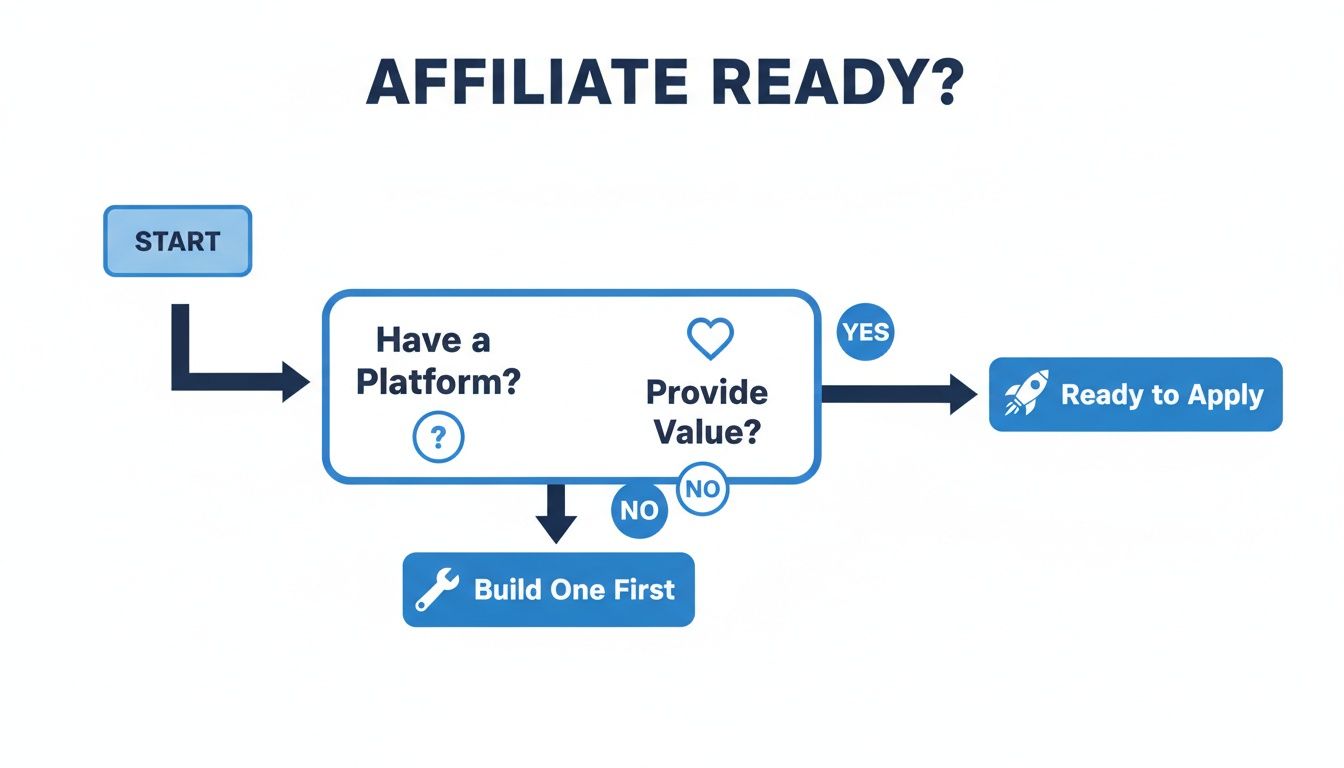
The key takeaway here? A platform that provides real value is the price of admission. Without it, you're just wasting your time applying.
Comparing Affiliate Program Sources
Deciding where to focus your search can be tough. Each source has its own quirks and benefits depending on your niche and experience level. This table breaks down the main differences to help you figure out where your time is best spent.
Ultimately, a mix-and-match approach often works best. Start with a large network to get your feet wet, but keep an eye out for promising in-house programs from brands you already love and use.Vetting Programs Beyond the Commission Rate
It's easy to get tunnel vision when you see a high commission rate. But a 30% commission is completely worthless if the product is junk or the program's terms are designed to make it impossible to get paid. A good vetting process is your best defense against partnering with the wrong brands.
As you start your research, you'll want to benchmark against the best. Take a look at some of the top high-paying affiliate programs to get a feel for what a great partnership looks like.
Here’s the checklist I run through for every single program I consider:
- Cookie Duration: How long does your referral link stay active after someone clicks it? A longer window—like 30, 60, or even 90 days—is always better. It gives your audience time to think before buying while making sure you still get credit for the sale. A 24-hour cookie is a major red flag.
- Commission Structure: Is it a one-time payment or a recurring commission? For any subscription product (like most SaaS tools), a recurring commission is the gold standard. Getting paid every single month that your referral remains a customer is how you build a stable, long-term income.
- Payout Threshold and Terms: What's the minimum you have to earn before they'll send you money? A high threshold of $100 or more can mean you're waiting months for your first check. Also, look at the payment schedule. "Net-30" or "net-60" tells you how long they hold your money after a sale is made.
- Brand Reputation and Product Quality: This is non-negotiable. Promoting a bad product will absolutely torch the trust you've built with your audience. Read reviews, see what people are saying on social media, and if you can, try the product for yourself. Remember, every affiliate link is an endorsement.
Pro Tip: Always look for programs that have a dedicated affiliate manager. Having a real human you can email with questions or for marketing materials is a massive advantage. It’s also a clear sign the brand actually cares about its partners.
Crafting an Application That Actually Gets Approved
Your affiliate application is your one shot to make a good first impression. An affiliate manager might spend less than a minute scanning it, and a handful of common mistakes will land you in the rejection pile instantly. This is where you go from being just another name in a list to a potential partner, so getting it right is crucial.
Think of it like applying for a job. You wouldn't send a resume with that "fun" email address you made in high school. The same rule applies here. Using a professional email tied to your domain (like sara@sustainabletravel.com) is a simple way to signal you're a serious business owner. It shows you've invested in your platform and you're not just a passing hobbyist.
Describing Your Promotional Methods Clearly
This is the make-or-break section of any application. When asked how you plan to promote the product, vague answers like "social media" or "on my blog" are immediate red flags. Affiliate managers have heard it a thousand times. They need specifics to understand your strategy and make sure it aligns with their brand.
Instead of being generic, show them you've done your homework:
- For SEO-Driven Bloggers: "My main promotional strategy is long-form, SEO-optimized content on [YourWebsite.com]. I plan to write a detailed product review, a comparison post against competitor X, and integrate your product into my 'Best Tools for Y' article, which already gets over 3,000 monthly visitors from Google."
- For Email Marketers: "I'll be promoting your software to my engaged email list of 15,000 subscribers, who are mostly small business owners. My plan is a dedicated email broadcast that dives into the key features, followed by a mention in my weekly newsletter’s popular 'Tools I Love' section."
- For Social Media Influencers: "I will create a series of three Instagram Reels showing how your product solves [specific problem]. I’ll also set up a dedicated Story Highlight and use a unique discount code in my link-in-bio to drive conversions from my 50,000 followers."
This level of detail proves you’ve actually put thought into a partnership and have a real plan. It removes the guesswork for the affiliate manager and builds instant confidence in what you can deliver.
Articulating Your Value and Alignment
Almost every application will ask, "Why do you want to join our program?" This is your chance to shine. It's not the time to talk about commission rates or how much money you hope to make. It's your opportunity to show you understand their brand and that your audience is a perfect match.
Key Insight: Frame your answer around mutual benefit. Affiliate managers are looking for partners who will represent their brand well and drive qualified sales. Show them you're aligned with their mission, not just focused on your commission.
A weak answer sounds something like this: "I want to join because your commission rate is good and I think my audience would like your products." It’s self-serving and shows you've done zero research.
A strong answer, on the other hand, connects your platform directly to their brand: "I've been using your project management tool for six months, and it has genuinely boosted my productivity. My audience of freelance creatives constantly struggles with organization, and I’m convinced your product is the best solution on the market. I'm excited to create a tutorial showing them exactly how I use it to manage client projects, which aligns perfectly with my blog's mission to help creatives streamline their workflows."
This response is a home run because it demonstrates:
- Authenticity: You're a real, happy user of the product.
- Audience Fit: You clearly define your audience and their specific pain points.
- Specific Plan: You outline the exact type of valuable content you intend to create.
- Shared Goals: You show that your goals (helping your audience) perfectly align with their goals (selling a solution).
When you craft an application that's thoughtful, detailed, and professional, you immediately move yourself to the top of the pile. You show you’re not just another person trying to join affiliate programs; you're a strategic partner ready to deliver real value.
Your First Steps After Getting Affiliate Approval
So, you’re in. That approval email is a great feeling, but the real work—and the fun—is just getting started. What you do in the first few hours after joining an affiliate program can make a huge difference in how quickly you start earning and how smooth the partnership will be.
Getting these initial steps right saves you from major headaches down the road. It ensures you get paid correctly, understand the rules, and can hit the ground running. Think of it as your post-approval orientation.
Get Acquainted With Your Affiliate Dashboard
First things first: log in and take a look around your new affiliate dashboard. Every platform is a little different, but they all share the same core components. Spend a good 15-20 minutes just clicking on every tab and menu item to get the lay of the land.
You’re hunting for three key areas:
- Your Unique Links: This is mission critical. Find out where and how to generate your affiliate tracking links.
- Marketing Assets: Most brands give you pre-made banners, logos, and swipe copy to make promotion easier.
- Reporting and Analytics: This is where you’ll live once you start promoting, tracking every click, conversion, and commission.
Don't be shy. Get comfortable with the interface now. The sooner you know where everything is, the faster you can work.
Key Takeaway: Your affiliate dashboard is your command center. Get comfortable with it right away. Find the link generator and the analytics section first—these are the two tools you’ll use every single day to manage and grow your income.
Generating and Managing Your Tracking Links
Your unique affiliate link is the piece of tech that guarantees you get credit for every customer you send their way. Generating it is usually simple. You'll likely find a default link to the brand's homepage and, more importantly, a tool for creating “deep links” to specific product pages.
For example, if you write a blog post about a specific feature, don't just send readers to the generic homepage. Link them directly to that product or feature page. This small step dramatically improves the user experience and can give your conversion rates a serious boost. Knowing how to track affiliate links properly is a core skill that separates the pros from the beginners.
Managing these links is just as crucial. As you join more programs, things get messy fast. I highly recommend using a link management tool to keep them organized. It makes inserting links into content a breeze and helps you track performance without losing your mind in a sea of URLs.
Locating and Using Marketing Assets
Most good brands want you to succeed, so they’ll provide a library of marketing materials, often called “creatives.” These are designed to help you promote their products effectively while keeping everything on-brand.
Look for a tab in your dashboard labeled “Creatives,” “Assets,” or “Marketing Materials.” Inside, you’ll typically find:
- Logos and Banners: Professionally designed graphics ready for your website or social media posts.
- Product Images: High-resolution photos you can use in your reviews and tutorials.
- Email Templates: Pre-written copy you can adapt for your own newsletters.
- Promotional Guidelines: The rulebook on how you can (and cannot) represent the brand.
Always, always read the guidelines. Some brands are very strict about using their name in paid ads or altering their logos. Following the rules is non-negotiable if you want to maintain a healthy, profitable partnership.
Setting Up Your Payment and Tax Information
This is the most important step if you actually want to get paid. Find the payment or account settings section and fill everything out immediately. If you put this off, you’re just creating delays in receiving your hard-earned cash.
You'll usually need to do three things:
- Connect a Payment Method: Most programs offer PayPal, Payoneer, or direct bank deposit (ACH). Pick whichever is easiest for you.
- Fill Out Tax Forms: If you’re in the US, this will almost certainly be a W-9 form. International affiliates will likely need to complete a W-8BEN form. It’s a standard procedure.
- Understand the Payout Schedule: Check the program’s terms and conditions to see when they pay out. Is it Net-30 (30 days after the end of the month)? Is there a minimum payout threshold you have to reach, like $50 or $100, before they send the money?
Smart Strategies for Promoting Affiliate Products
Getting approved for a program is just the first step. Now comes the real work: promoting your links in a way that actually earns you a commission.
The biggest mistake I see new affiliates make is treating their links like digital confetti—scattering them everywhere and just hoping something sticks. That’s a fast track to annoying the audience you’ve worked so hard to build.
Great affiliate marketing isn’t about becoming a pushy salesperson. It’s about being a trusted guide. Your audience has problems, and you have the opportunity to present a product as the perfect solution. The magic happens when you weave recommendations into content that’s already packed with value. When a product mention feels like a natural, helpful suggestion instead of a jarring ad, you've hit the sweet spot.
That mindset shift is what separates affiliates making pocket change from those building a real income.
Weave Links into Your Best Content
Your foundation is always high-quality content. People follow you for your expertise and your voice, not to be sold to. Your affiliate links should feel like a helpful extension of the value you’re already providing.
Here are a few battle-tested content formats that consistently convert:
- In-Depth Product Reviews: Go way beyond just listing features. Share your personal story with the product. What problem did it actually solve for you? Use your own photos and videos, and don't be afraid to mention any downsides. That honesty is what builds real trust.
- Detailed Comparison Posts: Your audience is almost certainly weighing their options. Do the heavy lifting for them with a direct, side-by-side comparison. A post titled "Product A vs. Product B: My Honest Breakdown" is a magnet for people who are on the verge of making a purchase.
- Actionable Tutorials and How-To Guides: Show, don't just tell. A guide on "How to Achieve X Using Product Y" is infinitely more powerful than a simple link to a product page. It proves the product's value in a real-world context.
Don’t forget to optimize this content for search engines. A well-crafted tutorial that ranks on Google for the right keywords can become a source of passive affiliate income for years. Mastering the fundamentals of SEO for affiliate marketing is a game-changer for long-term growth.
Adapt Your Strategy to Your Platform
The way you promote on a blog is completely different from how you'd do it on TikTok or YouTube. You have to tailor your approach to where your audience is and what they expect to see there.
For Bloggers and Content Writers Long-form content is your superpower. Embed your links contextually within your articles where they make the most sense. A link that flows naturally in a sentence will always outperform a generic "click here" button. It’s also a great idea to create a dedicated "Tools" or "Resources" page that lists all the products you genuinely use and recommend.
For Video Creators (YouTube, TikTok, Instagram) Video gives you the incredible advantage of demonstrating a product visually. You have a few key places to share your links:
- In the Video Description: This is the prime real estate. Make it a habit to verbally mention that the links are in the description.
- Pinned Comments: Pinning a comment with your link and a bit of context keeps it right at the top of the conversation.
- On-Screen Call-Outs: Simple text overlays or verbal cues pointing viewers to your links work wonders. For YouTubers, features like end screens and cards are also perfect for this.
Crucial Insight: No matter the platform, your recommendation must feel genuine. People can spot a forced endorsement from a mile away. Only promote products you have actually used and can confidently stand behind. That long-term trust is far more valuable than any short-term commission.
Protect Your Trust with Full Transparency
Trust is your single most valuable asset. Once it's gone, it's nearly impossible to win back. That’s why being completely transparent about your affiliate relationships isn't just good practice—it's a legal requirement.
The Federal Trade Commission (FTC) requires you to clearly disclose that you might earn a commission from your links. This isn't something you can hide in the footer. Your disclosure should be placed right near the affiliate link or at the very top of your content.
Here’s how to handle it correctly:
- Use Simple Language: A straightforward statement like, "Just so you know, this post contains affiliate links, and I may earn a small commission if you make a purchase," is perfect.
- Use Platform Tools: On social media, using hashtags like #ad or #sponsored is the standard and widely understood way to disclose a partnership.
- Be Proud of It: Don't try to be sneaky. People appreciate honesty, and being upfront about how you support your work can actually strengthen the bond with your audience.
At the end of the day, getting into an affiliate program is only half the battle. Real success comes from promoting products in a way that truly helps your audience and feels authentic to you and your brand.
Got Questions About Joining Affiliate Programs?
Jumping into the affiliate world feels like it comes with a million questions. From the sting of a rejected application to wondering if you can even start without a website, these are the hurdles pretty much everyone hits. Let’s clear up the most common questions new affiliates have right out of the gate.
Getting these answers straight will help you navigate your first steps with a lot more confidence.
Why Did My Affiliate Application Get Rejected?
It’s easy to get discouraged when an application gets denied, but don’t sweat it. Rejections are incredibly common and almost always fixable. They usually boil down to a few key issues you can sort out before applying again.
More often than not, the reason is a simple lack of high-quality, relevant content on your site or channel. Brands want to see that you’re already a trusted voice in their niche. If your blog only has a handful of posts or your YouTube channel looks like a ghost town, an affiliate manager will probably take a pass. They need to see a living, breathing community that trusts what you have to say.
Another huge red flag is an unprofessional-looking website. An application can get tossed in the trash instantly if your site is missing a few fundamental pages.
- No "About" Page: Brands want to know who they’re partnering with. It’s that simple.
- No Contact Information: This makes you look hard to reach and a little shady.
- No Privacy Policy: A missing privacy policy is a massive red flag that screams "amateur." It suggests you aren't running a serious operation.
Sometimes, it’s not you, it’s them. Your audience of budget backpackers just might not be the right fit for a luxury hotel chain, no matter how amazing your content is. And finally, remember that many top-tier programs have minimum traffic numbers. If you haven't hit their monthly visitor threshold, just focus on growing your audience and circle back when you do.
Expert Tip: Don't take a rejection personally. Seriously. Treat it like free feedback. Use the denial as a checklist to audit and beef up your platform, then give it another shot in a few months.
Can I Join Affiliate Programs Without a Website?
Yes, you absolutely can. It just calls for a slightly different playbook. While many old-school affiliate programs, especially those on the big networks, still want to see a website during the review, things are definitely changing. The real currency is an engaged community, no matter where it hangs out.
A growing number of programs are more than happy to partner with creators who live primarily on other platforms. If you have a dedicated YouTube following, a super-engaged Instagram or TikTok account, or a massive email list, you’re sitting on a goldmine that brands want access to. The trick is showing it off effectively in your application.
When you apply, get specific about where and how you’ll promote their stuff. Don’t just write "social media." Drop direct links to your profiles and channels. Make sure to highlight your key stats, like follower counts, average video views, or email open rates. This is the data that proves your influence and helps an affiliate manager see the value you bring to the table.
How Long Does It Take to Get Approved?
The approval time for affiliate programs is all over the map. The wait can be anything from a few minutes to several weeks, and it really just depends on the company and how they run their ship.
Some of the giants, like Amazon Associates, often use automated systems that can give you provisional or full approval almost instantly. This means you can be grabbing links and promoting within hours—sometimes minutes—of signing up.
Most programs that use a manual review process, however, will take a bit longer. For applications you send through major networks like ShareASale or CJ Affiliate, you can generally expect to hear back in a few business days.
In-house programs that brands manage themselves have the most unpredictable timelines. A small company with one busy affiliate manager might take a week or more to get through new applications. My advice? Be patient. But if you haven't heard a peep after two weeks, it's totally fine to send a polite, professional follow-up email to check on your status.
Ready to manage your affiliate partnerships without the hassle? LinkJolt provides a powerful, all-in-one platform to create, track, and scale your affiliate program effortlessly. With our intuitive dashboard and zero-fee payouts, you can focus on building relationships while we handle the rest. Discover how LinkJolt can simplify your affiliate management.
Watch Demo (2 min)


Trusted by 300+ SaaS companies
Start Your Affiliate Program Today
Get 30% off your first 3 months with code LINKJOLT30
✓ 3-day free trial
✓ Cancel anytime