Free Commission Tracking Software: 12 Best Options for 2026

Ollie Efez
January 08, 2026•20 min read•Updated Sep 14, 2026

The best free commission tracking software in 2026 depends on where you sell: GoAffPro and UpPromote offer the most generous free tiers for Shopify stores, FluentAffiliate and SliceWP lead the free WordPress plugins, and Shopify Collabs is free to install with no monthly fee at all. If you run a SaaS business on Stripe or Paddle, no genuinely free tool handles recurring commissions well, so your realistic options are a cheap paid plan starting around $19 to $20 per month or a 14-day trial of a SaaS-focused platform.
This guide reviews the top 12 free options available today. We move beyond generic feature lists to provide a practical analysis of each tool's core capabilities, critical limitations, and ideal use cases. You'll also learn about the hidden costs that "free" often carries: payout processing fees, performance fees on paid upgrades, and affiliate caps that quietly limit growth.
Further down, we compare the cheapest paid plans side by side, free vs cheap vs trial-only. If a free tier will not cut it for your business, or you expect to outgrow one within a few months, you can see exactly what the jump to paid commission tracking software costs in 2026.
1. GoAffPro
GoAffPro is a popular choice, especially for ecommerce businesses using Shopify, because it offers one of the most generous free commission tracking software plans available. The "Hobby" plan is genuinely free and surprisingly powerful, allowing for unlimited affiliates, sales, and revenue tracking without an initial investment. This makes it an ideal starting point for new businesses testing the waters with affiliate marketing.
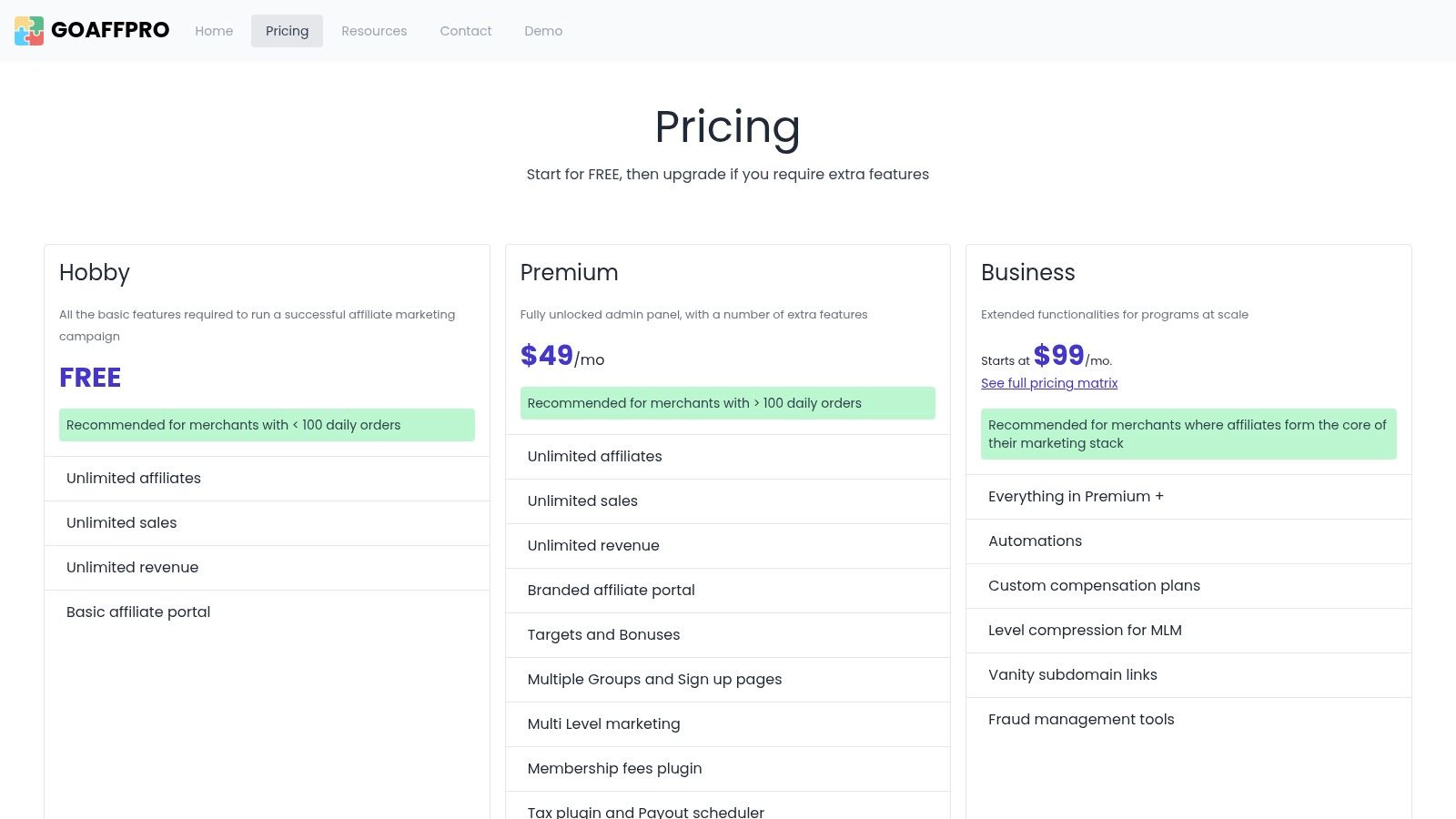
What sets GoAffPro apart is its balance between ease of use and feature depth on the free tier. You can quickly set up a branded affiliate portal, create commission rules, and even track sales originating from coupon codes. The platform’s seamless integration with Shopify means you can be up and running in minutes. This quick setup is a significant advantage if you're looking for a low-friction way to launch your program. For a detailed walkthrough, you can find helpful tips on how to start an affiliate program.
Key Features & Limitations
- Free Plan: The Hobby plan includes unlimited affiliates and revenue, a branded portal, and basic analytics.
- Ease of Use: The Shopify app installation is famously straightforward, making it accessible even for non-technical users.
- Payouts: Supports PayPal Payouts for easy commission distribution.
- Limitations: While the free plan is robust, more advanced features like multi-level marketing (MLM), custom commission structures, and automated fraud detection are reserved for its paid tiers. The interface can also feel a bit cluttered if your only goal is simple link tracking.
Website: https://goaffpro.com/pricing
2. UpPromote
UpPromote is another dominant player in the Shopify ecosystem, offering a feature-rich free commission tracking software plan that allows merchants to launch a full-fledged affiliate program. Its free plan supports up to 200 affiliates and includes unlimited referral orders, making it a great option for small businesses ready to scale their initial partner marketing efforts. The platform is known for its clean interface and straightforward setup process, which simplifies launching your program.

What makes UpPromote stand out is its emphasis on affiliate management and engagement, even on the free tier. You can create a branded affiliate portal, track performance with real-time analytics, and communicate with partners directly through the platform. This focus on relationship building from day one helps foster a loyal and effective affiliate base. It provides a solid foundation before you need to upgrade for more advanced features like post-purchase popups or multi-level marketing.
Key Features & Limitations
- Free Plan: The free plan allows up to 200 affiliates, unlimited referral orders, coupon and link tracking, and a customizable affiliate portal.
- Ease of Use: A guided setup and a well-organized dashboard make it simple for merchants to manage their programs without a steep learning curve.
- Payouts: Integrates with PayPal for easy commission payouts, with options for manual or scheduled payments.
- Limitations: The free plan lacks some of the more sophisticated tracking and fraud detection tools found in its paid tiers. Additionally, while the core tracking is free, moving to paid plans introduces a performance-based fee on successful referral sales, which is an important consideration for scaling businesses.
Website: https://uppromote.com/pricing/
3. BixGrow
BixGrow is another excellent choice for Shopify merchants, offering a lightweight and user-friendly approach to affiliate marketing. Its free "Starter" plan is designed for new programs, providing core functionalities without the complexity of more advanced systems. This makes it a great piece of free commission tracking software if your primary goal is to get a simple link and coupon code program running quickly.
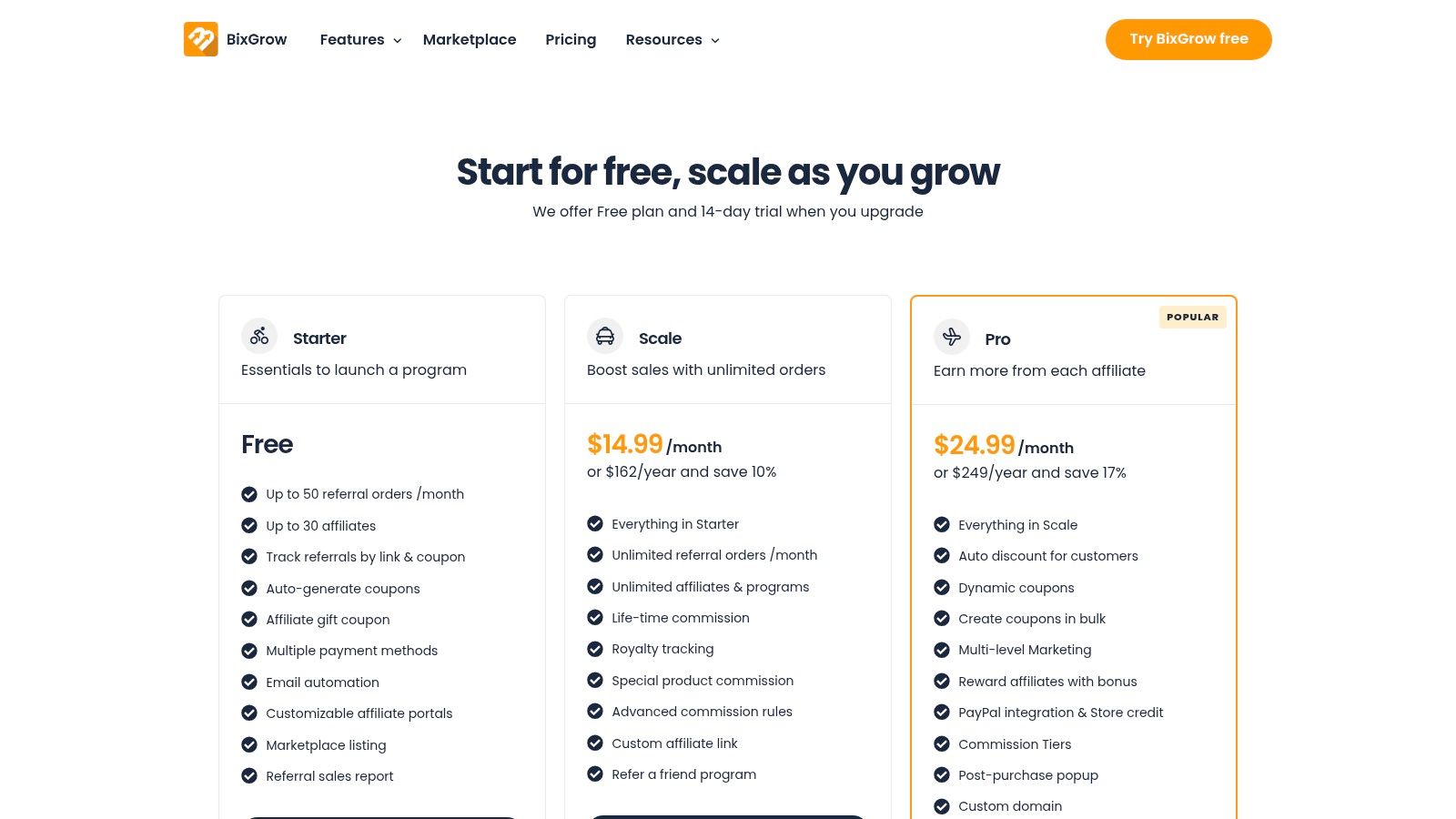
What makes BixGrow stand out for beginners is its focus on essential features that drive initial growth. The free plan includes not just link and coupon tracking but also email automations to keep your affiliates engaged. A unique offering is the ability to list your program on the BixGrow Marketplace, helping you attract new affiliates from day one. This proactive approach to affiliate discovery is a significant benefit for businesses just starting to build their network.
Key Features & Limitations
- Free Plan: The Starter plan supports up to 30 affiliates and 50 referral orders per month, which is generous for testing the waters.
- Core Functionality: Includes essential link and coupon code tracking, referral reporting, and email automations.
- Affiliate Discovery: Features a marketplace listing to help you recruit new partners, even on the free tier.
- Limitations: The free plan’s limits on affiliates and orders mean you will need to upgrade as your program grows. It is also heavily Shopify-centric, and more complex features like tiered commission structures are reserved for paid plans.
Website: https://bixgrow.com/pricing/
4. Shopify Collabs
For businesses built on Shopify, Shopify Collabs is the most deeply integrated free commission tracking software available. As a native Shopify app, it removes the friction of third-party tools by operating directly within your store’s ecosystem. It’s designed to help merchants connect with creators and influencers, offering a streamlined workflow from affiliate application to commission payout, all managed inside the familiar Shopify dashboard.
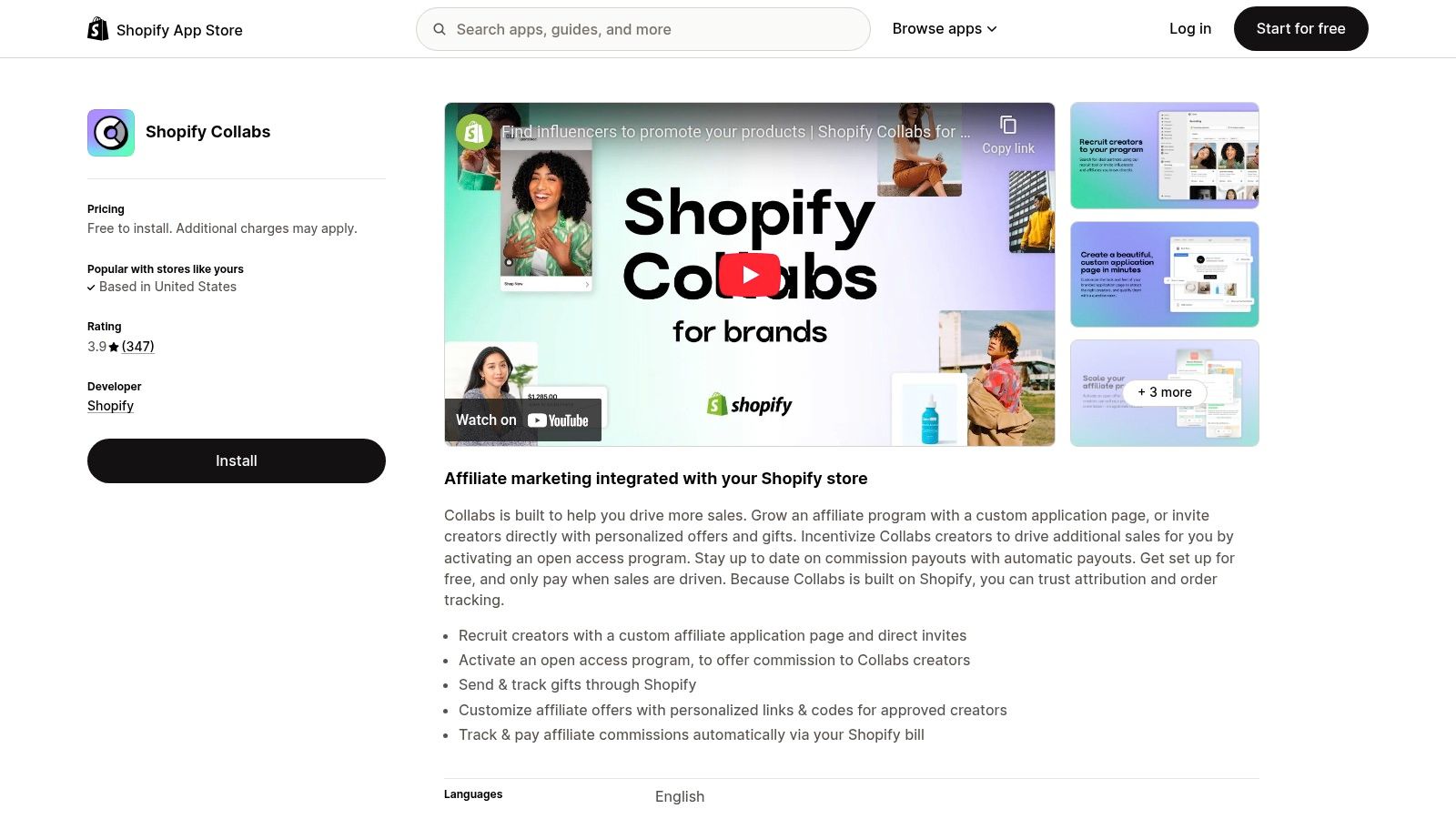
What makes Shopify Collabs stand out is its zero-cost entry point and effortless setup. You can create a branded affiliate application page, generate unique links and discount codes, and track performance without a monthly subscription. This approach is perfect for merchants who want to launch a basic affiliate program quickly. By leveraging affiliates, store owners can implement powerful strategies to increase Shopify sales without a significant upfront software investment.
Key Features & Limitations
- Free Plan: The app is free to install and use, with no monthly fees or limits on the number of affiliates you can partner with.
- Ease of Use: Being a native app, its interface is clean and familiar to anyone who uses Shopify, making it incredibly easy to manage.
- Payouts: Commissions are tracked automatically and can be paid out directly through your Shopify admin, simplifying the payment process.
- Limitations: The platform is exclusively for Shopify stores. It also charges a 2.9% processing fee on commission payments, which can add up over time. Advanced features like multi-level marketing or complex commission tiers are not available, keeping it best suited for straightforward affiliate programs.
Website: https://apps.shopify.com/collabs
5. WP Affiliate Manager
For businesses running on WordPress, WP Affiliate Manager offers a compelling proposition: a completely free, self-hosted commission tracking software solution. As an open-source plugin, it allows you to build an affiliate program directly within your WordPress dashboard, giving you full ownership and control over your data without recurring SaaS fees. It’s an excellent choice for those who prefer a one-time setup and want to avoid third-party platform dependency.
What makes WP Affiliate Manager stand out is its direct integration with popular WordPress ecommerce ecosystems like WooCommerce, Easy Digital Downloads, and Stripe. This allows for seamless referral tracking and automated commission calculation right out of the box. You get a functional affiliate portal, sign-up forms, and the core mechanics needed to run a program without ever leaving your site's backend. This self-contained approach is ideal for technically confident users who value customization and data privacy.
Key Features & Limitations
- Free Plan: The core plugin is 100% free and includes unlimited affiliates, referral tracking, real-time reporting, and integrations with major ecommerce plugins.
- Data Ownership: Since it's self-hosted on your WordPress site, you own all affiliate and sales data, which is a major plus for privacy and security.
- Customization: As a plugin, it offers greater flexibility for developers to customize and extend its functionality to fit specific needs.
- Limitations: The primary downside is the responsibility of self-hosting. You must manage updates, security, and potential performance impacts on your site. Premium support and advanced features, like tiered commission structures or affiliate recruitment tools, require purchasing paid add-ons.
Website: https://wpaffiliatemanager.com/
6. FluentAffiliate
For WordPress users, FluentAffiliate stands out as a modern and powerful plugin offering a highly capable free commission tracking software solution. Its core plugin is completely free and allows you to run a full-fledged affiliate program with unlimited affiliates, links, and commissions right from your WordPress dashboard. This makes it a fantastic choice for businesses built on WordPress, especially those using WooCommerce or membership platforms like MemberPress.
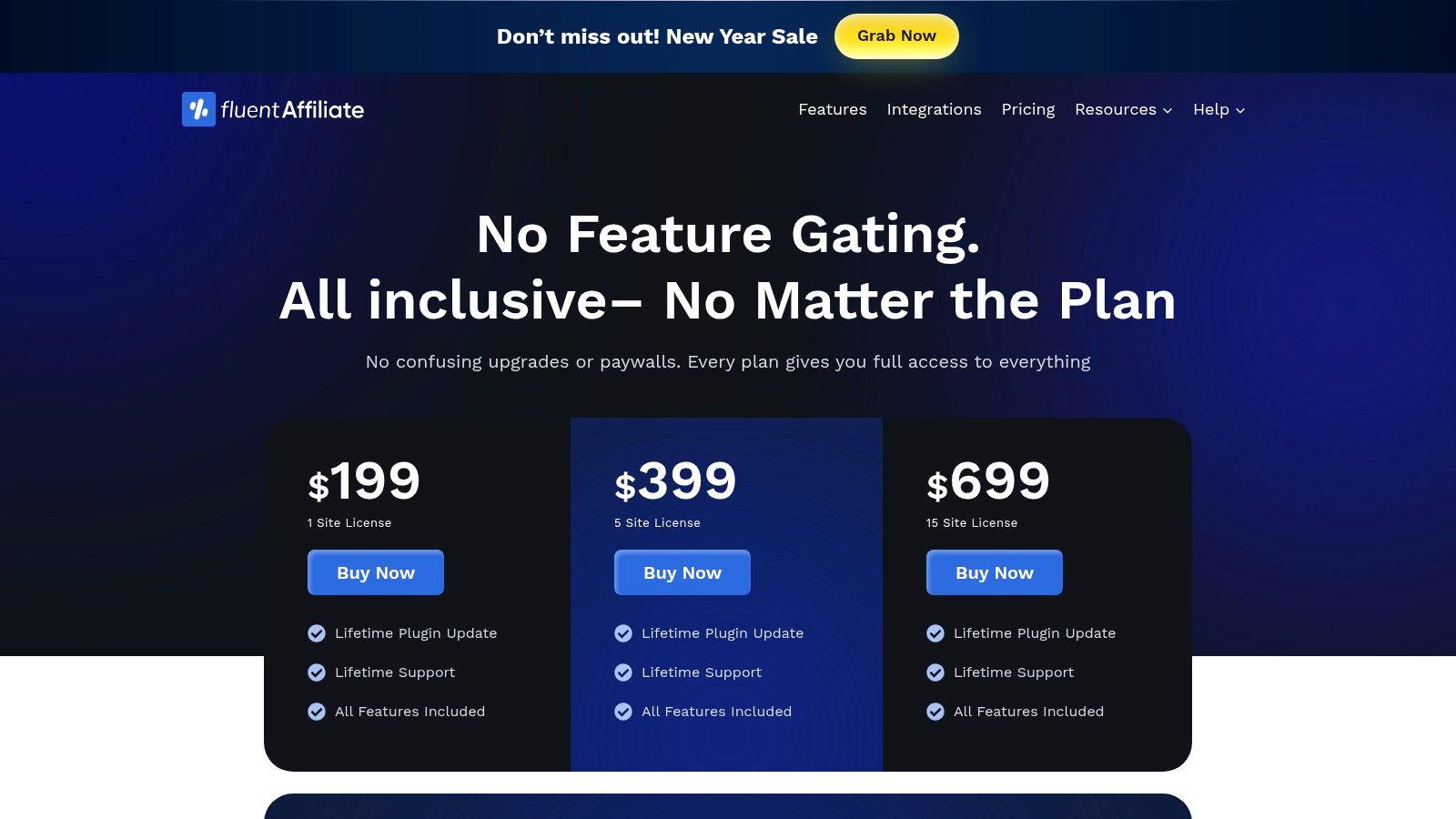
What makes FluentAffiliate unique is its combination of a clean, modern user interface and deep integration with the WordPress ecosystem. The free version provides a dedicated affiliate dashboard, real-time reporting, and automatic commission tracking for popular e-commerce plugins. Unlike many plugins that feel outdated, FluentAffiliate is actively developed and provides a smooth experience for both you and your affiliates. Its premium version also offers an attractive one-time lifetime license, a rare find in the SaaS-dominated market.
Key Features & Limitations
- Free Plan: The core plugin is genuinely free and includes unlimited affiliates, links, commissions, and a dedicated affiliate dashboard.
- WordPress Integration: Offers seamless, out-of-the-box integration with WooCommerce, Easy Digital Downloads, MemberPress, and more.
- User Experience: Boasts a clean, intuitive interface that is easy to navigate and manage.
- Limitations: As a self-hosted plugin, you are responsible for security, updates, and ensuring your server can handle the load. Advanced features like tiered commissions, affiliate grouping, and dedicated support require upgrading to a paid license.
Website: https://fluentaffiliate.com/pricing/
7. SliceWP
SliceWP is a powerful WordPress-native solution for businesses wanting to add an affiliate program directly into their existing site. Its freemium model provides a free core plugin that handles all the essentials, making it a risk-free way to test and validate an affiliate marketing channel. This approach is perfect for WordPress users who prefer to keep their tools within one ecosystem rather than relying on third-party platforms.
What makes SliceWP a great choice is its simplicity and tight integration with popular WordPress e-commerce plugins like WooCommerce, Easy Digital Downloads, and MemberPress. The setup is straightforward, and the interface is clean and intuitive, avoiding the feature bloat common in other systems. Affiliates get their own dashboard within your site to track performance and generate links, creating a seamless brand experience. This makes it an excellent piece of free commission tracking software for those deeply invested in the WordPress platform.
Key Features & Limitations
- Free Plan: The core plugin offers unlimited affiliates, real-time reporting, automatic affiliate registration, and customizable commission rates.
- WordPress Native: Everything is managed within your WordPress dashboard, simplifying workflow and eliminating the need to sync data with external services.
- Integrations: The free version integrates well with major WordPress commerce solutions right out of the box.
- Limitations: The free version is quite basic. Advanced features such as custom affiliate fields, recurring commissions, and affiliate leaderboards are locked behind paid add-ons. It is also a self-hosted solution, meaning you are responsible for maintenance and security, and it only works with WordPress sites.
Website: https://slicewp.com/free/
8. FirstPromoter
FirstPromoter is a powerful choice for SaaS and subscription-based businesses, offering deep integrations that automate recurring commission tracking. While it doesn't have a permanently free plan, its 14-day free trial (no credit card required) provides a complete look into its capabilities, making it a valuable tool for evaluation. This platform is specifically designed to handle the complexities of recurring revenue, a feature often missing in more generic affiliate software.
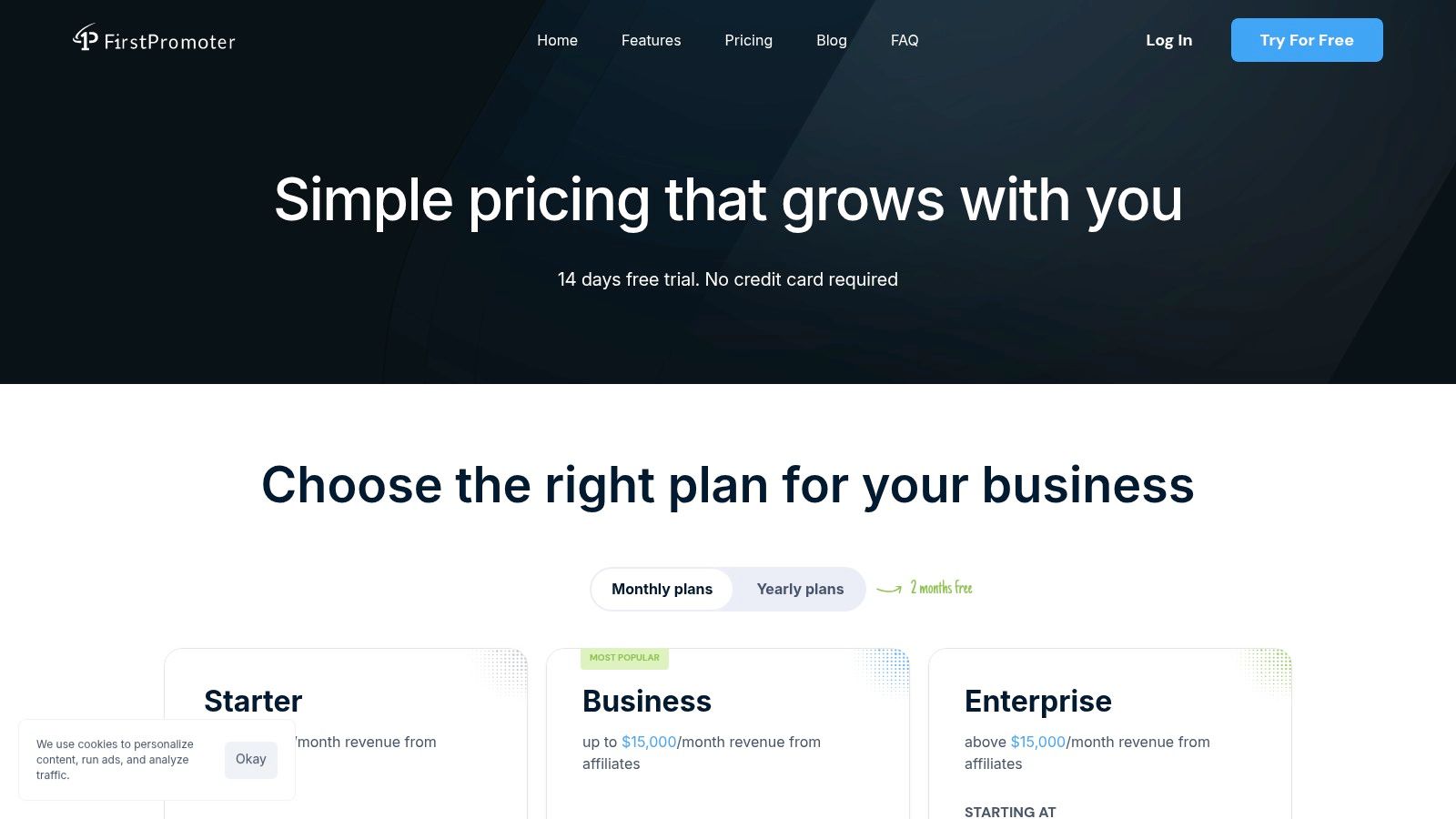
What makes FirstPromoter a standout option is its seamless connection with payment processors like Stripe, Paddle, and Braintree. This allows for automatic tracking of subscriptions, upgrades, downgrades, and cancellations, ensuring affiliates are paid accurately for the lifetime of a customer. The platform also provides a clean, branded affiliate dashboard that you can host on a custom domain, giving your partners a professional and cohesive experience from the start.
Key Features & Limitations
- Free Plan: Offers a 14-day full-featured free trial to test all functionalities.
- SaaS-Focused: Built-in support for recurring and lifetime commissions, which is essential for subscription models.
- Payouts: Simplifies mass payouts with PayPal and Wise integrations, and includes features for collecting W-9/W-8BEN tax forms.
- Limitations: The primary drawback is the lack of a permanent free plan, making it a "try before you buy" option rather than a long-term free commission tracking software solution. Paid plans start at $49 per month for the Starter tier, which caps affiliate-driven revenue at $5,000 per month, so pricing steps up as your program scales.
Website: https://firstpromoter.com/pricing
9. Rewardful
Rewardful is a top-tier commission tracking software built specifically for SaaS companies that use Stripe or Paddle. While it doesn't offer a permanently free plan, its 14-day free trial provides full access to its powerful features, making it an excellent choice for businesses ready to launch a serious, scalable affiliate or referral program. Its core strength lies in its deep, one-click integration with payment processors, which automates nearly the entire tracking and payout process for subscription-based revenue.
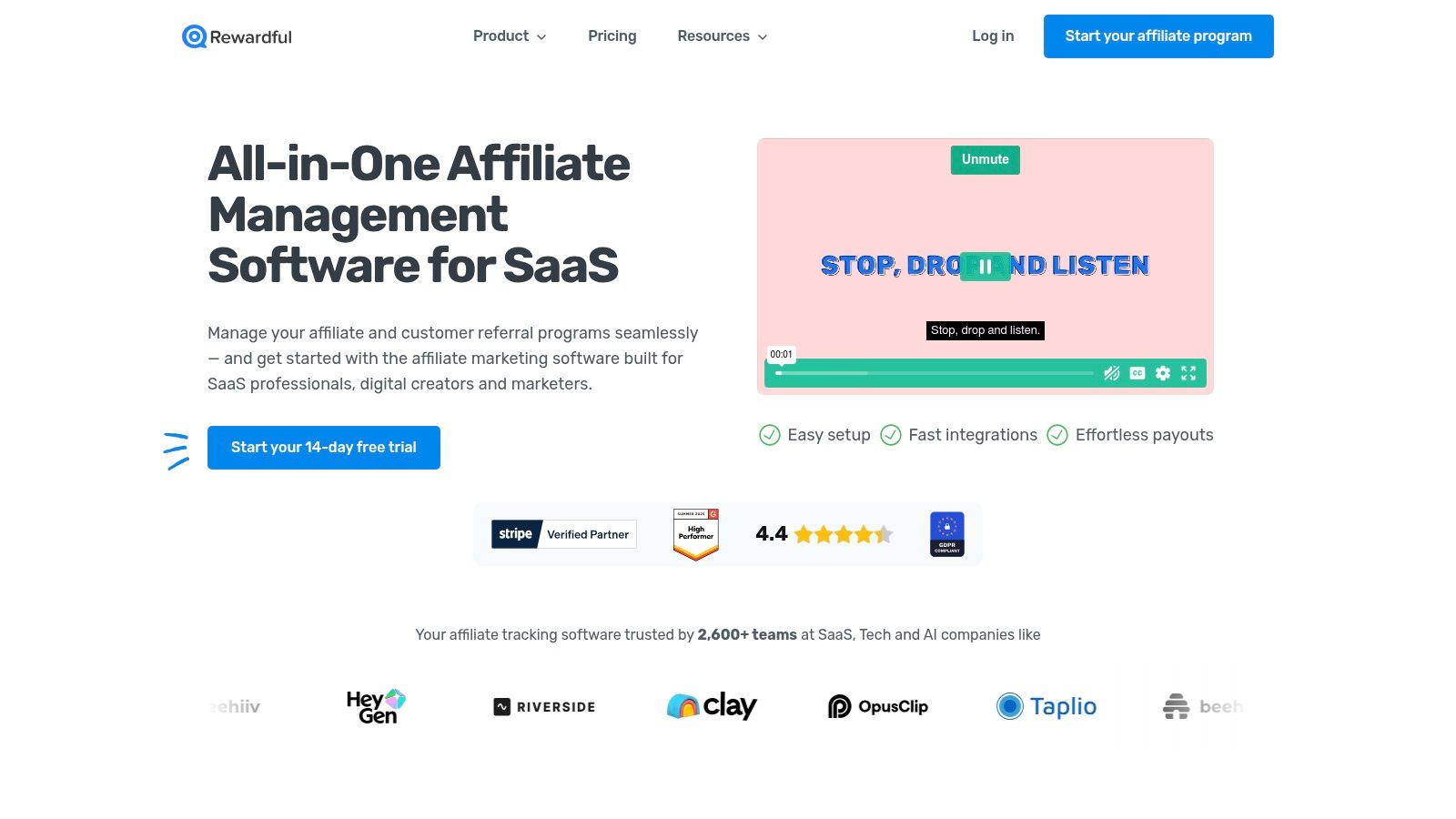
What makes Rewardful stand out is its simplicity and focus. Instead of trying to be a one-size-fits-all solution, it excels at serving the SaaS niche. You can set up recurring, tiered, or custom commission logic that aligns perfectly with subscription models. The platform also offers a clean, branded affiliate portal and automated payouts via PayPal and Wise, reducing manual administrative work. For a deeper look at how it stacks up against the wider market, see our guide to the best affiliate marketing platforms.
Key Features & Limitations
- Free Plan: Offers a 14-day free trial with all features, but no perpetual free tier.
- Ease of Use: Famous for its incredibly fast setup with Stripe and Paddle, often taking just a few minutes.
- Payouts: Automates commission payments through integrations with PayPal and Wise.
- Limitations: The primary drawback is its lack of a permanent free plan; paid plans start at $49 per month with a $7,500 monthly cap on affiliate-generated revenue on the Starter tier. Its specialized focus also means it has limited native integrations with e-commerce platforms like Shopify, making it less suitable for businesses outside the SaaS and subscription space.
Website: https://www.rewardful.com/
10. Tapfiliate
While not a perpetually free commission tracking software, Tapfiliate earns its spot by offering a comprehensive 14-day free trial that unlocks its entire professional feature set. This makes it an excellent choice for established businesses that want to rigorously test a powerful platform before committing. It's a mature SaaS solution known for its stability, real-time reporting, and extensive integration library, which includes Shopify, WooCommerce, Stripe, and over 30 other platforms.
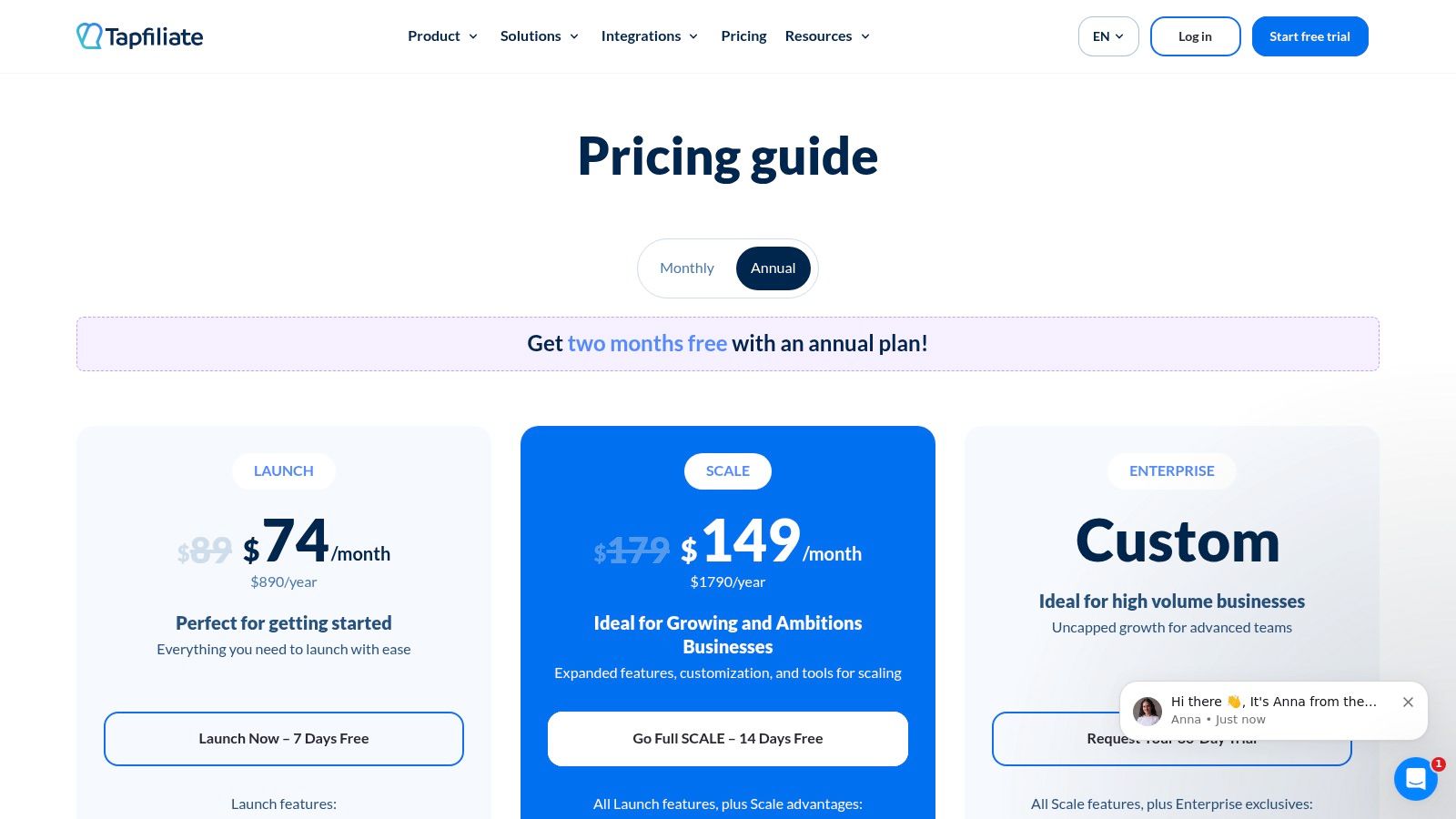
Tapfiliate's strength lies in its scalability and robust automation capabilities. During the trial, you can set up recurring commissions for subscription products, create performance-based bonuses, and manage affiliates in bulk, features often missing from permanently free plans. This trial period allows you to experience an enterprise-grade system without any initial cost, giving you a clear picture of what a premium tool can do for your affiliate program. You can explore how it compares to other leading solutions by reading more about the best affiliate tracking software.
Key Features & Limitations
- Free Plan: Offers a 14-day full-featured free trial, not a permanent free plan.
- Integrations: Connects seamlessly with 30+ ecommerce, payment, and marketing platforms.
- Advanced Features: Provides access to recurring commissions, performance bonuses, and custom affiliate onboarding fields during the trial.
- Limitations: The primary limitation is the lack of a free-forever tier. Once the trial ends, you must upgrade to a paid plan starting at $89 per month, with overage fees for clicks and conversions beyond your plan's allowance, making it one of the pricier entry points on this list.
Website: https://tapfiliate.com/pricing/
11. Refersion
Refersion is a heavyweight in the ecommerce affiliate marketing world, especially for businesses on platforms like Shopify, BigCommerce, and Magento. While it doesn't offer a permanently free plan, it earns its spot on this list because its 14-day free trial, accessible via the Shopify app store, provides a comprehensive look into what a premium, enterprise-ready commission tracking software can do. This makes it an excellent choice for established stores planning to scale their affiliate program and wanting to test-drive a powerful solution before committing.
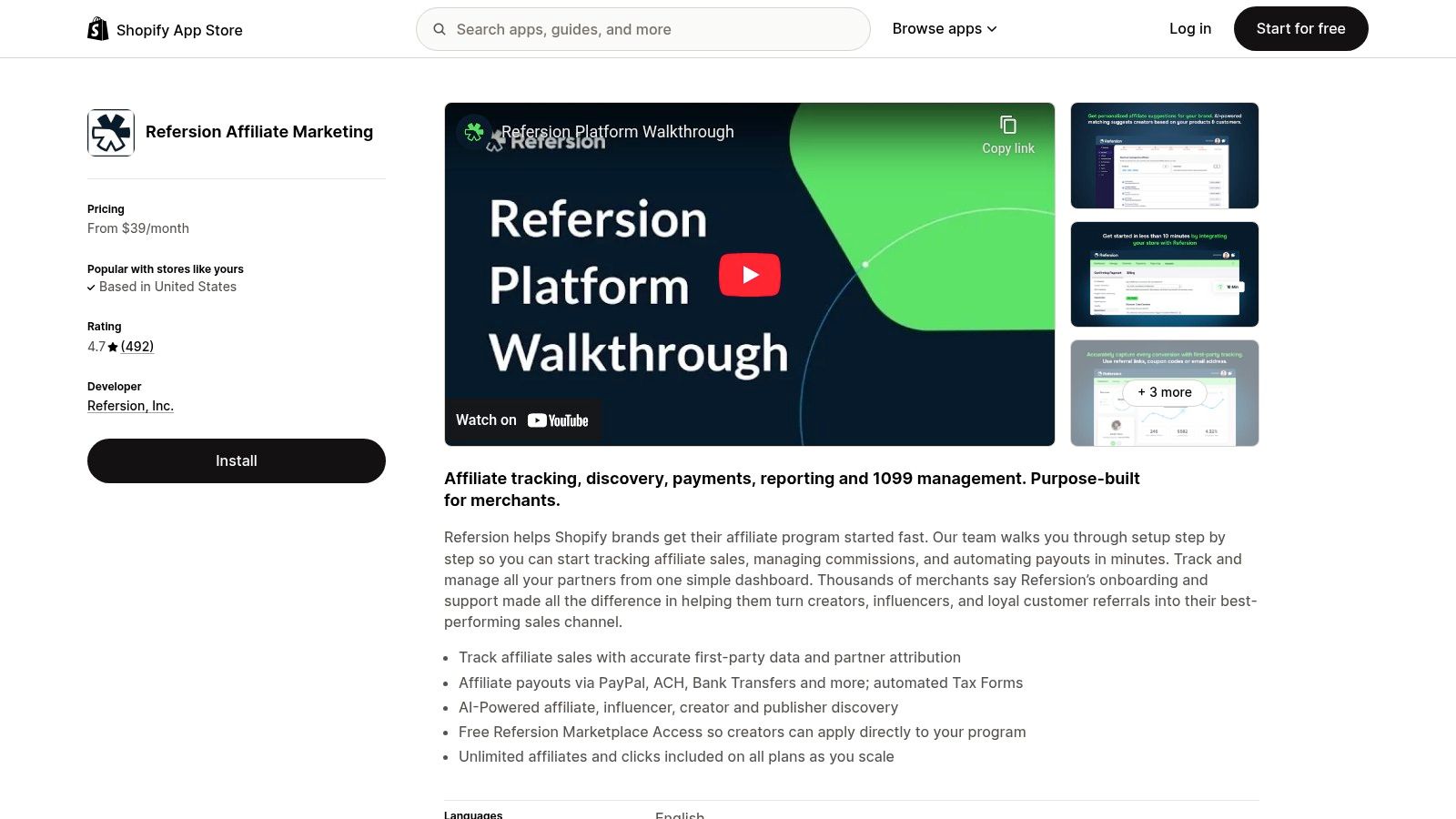
What distinguishes Refersion is its robust feature set and the Refersion Marketplace, which helps you discover and recruit new affiliates. The platform offers deep tracking capabilities, including SKU-level commissions, allowing you to set different rates for specific products. This flexibility is invaluable for brands with varied profit margins across their product lines. The one-click PayPal Payouts and multi-currency support also streamline the otherwise tedious process of paying global partners.
Key Features & Limitations
- Free Plan: No permanent free plan; a 14-day free trial is available through the Shopify App Store to test all features.
- Affiliate Discovery: The Refersion Marketplace provides a built-in network to find and recruit new partners.
- Flexible Commissions: Offers various commission structures, including flat-rate, percentage-based, and even SKU-specific rates.
- Limitations: The primary limitation is the lack of a forever-free tier. Once the trial ends, you must upgrade to a paid plan, which can be a significant investment. Some plans also include transaction fees on top of the monthly subscription, which can add up for high-volume stores.
Website: https://apps.shopify.com/refersion
12. Post Affiliate Pro
Post Affiliate Pro is a powerhouse in the affiliate software space, known for its extensive feature set and customization capabilities. While it doesn't offer a permanently free plan, its 14-day free trial provides full access to its robust tools, making it an excellent choice for businesses that anticipate needing advanced features and want to thoroughly test a platform before committing. This makes it a strong contender if you're looking for free commission tracking software to evaluate complex program needs.
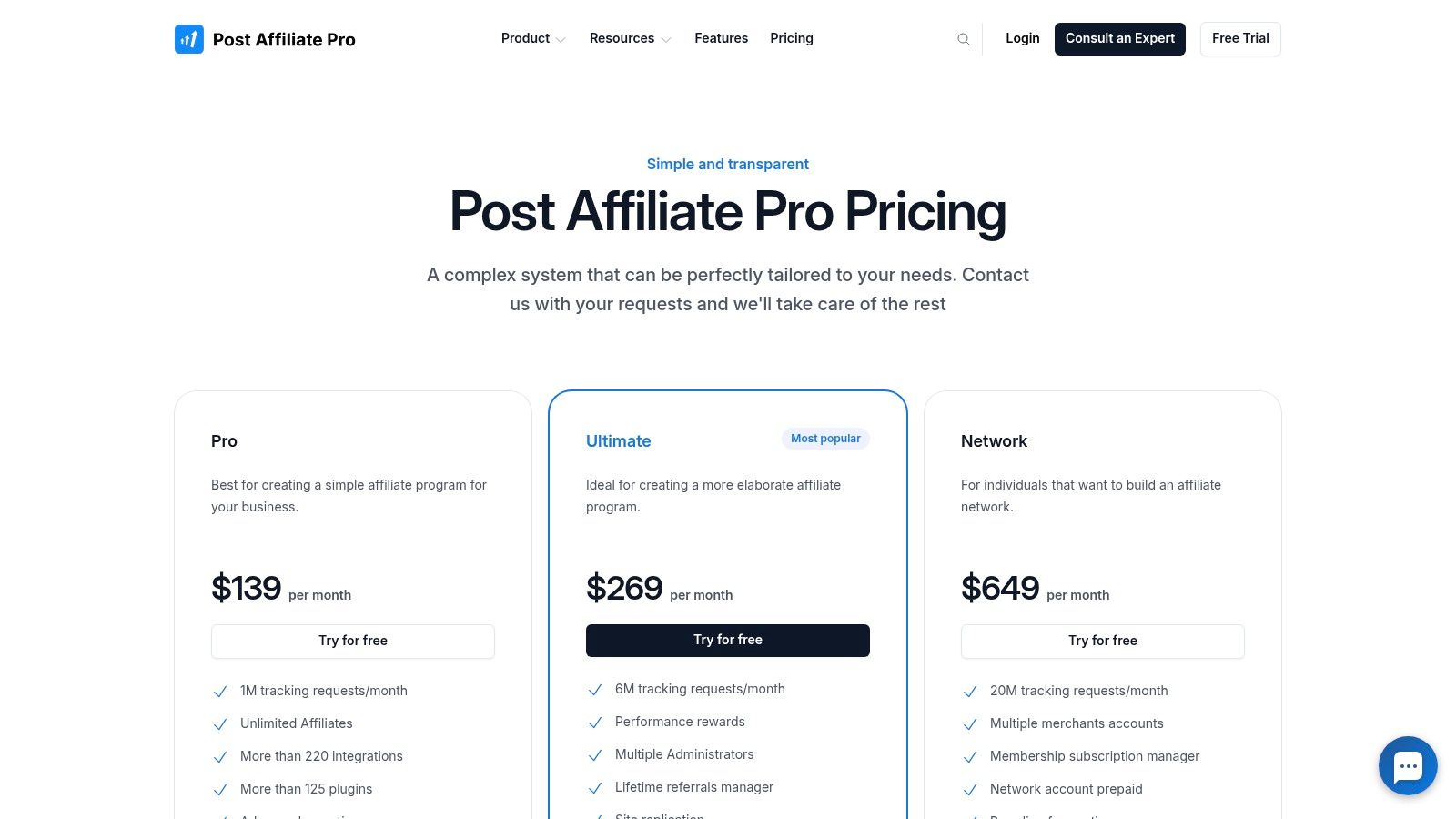
What makes Post Affiliate Pro stand out is its sheer depth. With over 220 integrations and 125 plugins, it can connect to virtually any CMS, payment gateway, or marketing tool you use. The trial period allows you to explore advanced commission structures, such as performance-based bonuses, split commissions, and lifetime referrals. This is ideal for established businesses or networks planning sophisticated, multi-layered affiliate programs that simple free tools cannot support.
Key Features & Limitations
- Free Plan: Offers a full-featured 14-day free trial, not a permanent free tier. This includes unlimited affiliates and advanced tracking.
- Customization: Provides highly customizable affiliate portals, commission rules, and reporting dashboards to match your brand and program logic.
- Integrations: Its vast library of integrations makes it one of the most versatile platforms for complex tech stacks.
- Limitations: The primary limitation is the lack of a permanent free plan. The platform's extensive features can also present a steep learning curve and may be overkill for startups or small businesses with basic tracking needs.
Website: https://www.postaffiliatepro.com/pricing/
Top 12 Free Commission Tracking Tools Comparison
Free vs Cheap vs Trial: What Commission Tracking Software Really Costs in 2026
Not every "free" tool is free forever, and not every paid tool is expensive. Commission tracking software falls into three buckets:
- Free forever: GoAffPro (Hobby), UpPromote (free plan), BixGrow (Starter), Shopify Collabs, WP Affiliate Manager, FluentAffiliate, and SliceWP all offer perpetual free tiers. Almost all are tied to Shopify or WordPress, and the limits usually bite on payouts, fraud checks, or affiliate caps.
- Cheap paid plans: if you need recurring commissions, webhook-based tracking, or payment-processor integrations, entry pricing starts lower than most founders expect.
- Trial only: FirstPromoter, Rewardful, Tapfiliate, Refersion, and Post Affiliate Pro have no free tier at all, just 14-day trials.
Here is what the cheapest paid plan on each major platform costs, checked against each vendor's live pricing page in August 2026:
To be transparent about our own product: LinkJolt is paid software, not free. There is no free tier, just a 7-day trial with a card required. What $19.99 per month buys is 0% transaction fees on affiliate sales, webhook-based tracking for Stripe, Paddle, Polar, Lemon Squeezy, Gumroad, and Apple in-app purchases, and automated affiliate payouts through Stripe Connect. You can compare LinkJolt against these platforms plan by plan.What about actually paying commissions?
Tracking a commission and paying it out are two different jobs, and payouts are where many free and cheap tools get expensive:
- Shopify Collabs charges a 2.9% processing fee on commission payments.
- Rewardful's optional Managed Payouts service charges 3% and takes custody of the funds: you transfer money to Rewardful, and your affiliates withdraw from there.
- Tolt's automated payouts use an invoice model where Tolt collects your money and pays affiliates from its own accounts, with an $8 flat ACH fee or 4% by card per payout invoice.
- Affonso's managed payouts add a 2.8% to 3.25% surcharge plus $25 per month.
- LinkJolt automates payouts through Stripe Connect on a daily cycle, and money never sits with LinkJolt: funds move from the merchant to the affiliate. For affiliates outside supported Stripe Connect regions, a CSV export covers PayPal and Wise payouts.
If your program pays out more than a few hundred dollars a month, run the payout fees before comparing subscription prices. A 3% to 4% payout surcharge on a growing program quickly outgrows the difference between a $19 and a $49 plan.
Graduating from 'Free': When to Upgrade to a Dedicated SaaS Platform
We've explored an extensive lineup of powerful free commission tracking software, from Shopify-centric apps like GoAffPro and UpPromote to flexible WordPress plugins such as FluentAffiliate and SliceWP. Each tool offers a fantastic, risk-free entry point into the world of affiliate marketing. They allow you to test the waters, validate your partner program, and build initial momentum without a significant financial investment.
For many startups and content creators, a free plan provides everything needed to manage a handful of affiliates and track basic conversions. You can set up simple campaigns, generate referral links, and get a clear picture of which partners are driving results. This initial phase is crucial; it’s where you learn what works for your brand and begin building valuable relationships.
However, growth introduces complexity. As your affiliate program matures from a side project into a core revenue channel, the very limitations that make free tools accessible can become significant operational roadblocks.
The Tipping Point: Recognizing the Signs You've Outgrown Free
How do you know when it's time to make the leap? The answer lies in the friction you start to feel in your daily operations. Watch for these tell-tale signs that your current free setup is holding you back.
- Manual Payouts Are Consuming Your Week: If you spend hours each month manually calculating, verifying, and processing payouts via PayPal or bank transfers, you've hit a major scaling bottleneck. This time could be better spent on recruiting new partners or optimizing your program.
- Affiliate Caps Are Stifling Growth: Many free plans limit the number of affiliates you can onboard. When you have to turn away promising new partners or hesitate to expand your recruitment efforts because of a software cap, you are actively leaving money on the table.
- Lack of Fraud Protection Creates Risk: As your program gains visibility, it becomes a target for referral fraud. Basic tracking on free tiers often lacks sophisticated fraud detection, leaving you vulnerable to paying out commissions on illegitimate sales or self-referrals. This erodes your margins and program integrity.
- Your Data Needs Are More Sophisticated: You've moved beyond simple click-and-conversion tracking. Now you need deeper insights: lifetime value of customers from a specific affiliate, cohort analysis, and detailed performance breakdowns. Free tools typically offer only surface-level analytics. At that stage it helps to check your program against real SaaS affiliate benchmarks instead of guessing what healthy looks like.
- The Affiliate Experience Feels Unprofessional: Your partners are a critical extension of your marketing team. A clunky, unbranded, or generic affiliate portal reflects poorly on your company. A professional, intuitive dashboard is essential for partner retention and engagement.
Making the Strategic Upgrade: What to Look for Next
Moving from free commission tracking software to a paid platform isn't just an expense; it's a strategic investment in automation, security, and scalability. When you're ready to upgrade, your focus should shift from "what's free" to "what drives ROI."
Look for a dedicated SaaS solution built for your business model. For a SaaS company, this means native support for recurring revenue from payment processors like Stripe and Paddle. It means automated, consolidated payouts that save you hours of administrative work. And it means advanced features like affiliate marketplaces for recruitment and robust analytics to guide your strategy.
While starting with a free tool is a smart and resourceful first step, the ultimate goal is to build a program that can scale seamlessly with your success. Don't wait until the operational cracks become chasms. By recognizing the signs and planning your upgrade, you ensure your affiliate channel remains a powerful, efficient, and profitable engine for growth.
Ready to move beyond the limitations of free tools and build a scalable, professional affiliate program? LinkJolt is built for SaaS companies ready to grow, with zero transaction fees, rule-based fraud detection, and native Stripe, Paddle and Polar integration. Plans start at $19.99 per month with a 7-day trial. See how you can automate and scale your partner program by exploring LinkJolt today.
When free tracking tools start to creak, the next bottleneck is paying affiliates reliably. LinkJolt automates affiliate commission payouts via Stripe Connect with 0% commission fees on conversions, plus CSV export for PayPal and Wise. See how affiliate payments work on LinkJolt.
Watch Demo (2 min)


Trusted by 300+ SaaS companies
Start Your Affiliate Program Today
Get 30% off your first 3 months with code LINKJOLT30
✓ 7-day free trial
✓ Cancel anytime
Frequently Asked Questions
What is the best free commission tracking software in 2026?
GoAffPro and UpPromote have the most generous free tiers for Shopify stores, FluentAffiliate and SliceWP are the strongest free WordPress plugins, and Shopify Collabs is free to install with no monthly fee. For SaaS businesses on Stripe or Paddle, no genuinely free tool handles recurring commissions well, so a cheap paid plan or a 14-day trial of a SaaS-focused platform is usually the better route.
What are the limitations of free commission tracking software?
Most free tiers hold back advanced features like multi-level commission structures, fraud detection, and custom commission rules for paid plans. Watch for payout costs too: Shopify Collabs charges a 2.9% processing fee on commission payments, and several platforms add performance fees once you upgrade. Affiliate caps and order limits are the other common ceiling, so review the fine print before building your program on a free plan.
What is the cheapest paid affiliate tracking software?
Affonso starts at $19 per month with a $1,000 monthly cap on affiliate revenue, and LinkJolt starts at $19.99 per month with a $5,000 monthly tracked-sales allowance and 0% transaction fees. Rewardful and FirstPromoter both start at $49 per month, Tolt at $69, and Tapfiliate at $89. The cheapest option for you depends on the volume cap: a low base price with a tight cap can cost more than a higher tier once your program grows.
Does LinkJolt have a free plan?
No. LinkJolt is paid software starting at $19.99 per month, with a 7-day trial that requires a card. There is no free tier. In exchange, every plan includes 0% transaction fees on affiliate sales, webhook-based tracking for Stripe, Paddle, Polar, Lemon Squeezy, Gumroad, and Apple in-app purchases, and automated affiliate payouts through Stripe Connect.
How do affiliates get paid with commission tracking software?
Free Shopify apps like GoAffPro and UpPromote typically pay affiliates through PayPal. Some paid platforms run custodial payout services: Rewardful's Managed Payouts charges 3% and holds the funds until affiliates withdraw, and Tolt collects your money and pays affiliates from its own accounts. LinkJolt automates payouts through Stripe Connect without holding funds, plus a CSV export for PayPal and Wise payouts.
When should you upgrade from free commission tracking software?
Upgrade when manual payouts start consuming hours each month, when affiliate caps force you to turn away partners, when you need recurring commissions for subscription revenue, or when fraud protection becomes a real concern. At that point a paid plan in the $19 to $49 per month range usually pays for itself in saved admin time alone.