Building a Referral Program: A Practical Guide to Rapid SaaS Growth
Building a Referral Program: A Practical Guide to Rapid SaaS Growth

Ollie Efez
December 16, 2025•20 min read
Building a referral program is all about turning your happiest customers into your most powerful, trusted sales force. It’s about creating a simple, structured system that incentivizes existing users to share your SaaS product with their network, driving a steady stream of high-quality leads and sustainable growth.
Why a Referral Program Is Your Next Growth Engine

Before we get into the nuts and bolts, let’s talk about why this matters. A referral program isn't just another box to check on your marketing to-do list; it’s a fundamental shift in how you find new customers. Instead of shouting into the void with paid ads, you're tapping into the single most powerful marketing channel out there: word-of-mouth.
Think about it. When a friend or colleague recommends a tool they actually use, that endorsement cuts right through the marketing noise. It comes with built-in trust and context, making it far more persuasive than any ad copy you could ever write. This is the simple, powerful idea behind building a referral program for your SaaS.
The Power of Trusted Recommendations
In a crowded market, trust is everything. A recommendation from a peer is often the final nudge a potential customer needs to hit "sign up." This isn't just a hunch; the data is crystal clear. Referred customers are more loyal, they stick around longer, and they typically have a much higher lifetime value (LTV).
The global referral marketing market is on track to hit USD 7.24 billion by 2031, growing at a blistering 19.5% compound annual growth rate. This explosion is fueled by real-world results—referred customers have a 37% higher retention rate and are 27% less likely to churn. If you want to dig deeper, you can explore more referral marketing statistics to see the full picture.
A referral program transforms customer satisfaction from a happy accident into a predictable, scalable acquisition channel. It’s not about hoping for referrals; it’s about systematically creating them.
This process builds a powerful, self-sustaining growth loop. Your best customers—the ones who genuinely get your product's value—bring in more high-quality users who are just like them. This cycle continuously drives down your customer acquisition cost (CAC) while simultaneously improving the overall quality of your user base.
Tangible Benefits for Your SaaS
Let’s quickly break down how a referral program directly impacts your key business metrics. A well-designed program delivers far more than just new sign-ups.
Here's a quick look at the core benefits you can expect.
Core Benefits of a SaaS Referral Program
As you can see, the data paints a clear picture: referrals are a powerhouse for growth.For a SaaS company like LinkJolt, this isn't just a marketing tactic—it's an essential part of building a community around your product. You're not just selling software; you're empowering your users to share something they love and rewarding them for it. This guide will walk you through exactly how to set that process up.
Laying the Groundwork for Referral Success

A powerful referral program doesn’t just appear out of thin air. It’s built on a solid strategic blueprint, and skipping this step is like building a house with no foundation. Too many teams jump straight to brainstorming rewards or designing landing pages, but that's putting the cart way before the horse.
Before you touch a single line of code or pick a reward, you need to define exactly what success looks like for your SaaS.
The first move is to set clear, practical goals. What's the primary mission here? Are you chasing sheer user volume to grab market share as quickly as possible? Or is your focus on attracting higher-quality leads who are more likely to upgrade to your premium plans? Your main objective will dictate every other decision you make down the line.
For example, a new project management tool might need to prioritize rapid user acquisition. A concrete goal for them could be acquiring 1,000 new users via referrals in the first quarter. On the other hand, an established enterprise analytics platform will care more about lead quality. Their goal might be to secure 50 qualified enterprise demos from referrals in that same timeframe. Get specific, and make it measurable.
Pinpointing Your Ideal Advocate
Once your goals are locked in, it's time to figure out who you're building this for. Not every customer is a natural-born advocate. You're looking for the true champions—the users who not only love your product but are also in a position to share it with the right people.
Start by digging into your own customer data. You're searching for patterns among your most engaged and loyal users.
- High Engagement Metrics: Who’s logging in daily? Are there specific power users who live inside your most advanced features? That’s a huge green flag for satisfaction.
- Positive Feedback History: Think about the customers who have left glowing reviews, participated in case studies, or sent praise to your support team. They're already warm leads.
- Network Influence: Consider the user's role. A team lead or department head who rolls out your software to their entire team has far more referral leverage than an individual user. For a design tool, this might be an Art Director; for a CRM, it's probably a Sales Manager.
Identifying your ideal advocate isn't about targeting everyone. It's about focusing your efforts on the segment of your user base that is most likely to produce high-quality, successful referrals.
For a SaaS providing accounting software to freelancers, the ideal advocate might be a user who has connected their bank account and successfully sent their first five invoices. Hitting this "moment of success" means they've seen the core value of your product, making them much more likely to recommend it with genuine enthusiasm.
Mapping the Complete Referral Journey
With your goals set and advocates identified, you need to map out the entire referral journey. Put yourself in the shoes of both the person referring (your customer) and the person being referred (their friend). A clunky or confusing experience will kill your program’s momentum before it even has a chance.
Think through every single touchpoint from start to finish:
- Discovery: How will your advocates even learn about the program? Will it be an in-app banner, a targeted email campaign, or maybe a notification that pops up after they complete a key action?
- Sharing: What tools are you giving them? A simple, one-click copy-and-paste link is absolutely essential. Adding pre-written social media posts and email templates can also slash the effort required to share.
- Friend's Experience: What happens when the friend clicks that referral link? They should land on a dedicated page that acknowledges the referral, clearly states your product's value, and highlights their special offer.
- Conversion: The friend signs up or buys something. This process has to be seamless, and your tracking must be flawless to make sure the original advocate gets credit. No exceptions.
- Reward Fulfillment: How and when do your advocates get their reward? Is it an automatic credit to their account? An email with a gift card code? Instant gratification is incredibly powerful, so automate this step whenever you can.
Carefully crafting this journey ensures a smooth, positive experience that encourages people to share again and again. For a more structured approach, you can find a ton of helpful guidance in our client referral program template, which provides a solid framework for organizing these steps.
Designing Referral Incentives That Actually Motivate
The engine of any referral program is the incentive. Get it right, and you’ve built a powerful motivator that turns happy customers into your best marketers. Get it wrong, and even the slickest program will stall on the launchpad. The key is to move beyond the simple cash-versus-credit debate and design a reward that feels like a natural, valuable part of your product experience.
A great incentive isn't just a bribe; it aligns with your customer's motivations and actually strengthens their relationship with your brand. While cash is an easy default, don't overlook non-cash rewards. For a dedicated SaaS user, an incentive that improves their workflow or unlocks a new feature can be far more exciting than a small cash payout.
Choosing Between Cash, Credit, and Features
The first big decision you'll make is what kind of reward to offer. Each option has its own vibe and works best for different types of products and customer bases.
- Cash Rewards: This is the most straightforward option. A direct cash payment (usually via PayPal or a gift card) is universally understood and appreciated. It works well for products with a broad user base where in-app value isn’t the primary driver.
- Account Credits: Offering credits toward a user's next subscription bill is a fantastic move for most SaaS companies. It ties the reward directly back to your product, boosting retention and rewarding loyalty. Plus, it's more cost-effective since the cash stays inside your ecosystem.
- Feature-Based Rewards: This is where you can get really creative. Think about offering access to a premium feature, more cloud storage, extra user seats, or early access to a new tool. These rewards have a high perceived value for your power users but often a very low marginal cost for you.
Imagine a project management tool offering an extra month of a higher-tier plan for a successful referral. Or a graphic design platform rewarding users with a bundle of premium templates. These incentives don't just reward the user; they deepen their engagement with your product, making them stickier and more likely to refer again.
The most effective incentive isn't always the one with the highest dollar value. It's the one that provides the most relevant value to your user, making their experience with your product even better.
The Power of Double-Sided Incentives
One of the most effective strategies you can use is to reward both the person making the referral (the advocate) and the new user they bring in (the friend). This is called a double-sided incentive, and it completely changes the dynamic of the referral. It goes from a purely transactional request to a shared win.
The advocate feels good about giving their friend a deal, which melts away any awkwardness they might feel about "selling" to their network. The friend is far more motivated to sign up because they’re getting an exclusive offer from someone they trust. It’s a classic win-win that can dramatically boost your conversion rates.
The data backs this up in a big way. While 71% of companies still lean on simple cash bonuses, a smarter 78% of programs use double-sided rewards to drive engagement. Better yet, 54% offer the exact same perk to both people, creating a perfectly balanced and appealing offer. You can dig into more referral marketing data to see just how impactful these strategies are.
So, how do these different models look in the real world? Let's break it down.
SaaS Referral Incentive Models Compared
Choosing the right incentive structure can feel complicated, but it's really about matching the reward to your product's value and your users' motivations. This table compares a few common models to help you see which one might be the best fit for your SaaS business.
Ultimately, building a referral program that actually works comes down to knowing your customer inside and out. Do they value cash, or would they get more excited about unlocking a powerful new feature? Start with a model that feels like a natural extension of your product's core value. Don't be afraid to test and tweak your approach over time. The perfect incentive is out there; you just have to design it.Building Your Program with LinkJolt
You’ve got your strategy and incentives mapped out—that’s the blueprint. Now it's time to pick up the tools and start building. This is where your vision for a referral program stops being a document and starts becoming a living, breathing system.
Using a dedicated platform like LinkJolt is the difference between a smooth launch and a technical nightmare. It handles the heavy lifting, letting you focus on creating a program that just works from day one. We're moving from planning to a live system your customers can start using right away.
Let's walk through how to set up your campaign in LinkJolt, get those crucial unique links generated, and tailor the experience for new users.
Kicking Off Your First Campaign
First things first: you’ll create a new campaign inside LinkJolt. Think of a campaign as a container for a specific referral initiative. You'll likely start with one for your main product, but down the line, you could easily spin up another for a new feature launch with totally different rewards. This separation keeps your reporting clean and your goals crystal clear.
Inside the campaign setup, you'll lay down the core rules of engagement. This is where you plug in the commission structure you decided on earlier.
- Will it be a flat fee for every new customer?
- A percentage of their first payment?
- Or a recurring commission for as long as they stay subscribed?
You’ll also configure the reward triggers, which tell LinkJolt exactly when a commission is earned. For most SaaS businesses, this trigger is a paid conversion—the moment a referred user signs up and their first payment goes through successfully.
Your program's success hinges on clarity and simplicity. From the moment a user decides to share, the process should be intuitive. A platform like LinkJolt handles the complex tracking in the background so the user experience remains effortless.
With the rules in place, LinkJolt gets to work, automatically generating unique referral links for every single user who joins. This is the magic that makes airtight tracking possible. Each link is tied to a specific advocate, so they get credit for every customer they send your way. No more manual tracking headaches or disputes over who referred whom.
This is all about finding the right incentive that clicks with your users and makes sense for your business model—be it cash, account credits, or early access to new features.
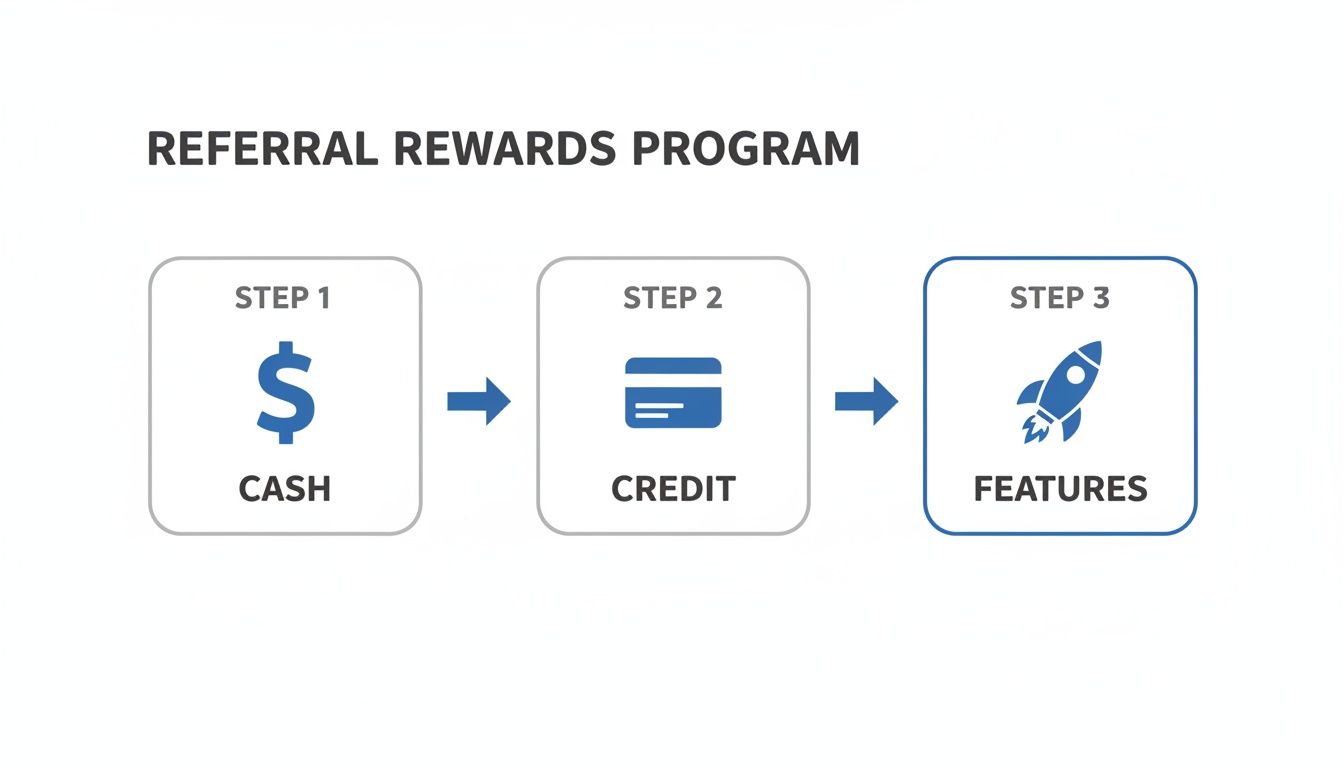
The key takeaway here is that the most effective reward is the one that best aligns with your users' motivations and your business model.
Customizing the Referred User Experience
A generic landing page is a conversion killer. When someone clicks a friend's referral link, they need to land somewhere that acknowledges the connection and reinforces the value they just heard about. Even a simple, personalized greeting like, "Your friend Jane invited you to try..." immediately builds trust and provides context.
LinkJolt lets you customize this landing page experience completely. You can direct all referred traffic to a specific page on your site that highlights the benefits and clearly spells out the special offer they're getting. This continuity is absolutely critical for turning a warm lead into a happy new customer.
This is also a good moment to think about how your referral program fits into your broader marketing stack. For truly seamless operation, consider the power of marketing automation and CRM integration. Pushing your referral data into these systems gives you a much richer, 360-degree view of your customer journey.
Activating Automation and Security
Once the core pieces are in place, you can tap into the real power of a tool like LinkJolt: its automation and security features. Let's be honest, you don't want to be manually approving every single payout or constantly worrying about fraud.
Go ahead and configure automatic reward payouts. This ensures your advocates get paid on time, every time, which is fundamental for building trust and keeping them motivated. You can set your own payout schedules (like net-30) and connect directly to payment processors to make the whole process hands-off. Remember, fast and reliable rewards are a cornerstone of a referral program people actually love.
Finally, switch on the built-in fraud detection tools. These systems are designed to automatically flag suspicious activity—things like self-referrals or a flood of clicks from known fraudulent sources. This protects your program's integrity and makes sure you're only rewarding legitimate, high-quality customers. With these features active, you can launch with confidence, knowing your program is not only effective but also secure.
Promoting Your Program So People Actually Use It
You can build the most generous, perfectly designed referral program in the world, but if your customers don’t know it exists, it’s a wasted effort. The "if you build it, they will come" philosophy is a recipe for a referral program that gathers digital dust.
Instead, a strong launch requires a proactive, multi-channel promotion strategy that keeps the momentum going long after day one.
Think of your program’s launch less as a single event and more as the beginning of an ongoing conversation with your users. The real goal is to weave the idea of referring so naturally into the user experience that it becomes an obvious, unmissable part of their journey with your product.
Make Your Program Impossible to Ignore
Visibility is everything. Your referral program can't be buried in the footer of your website or hidden three clicks deep in a settings menu. It needs to be front and center, showing up right when your customers are happiest with your product.
Start by placing clear calls-to-action (CTAs) directly inside your app or user dashboard. A permanent link in the main navigation or the user profile section is a great first step. This gives your most engaged users a way to discover the program on their own terms.
To be more direct, use timely in-app notifications. You can trigger a pop-up or a small banner after a user accomplishes something meaningful—like exporting their first big report, upgrading their plan, or hitting a usage milestone. A simple message like, "Loving the results? Share with a friend and you both get a reward!" can be incredibly powerful when the timing is right.
Use Targeted Communication Channels
Beyond your app, your existing communication channels are your best friends. But don't just send a generic email blast to your entire list and call it a day. This is where segmentation comes in.
Craft a specific email campaign aimed at your most active and loyal users—the "ideal advocates" we talked about earlier. These are the folks who are most likely to take action immediately. Personalize the message to thank them for their loyalty and frame the referral program as an exclusive opportunity for them.
A great promotion strategy is about delivering the right message to the right user at the right time. Instead of shouting at everyone, whisper to your biggest fans. They're the ones who will amplify your message the loudest.
Consider a few of these tactics to build out your outreach plan:
- Dedicated Landing Page: Create a single, polished landing page that explains exactly how the program works, highlights the rewards, and makes it incredibly easy to sign up and start sharing.
- Email Signatures: Add a simple, clickable link to your referral program in the email signatures of your entire team, especially customer support and success reps. It’s a small touch that gets consistent visibility.
- Social Media Campaigns: Run a small campaign to announce the program. You could even feature your top referrers to create social proof and inspire others to get involved.
If you need more creative ways to get the word out, we’ve put together a list of powerful marketing referral program ideas you can steal for your own SaaS.
Test and Optimize Your Messaging
The copy you launch with is just your starting point. A/B testing is crucial for figuring out what messaging actually gets people to click and share. Don't be afraid to experiment with different headlines, CTAs, and even the core value prop of your emails.
For instance, you could test a benefit-focused headline like "Get a Free Month of Pro" against a more direct one like "Refer a Friend, Get Rewarded". Tools like LinkJolt give you the data to see which version drives more sign-ups. You'd be surprised how small tweaks can lead to big jumps in participation over time.
Of course, getting people to join is only half the battle. The program's ultimate success depends on referred customers converting. If you're in e-commerce, making sure that checkout experience is seamless is critical. Check out some quick wins to boost e-commerce conversion rates to make sure those valuable referred leads turn into new customers.
At the end of the day, consistent promotion is what turns a good referral program into a reliable growth engine.
Of course, even the best-laid plans run into questions once you start building. Getting ahead of these common concerns is the key to moving from a solid strategy to a successful launch without getting bogged down.
Let's walk through some of the most frequent questions I hear from SaaS founders.
How Much Should I Actually Offer for a Referral?
This is the big one, but there's no single magic number that works for everyone.
A great starting point is to aim for a reward valued at 10-20% of your average customer lifetime value (LTV). For instance, if your SaaS has a $50/month plan and customers typically stick around for a year, your LTV is $600. In that scenario, a reward somewhere between $60 and $120 is going to feel pretty compelling.
The most important rule, though, is this: your referral reward must be significantly less than your customer acquisition cost (CAC). If you're spending $250 on ads to get one new customer, offering a $75 reward for a referral is a huge financial win. It's just smart business.
Don't sleep on non-cash incentives. Things like account credits, upgrades to a premium feature, or a few extra free months often have a much higher perceived value to your user than what they actually cost you. That makes them incredibly efficient rewards.
When Is the Right Time to Ask for a Referral?
Timing is absolutely critical. Ask too soon, and it feels pushy. Ask too late, and you’ve missed that peak moment of customer delight.
The sweet spot is right after a user has a "moment of success" with your product—a clear sign they've just gotten real value out of it.
Think about these key moments:
- Right After Onboarding: They've successfully finished their initial setup and see the path forward.
- Hitting a Milestone: They just exported their first big report, launched their first campaign, or hit a key usage goal.
- Following Positive Feedback: This one's a gimme. The moment a user leaves a 5-star review or sends a glowing email to your support team is the perfect time to follow up.
You can automate in-app prompts to pop up at these exact moments. A simple message like, "Glad you're loving the new report feature! Know anyone else who could use this?" feels natural and timely, which makes people far more likely to actually share.
How Do I Know if My Program Is Actually Working?
To figure out if your program is a success, you need to track the right things. Vanity metrics are nice, but you want to focus on the numbers that directly tie to your bottom line. Effective referral program tracking is non-negotiable for proving ROI.
Here are the key performance indicators (KPIs) you should have your eyes on:
- Participation Rate: What percentage of your active users have actually signed up for the referral program? For a brand new program, hitting around 5% is a solid initial goal.
- Share Rate: Of the people who joined, how many are actually sharing their referral link? This tells you how motivated your advocates really are.
- Conversion Rate: What percentage of referred friends click the link and become paying customers? Aim for a 10-15% conversion rate to start.
- Referral-Generated Revenue: This is the ultimate proof. How much new revenue can you directly attribute to your referral program?
Tools like LinkJolt give you a real-time dashboard to watch these metrics, so you can see what’s working and what needs tweaking. Keeping a close eye on this data is how you prove the program's long-term value to your business.
Ready to stop hoping for referrals and start building a predictable growth engine? With LinkJolt, you can launch, manage, and scale your referral program in minutes. Get started today and turn your happy customers into your most powerful sales team. Learn more at https://linkjolt.io.
Watch Demo (2 min)


Trusted by 300+ SaaS companies
Start Your Affiliate Program Today
Get 30% off your first 3 months with code LINKJOLT30
✓ 3-day free trial
✓ Cancel anytime