What Is Partnership Marketing A Guide to Sustainable Growth
What Is Partnership Marketing A Guide to Sustainable Growth

Ollie Efez
January 29, 2026•16 min read
Let's cut to the chase: what is partnership marketing?
Think of it as two bands co-headlining a tour. Each has its own loyal fanbase, but by teaming up, they sell more tickets, reach new listeners, and create a much bigger event than either could alone. It's a strategic collaboration where businesses team up to hit mutual growth goals by tapping into each other’s strengths and audiences.
The Foundation of Partnership Marketing
At its heart, partnership marketing is built on a foundation of shared value and trust, moving way beyond traditional ads. Instead of just buying clicks, you build a real relationship with a non-competing business whose customers look a lot like yours. This creates a powerful, authentic endorsement that gives you access to a warm audience that already trusts your partner.
This isn't just a single tactic but a whole playbook that can take many forms, from simple affiliate links to ambitious co-branded projects. But the goal is always the same: grow faster and more efficiently together than you ever could apart. It’s an engine for scalable growth fueled by genuine relationships, not just ad spend.
Before diving deeper, let's get a quick snapshot of the core concepts.
Partnership Marketing At a Glance
The table below breaks down the essentials of partnership marketing, its primary objective, and the key players who make it work.
This collaborative approach isn't just a feel-good strategy; it's a powerful engine for building credibility and driving measurable results.Why It Works So Well
Partnerships are effective because they tap into a fundamental aspect of human nature: trust. A recommendation from a source you already know and respect is infinitely more powerful than a cold ad. When a complementary brand—one your ideal customer already follows and listens to—vouches for your product, it instantly builds credibility and can dramatically shorten the sales cycle.
Partnership marketing is about creating a synergy that amplifies your impact far beyond what you could achieve individually. It’s a collaborative approach built on mutual value, shared goals, and transparency.
Key Elements of a Strong Partnership
For any collaboration to truly succeed, it needs to be built on a solid, non-negotiable foundation.
- Audience Alignment: This is the big one. Both partners must serve a similar or overlapping audience to ensure the collaboration feels natural and genuinely useful to the end customer.
- Mutual Benefit: The "what's in it for me?" question has to have a clear answer for everyone involved. This could be anything from lead generation and direct sales to brand exposure or breaking into new markets.
- Shared Goals: Before you even start, both sides must agree on what success looks like and which key performance indicators (KPIs) will be used to track progress.
Exploring Different Partnership Models
Knowing what is partnership marketing is one thing, but actually putting it into practice is a whole different ballgame. The strategy isn't a one-size-fits-all template. Think of it more like a versatile toolkit, packed with different models designed for specific goals and business types.
You can think of these models as different flavors of collaboration. Some are like hiring a freelance sales team that only gets paid on results, while others are closer to co-authoring a book to combine your expertise with a partner's. The real key is picking the model that lines up perfectly with your resources, your audience, and what you’re trying to achieve.
The diagram below shows how all these partnerships are built on the same foundation: mutual growth that leads to shared value and a broader reach for everyone involved.
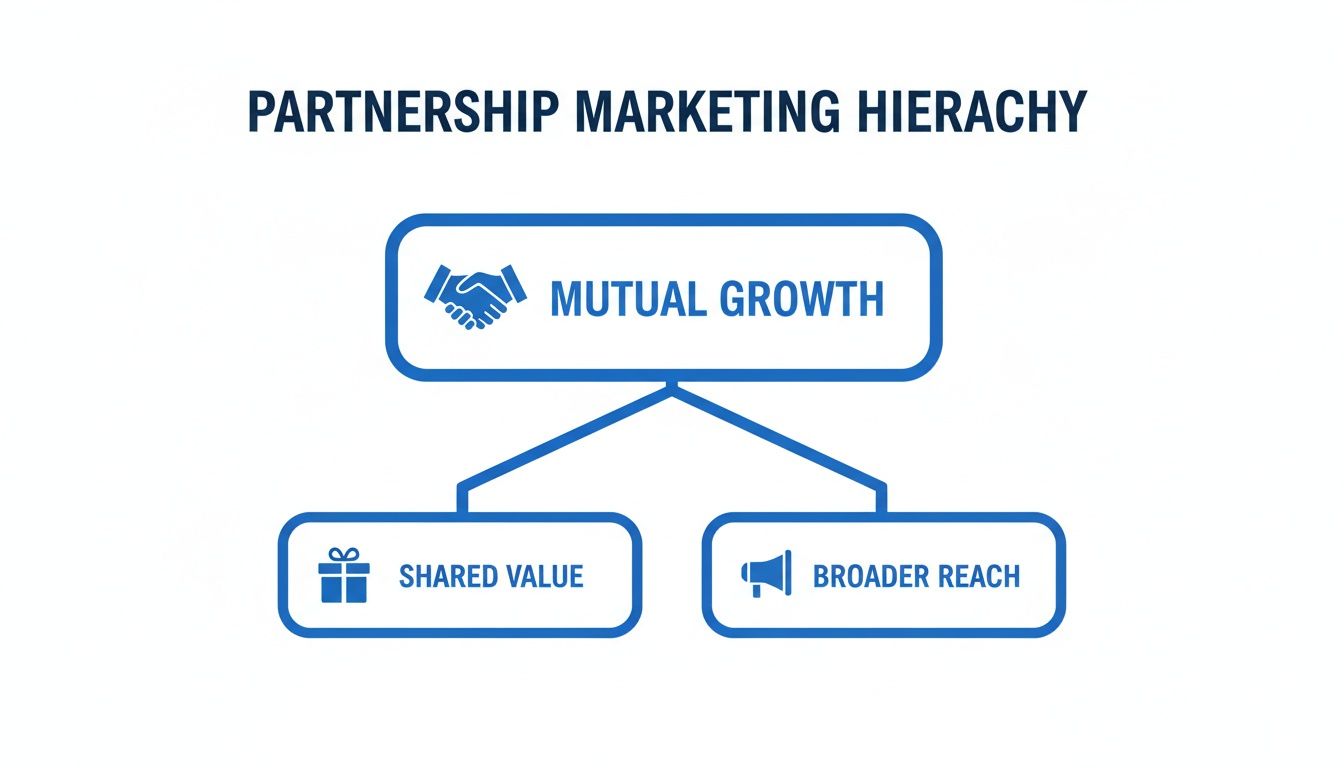
This visual makes it clear that no matter the structure, a successful partnership has to deliver real benefits and expand your market footprint to be worthwhile. Let's break down the four primary types you'll run into.
Affiliate Marketing
Affiliate marketing is a straightforward, performance-based model where you pay partners (affiliates) a commission for each new customer they send your way. These affiliates—often content creators, bloggers, or industry influencers—promote your product using a unique tracking link you provide.
It's essentially a commission-only sales force. You only pay for actual results, like a completed sale or a qualified lead, which makes it a low-risk, high-reward strategy for driving direct sales. This model works exceptionally well for SaaS and e-commerce businesses with a clear path to conversion.
Referral Programs
While they sound similar to affiliate marketing, referral programs are different in one crucial way. They focus on encouraging your existing customers to recommend your product to their network in exchange for a reward. It’s the digital version of genuine, trusted word-of-mouth.
The secret sauce of referral programs is the trust factor. A recommendation from a friend is infinitely more powerful than a traditional ad, almost always leading to higher conversion rates and customers who stick around longer.
This approach turns your happiest users into a potent marketing channel. You're tapping into their genuine enthusiasm to attract high-quality leads who are already primed to trust your brand from the get-go.
Co-marketing and Content Partnerships
Co-marketing happens when two or more companies that don't compete with each other team up for a promotional effort. This often takes the shape of a content partnership, where you join forces to create something valuable for both of your audiences.
Think of it like co-hosting a webinar or co-authoring a book. Each brand brings its unique expertise and audience to the project, creating something more powerful than either could have produced alone. Common examples include:
- Joint Webinars: Combining knowledge to teach a shared audience.
- Co-authored eBooks: Merging research and insights for a definitive guide.
- Shared Industry Reports: Pooling data to produce market-leading research.
This model is fantastic for building brand authority, generating high-quality leads, and breaking into new audience segments by tapping into your partner’s established community.
Channel Partnerships
Channel partnerships represent a much deeper and more integrated form of collaboration. In this model, you partner with another company—like a reseller, agency, or systems integrator—to sell your product on your behalf. They effectively become an extension of your sales team.
This is a powerful strategy for breaking into new markets or industries where a partner already has established relationships and distribution channels. For example, a SaaS company might partner with marketing agencies that can sell and implement its software for their own clients, creating an entirely new and scalable revenue stream.
Choosing Your Partnership Model
Deciding where to start can feel overwhelming. Each model serves a different primary purpose and requires a different level of investment in time and resources. This table breaks down the four main types to help you find the best fit for your business goals right now.
Ultimately, the right choice depends on your current stage of growth. A startup might get the most bang for its buck with a simple referral program, while a more established company could be ready to invest in building out a full channel partner network. You can always start with one and add others as your business matures.Why Partnerships Are a Growth Engine for SaaS
In a world where customer attention is scattered and the cost of paid ads keeps climbing, relying only on traditional marketing is like trying to fill a leaky bucket. Partnerships offer a smarter, more durable way to grow because they're built on trust, not just ad spend. They aren't just another tactic on a checklist; they're a core business strategy for building scalable success.
The real magic of partnership marketing is borrowed credibility. When a brand, influencer, or industry expert your audience already trusts recommends your SaaS product, people listen. That endorsement is a powerful shortcut that shrinks the sales cycle and brings in customers who are already convinced of your value. The result? Faster conversions and much higher-quality leads.
Driving Down Acquisition Costs
One of the most convincing reasons for SaaS companies to go all-in on partnerships is the immediate impact on the bottom line. With customer acquisition costs (CAC) jumping 60% in just five years, partnerships deliver a much more cost-effective alternative.
By tapping into a partner's existing audience, you get to sidestep the massive expense of building brand awareness from the ground up. Plus, many partnership models—like affiliate and referral programs—are performance-based. You only pay for actual results, which creates a highly efficient and predictable revenue stream.
A partnership isn't about finding a bigger audience; it’s about finding the right audience through a channel they already trust. This shift from buying attention to earning trust fundamentally changes the growth equation.
Creating Scalable Revenue and Reach
Beyond just saving money, partnerships open up new, scalable channels for revenue and market growth that would be tough to achieve on your own. Think of each new partner as a new distribution channel, amplifying your message and extending your reach into completely new market segments. This creates a compounding effect where your growth is no longer chained to your own marketing budget.
- Access New Markets: Team up with partners who have a strong presence in regions or industries you're trying to break into.
- Boost Brand Authority: Co-marketing with respected brands in your space enhances your credibility and positions you as an industry leader.
- Increase Customer Lifetime Value (CLV): Customers who come from a trusted referral often show higher loyalty and stick around longer.
To see how partnerships fit into the bigger picture, check out this guide to a complete SaaS product marketing strategy. By weaving these collaborations into your plan, you build a resilient growth engine that delivers results month after month. For a deep dive into one of the most effective models, read our guide on creating a SaaS affiliate program.
How to Launch Your First Partner Program
Alright, so you understand the "what" of partnership marketing. Now for the fun part: actually building one. Moving from theory to a live program can feel like a huge leap, but it's really a series of small, manageable steps. Think of it less like building a skyscraper and more like putting together a piece of IKEA furniture—follow the instructions, and you'll have a solid structure you can build on later.
This roadmap will walk you through building a partner program from the ground up, turning that big idea into a real, achievable plan.

Set Clear and Measurable Goals
Before you write a single email or design a banner ad, you have to define what success actually looks like. A vague goal like "get more sales" is a recipe for a stalled program. Your objectives will shape every other decision, from the partners you court to the commission you pay.
Get specific. Set key performance indicators (KPIs) you can actually measure. For example, a rock-solid goal sounds like this: "Acquire 50 new customers through our affiliate program in the first quarter with a customer acquisition cost (CAC) under $200." That gives you a clear target and a benchmark to measure your performance against.
Identify and Recruit the Right Partners
Not all partners are created equal. The best programs are built on audience alignment, not just audience size. Your ideal partner already has the trust of the exact customers you’re trying to reach.
A partnership succeeds when the collaboration feels completely natural to the end customer. Look for non-competing businesses, content creators, or influencers whose audience perfectly matches your ideal customer profile.
So, where do you find these people?
- Analyze Your Customer Base: Where do your best customers hang out online? What blogs do they read, what podcasts do they listen to, and what tools are already in their tech stack? The answers are your treasure map.
- Use Search and Social Media: Simple searches for industry influencers, bloggers reviewing complementary products, or agencies that serve your target market can uncover a goldmine of potential partners.
- Start with Your Own Network: Never underestimate your existing fans. Your happiest customers can become your first—and most effective—partners through a simple referral program.
Create an Irresistible Partner Offer
Once you have a list of potential partners, you need a compelling reason for them to say yes. Your offer has to be a clear win-win, providing them with real value for their time and promotional efforts.
Your offer really boils down to two key pieces:
- Commission Structure: This is the heart of your proposal. It needs to be competitive enough to grab their attention but sustainable for your business. Common models include a percentage of the first sale, a flat fee per signup, or recurring commissions for subscription-based products (a huge plus for SaaS).
- Partner Resources: Make it ridiculously easy for them to succeed. Give them a "partner kit" packed with marketing materials like logos, ad copy, email templates, and product screenshots. The less work they have to do, the more likely they are to actually promote you.
Remember, effective partner relationship management is what keeps your program thriving long after the initial launch. It's not just about getting partners in the door; it's about nurturing those relationships for sustained, long-term growth.
Measuring the Metrics That Actually Matter

Launching a partner program without a way to measure it is just expensive guesswork. If you want to understand the real impact of your collaborations, you have to look past surface-level numbers like clicks and impressions. Tracking the right key performance indicators (KPIs) is what reveals the actual health and, most importantly, the revenue impact of your partnerships.
This data-driven approach is what separates a program that feels busy from one that demonstrably drives business growth. It gives you the power to spot your top-performing partners, fine-tune your strategy, and scale your program's success with confidence.
Core Metrics for Partnership Success
To get started, focus on the numbers that tie directly to your bottom line. These three KPIs are the bedrock of any measurable and successful program.
- Partner-Sourced Revenue: This is the ultimate metric. It’s the total new revenue directly generated or influenced by your partners' activities. Nothing proves the financial impact of your program more clearly.
- Customer Lifetime Value (CLV): Are partner-referred customers actually more valuable? Tracking the CLV of these customers often shows they’re more loyal and stick around longer, proving the high quality of the leads your partners are sending.
- Conversion Rate Per Partner: This number helps you find your superstars. By tracking the percentage of leads from each partner that convert into paying customers, you can see exactly who is most effective at driving real business.
The goal isn't just to track activity; it's to measure outcomes. A sharp focus on revenue-centric KPIs ensures your partnership efforts are always locked in on core business objectives.
Understanding Attribution Challenges
One of the biggest hurdles in measuring partnerships is attribution. A customer might discover your SaaS on a partner’s blog, later see one of your social ads, and finally sign up after a direct search. Who gets the credit? This is where your attribution model becomes absolutely critical.
While last-touch attribution is simple, it often completely undervalues the crucial role partners play in building awareness early in the journey. To get a more complete picture, it’s worth exploring different models. You can get a deeper understanding by reading our guide on what is revenue attribution.
Accurate tracking is the only way to ensure you’re rewarding the right partners and seeing the full value they bring to your ecosystem. Without it, you’re just flying blind, unable to make the informed decisions needed to scale your program effectively.
Real-World Partnership Marketing Wins
Theory is one thing, but seeing partnership marketing in the wild is what really brings the strategy to life. These examples show just how powerful these collaborations can be in fueling explosive growth. Think of them as a practical playbook, showing the models, strategies, and real results that successful companies have achieved.
These stories highlight what’s possible when businesses team up effectively, turning a marketing concept into a serious engine for revenue and brand reach.
HubSpot and Co-Marketing Mastery
HubSpot, a titan in the marketing and sales software world, has practically built an empire on smart content partnerships. They constantly team up with non-competing tech companies like Slack or Chatfuel to create co-branded webinars, ebooks, and research reports.
This co-marketing strategy is a masterclass in creating a win-win. Each partner brings their unique expertise and, more importantly, their audience to the table. The result is content that’s far more valuable—and reaches a much wider audience—than either company could have managed on its own. It’s a consistent, high-quality lead generation machine that also cements their status as industry authorities.
By pooling resources and credibility, co-marketing allows brands to generate leads and build trust at a fraction of the cost of traditional advertising, proving that collaboration is a direct path to growth.
Canva and Affiliate-Fueled Expansion
Canva, the design platform that everyone seems to use, owes a huge chunk of its explosive growth to a brilliant affiliate program. They empower content creators, educators, and design influencers to promote Canva Pro by offering them a generous cut for every new subscriber they send their way.
This performance-based model created a global army of genuine advocates who were financially motivated to show off Canva's value to their own dedicated audiences. By giving affiliates unique tracking links and a library of promotional assets, Canva built an acquisition channel that was both incredibly effective and highly scalable. This approach was absolutely critical in taking them from a small startup to a design powerhouse with millions of users across the globe.
Getting Started with the Right Tools
Understanding partnership marketing is one thing, and sketching out a strategy is the next logical step. But the real test comes at execution—and that’s exactly where even the most promising programs start to wobble.
Trying to manage dozens of partner links, track conversions in real-time, and handle commission payouts manually isn't just a headache. It's a direct roadblock to growth.
This is where dedicated partnership management software becomes your secret weapon. Think of it as the central command center for your entire partner ecosystem, automating the tedious work so you can focus on what actually matters: building strong relationships with your partners instead of getting lost in spreadsheets.
Choosing the Right Platform
A good tool handles everything from onboarding partners and tracking links to spotting fraud and sending out payments. As you look at different options, keep an eye out for the core features that make managing a program seamless and give your partners a professional experience.
You'll want a platform that includes:
- Automated Tracking and Payments: Look for direct integrations with payment processors like Stripe. This ensures every single conversion is tracked accurately and commissions land in your partners' accounts right on time, every time.
- Branded Partner Portal: This gives your partners a dedicated, professional dashboard where they can check their performance stats, download marketing materials, and see their earnings. It builds trust and keeps them engaged.
- Affiliate Discovery Marketplace: Some of the best platforms have a built-in network to help you find and recruit new, high-quality partners who are already looking for programs just like yours.
Of course, if you're exploring specific partnership models, you’ll need the right tools for the job. For example, if influencers are a key part of your strategy, you’ll want to check out the best influencer marketing platforms to help you find and manage them. The right software clears the path, making it simple to launch and scale a program that looks and feels professional from day one.
Ready to turn your partnership strategy into a real, revenue-generating engine? LinkJolt makes it easy to launch, manage, and scale your partner program with automated tracking, seamless payouts, and a branded portal. Start your free trial today and build your growth engine.
Watch Demo (2 min)


Trusted by 300+ SaaS companies
Start Your Affiliate Program Today
Get 30% off your first 3 months with code LINKJOLT30
✓ 3-day free trial
✓ Cancel anytime