What Are Affiliates and How Do They Drive SaaS Growth
What Are Affiliates and How Do They Drive SaaS Growth

Ollie Efez
January 03, 2026•17 min read

Imagine hiring a massive, motivated sales team that you only pay after they make a sale. At its core, that’s the simple answer to what are affiliates. They are partners—content creators, influencers, or other companies—who promote your product and earn a commission for each new customer they send your way.
What Exactly Is an Affiliate Partner

Think of an affiliate as a trusted advocate for your brand who works entirely on a performance basis. They are independent marketers who use their own platform, audience, and credibility to recommend your SaaS product.
When someone in their audience clicks their unique referral link and becomes a paying customer, the affiliate gets a predetermined cut of the sale. Simple as that.
This relationship creates a powerful win-win-win scenario. Your business gets a new customer without any upfront marketing costs. The affiliate is rewarded for their influence. And the new customer finds a great solution from a source they already know and trust.
Understanding the Key Players
To really get how this all works, you need to know the three main players involved. The entire ecosystem is a simple triangle of aligned incentives where everyone benefits from the others' success. This mutually beneficial structure is a huge reason why over 80% of brands now have affiliate programs.
At its heart, an affiliate partnership is a trusted handshake between a brand and a promoter. The brand gets low-risk marketing, and the promoter earns income by sharing products they genuinely believe in with their audience.
This model is so effective because it’s built on authentic recommendations, not just flashy ads. For a deeper dive into the business side of things, check out our detailed guide on what defines an affiliate company in our detailed guide.
Here's a quick look at the key players and what they bring to the table.
The Key Players in an Affiliate Partnership
Each player has a clear role and motivation, creating a self-sustaining cycle where growth for one directly contributes to the success of the others.The Different Types of Affiliates You Can Recruit

Knowing what an affiliate is gets you in the door. But the real strategy begins when you realize "affiliate" isn't one job title—it's a massive umbrella covering all kinds of potential partners. A truly effective affiliate program doesn't just find one type of promoter; it builds a diverse portfolio to reach every corner of the market.
Think about it this way: you wouldn't run the exact same ad on LinkedIn as you would on TikTok. The same logic applies here. Each type of affiliate brings a unique audience, a distinct promotional style, and a different level of trust to the table. Building a well-rounded roster of partners is the secret to creating sustainable, scalable growth.
Let's break down the main categories of affiliates you should be looking to bring into your SaaS program.
Content Creators and Niche Experts
This is the group that most people think of, and for good reason—they are often the most valuable partners you can find. These are the bloggers, YouTubers, podcasters, and newsletter writers who have painstakingly built a dedicated following around a specific topic. They don't just push products; they educate, review, and build incredible amounts of trust.
- Bloggers and SEO Specialists: These are masters of the long game. They create in-depth tutorials, detailed product comparisons, and "best of" listicles that climb the ranks of Google. They're experts at capturing potential customers who are already in research mode, actively looking for a solution like yours.
- Video Creators: For SaaS, seeing is believing. YouTubers and other video creators can produce compelling demos, walkthroughs, and reviews that show your software in action. This visual proof is often the final nudge a potential buyer needs.
- Podcasters: A recommendation from a trusted podcast host often feels less like an ad and more like getting advice from a smart friend. This channel is fantastic for reaching a loyal, engaged audience while they're commuting, working out, or focused on learning.
Influencers and Social Media Personalities
While content creators often focus on evergreen, educational material, influencers thrive in the fast-paced, immediate world of platforms like Instagram, TikTok, and X (formerly Twitter). Their power isn't just in the content they create, but in the massive reach and strong personal bond they have with their followers.
These partners are perfect for generating buzz, driving traffic to a time-sensitive promotion, or introducing your brand to a completely new demographic. When an influencer shares their genuine, positive experience with your software, it can spark immediate curiosity and a flood of new visitors.
The best affiliate relationships are built on genuine alignment. When a promoter truly loves your product, their recommendation isn't just a marketing tactic—it's authentic advocacy that their audience can see and feel.
Review Sites and Comparison Platforms
When a buyer is getting serious about making a purchase, where do they go for the final verdict? More often than not, they land on an authoritative review or comparison website. These platforms are the specialists, dedicated to unbiased, data-heavy analysis of different software tools within a specific category.
Getting your product featured on these sites puts you directly in front of high-intent buyers at the most critical moment of their decision-making process. Securing a top spot in an article like "Best Project Management Tools" can become a steady, reliable source of high-quality leads for years to come.
Finally, don't forget about strategic B2B partnerships. This includes marketing agencies, consultants, or even other SaaS companies that serve a similar, non-competing audience. They can refer clients to your platform as part of their service offering, creating a powerful and mutually beneficial referral engine.
How Affiliates Get Paid and How You Track Results
For any partnership to succeed, trust is everything. In affiliate marketing, that trust is built on two pillars: flawless payments and bulletproof tracking. Your partners need absolute confidence they’ll get paid fairly for every customer they send your way. You need the same confidence that you're only paying for real, measurable results.
This is where the engine of your affiliate program lives—the commission models and tracking technology that connect the dots. Getting these mechanics right is the key to building a program that’s both attractive to top-tier partners and profitable for your business.
The affiliate market is booming, currently valued at $18.5 billion and on track to hit $31.7 billion by 2031. This isn't just hype; it's driven by a powerful ROI, with businesses earning an average of $6.50 for every dollar they put in. For SaaS companies, it’s a natural fit. Over 70% of Australian businesses with affiliate programs are targeting overseas markets, and 60% are focused on the US, proving how affiliates can act as your global sales force from day one. Discover more insights about this affiliate marketing growth on eMarketer.com.
Choosing the Right Commission Model
How you pay your affiliates isn't a one-size-fits-all decision. The right commission structure is all about aligning your partners' incentives with your actual business goals. If you're a SaaS company aiming for long-term subscribers, a model that rewards high-quality sign-ups is infinitely better than one that just pays for clicks.
Let's break down the most popular ways to compensate affiliates, which will help you choose the best model for your goals.
Ultimately, the best model connects the affiliate's reward directly to the action you value most. For most SaaS businesses, that action is a paying customer.
For SaaS businesses, a recurring Pay-Per-Sale commission is often the most powerful incentive. It motivates affiliates to find customers who will stick around, creating a long-term revenue stream for both of you.
How Tracking Links and Cookies Work
The tech behind affiliate marketing might sound complicated, but the core idea is pretty simple. It all boils down to two things working together perfectly: a unique affiliate link and a small bit of code called a tracking cookie.
Here's how it plays out step-by-step:
- The Affiliate Link: Every partner in your program gets their own unique URL. This link has a special ID baked into it that acts like their digital signature. When they share it in a blog post, video description, or email, it’s unmistakably theirs.
- The Tracking Cookie: When a potential customer clicks that link, a tiny text file (the cookie) is saved in their browser. This file contains the affiliate’s ID and has a set expiration date, often 30 to 90 days. This is called the "cookie window."
- The Conversion: If that customer signs up for your service anytime within that cookie window, the tracking cookie attributes the sale back to the original affiliate. It works even if they leave your site and come back a week later to buy.
This automated system is what ensures every referral gets credited to the right person. It's the foundation of trust, which is why using a reliable platform like LinkJolt is non-negotiable. It handles all the technical heavy lifting, removing any guesswork and making sure the system is fair for everyone.
For a deeper dive, check out our guide on the specifics of tracking affiliate links in our guide. Getting this right is how you build the trust needed for strong, lasting partnerships.
Why an Affiliate Program Is a SaaS Superpower
Knowing what an affiliate program is and understanding why it's a non-negotiable part of modern SaaS growth are two different things. An affiliate program isn’t just another marketing channel on your list; it’s a powerful, performance-based engine that can fundamentally change how you acquire customers.
The entire model operates on a simple but potent principle: you only pay for actual results.
Unlike traditional advertising, where you pour money into campaigns hoping for conversions, affiliates completely flip the script. This pay-for-performance model eliminates the upfront financial risk, making your marketing budget scale perfectly with your revenue. It's easily one of the most cost-effective https://www.linkjolt.io/blog/saas-growth-strategies you can implement.
Scale Your Marketing Without Scaling Your Team
Imagine trying to hire a global sales team overnight. The overhead, training, and management costs would be staggering. Affiliates offer an elegant solution to this problem, letting you tap into thousands of marketing "teams of one"—bloggers, YouTubers, and niche experts who already have the audience and trust you’re trying to build.
This model lets you expand your reach into new markets and demographics almost instantly, all without adding to your headcount. Your affiliates handle the content creation and promotion, effectively becoming an extension of your marketing department but without the fixed salary and benefits. An affiliate program is a powerful component of broader strategies to grow your online business, offering scalable marketing and massive reach for SaaS companies.
An affiliate program turns marketing from a cost center into a profit center. Every dollar spent is directly tied to revenue earned, creating a sustainable and predictable growth loop that traditional advertising struggles to match.
Build Authentic Trust and Social Proof
In a crowded SaaS market, trust is your most valuable asset. People are far more likely to try a new tool based on a genuine recommendation from someone they follow than from a faceless ad that interrupts their feed.
When an expert content creator endorses your software, they are lending you their hard-earned credibility. This kind of authentic social proof is priceless. It cuts through the marketing noise and builds brand awareness in a way that feels helpful, not intrusive.
This is especially true as the global affiliate industry, currently valued between $17-18.5 billion, continues its rapid expansion. With projections showing it could reach $71.74 billion by 2034, and with over 80% of brands already running affiliate programs, the opportunity for SaaS is enormous.
This entire ecosystem of scalable, cost-effective, and trust-based marketing is made accessible through modern platforms. Tools like LinkJolt give you the ability to build and manage this performance-based marketing machine from day one, empowering everyone from solo founders to enterprise teams to turn partnerships into a true business superpower.
How to Build and Manage a Thriving Affiliate Program
Knowing what an affiliate program is and actually building one are two different things. If you want to build an affiliate ecosystem that doesn’t just launch but actually scales, you need a clear roadmap. It really boils down to three core stages: finding the right partners, giving them a seamless onboarding experience, and actively managing those relationships for long-term growth.
This isn't just about adding another marketing channel; it's about unlocking a few key superpowers for your SaaS business.
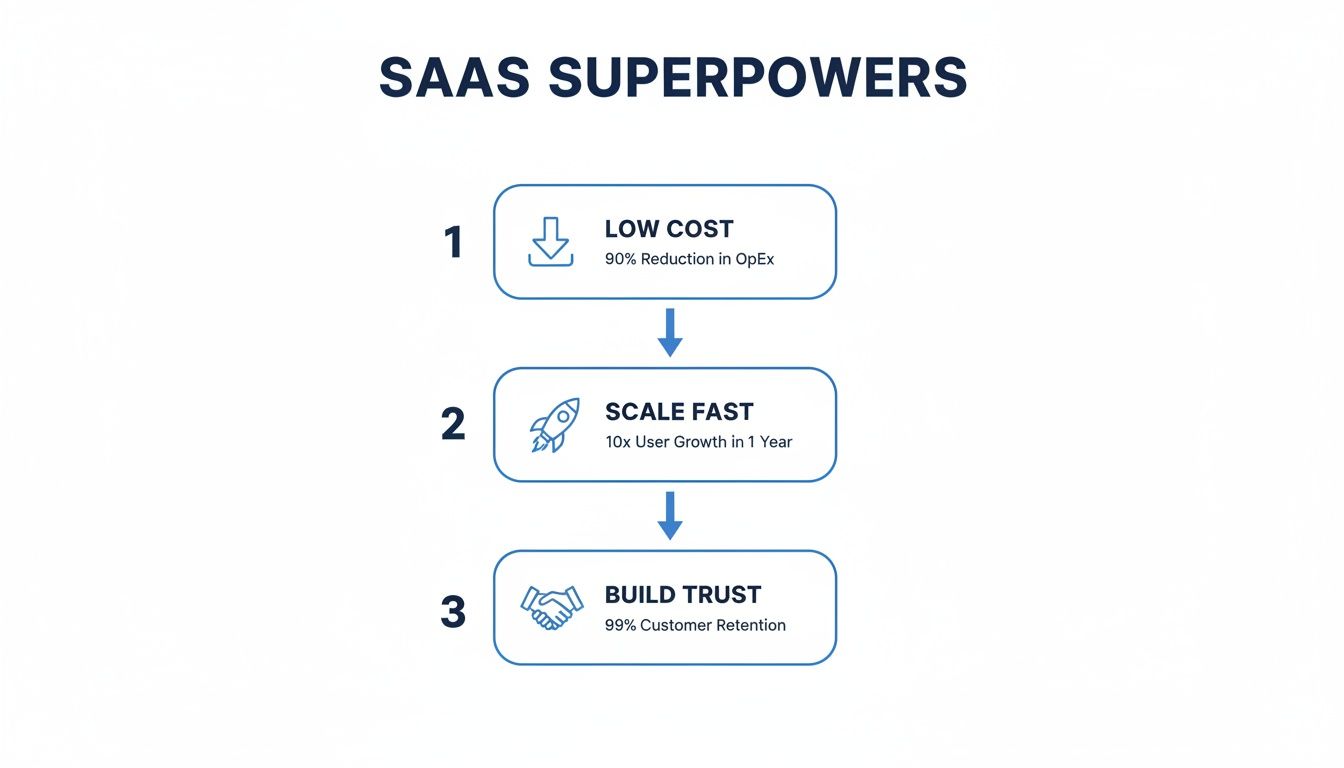
As you can see, a well-run program lets you acquire customers at a much lower cost, scale up your marketing efforts almost infinitely, and build incredible trust through authentic, third-party endorsements.
Finding and Recruiting the Right Partners
The foundation of any great affiliate program isn't quantity; it's quality. Your goal isn't just to find people with big audiences, but to find creators who have the right audience—one that genuinely aligns with your product. Inviting everyone with a pulse will only lead to low engagement and a lot of wasted time.
Instead, you need to be surgical in your approach.
- Analyze Your Competitors: Look at who is already promoting similar, non-competing SaaS products. These creators already get your market and have an audience that’s primed for what you offer.
- Identify Niche Experts: Hunt down the bloggers, YouTubers, and podcasters who create content around the problems your software solves. A creator focused on "productivity hacks for small teams" is a perfect match for a project management tool.
- Reach Out Personally: Ditch the generic, automated outreach. A personalized email that shows you actually understand and value their work is far more likely to get a response. Mention a specific piece of their content you enjoyed to prove you’ve done your homework.
Onboarding and Empowering Your Affiliates
Once a partner agrees to join, your next job is to make it ridiculously easy for them to succeed. A confusing or clunky onboarding process is the fastest way to kill the motivation of a great affiliate. Your job is to remove all friction and arm them with everything they need from day one.
A great affiliate program isn't just a set of links and a commission rate. It's a support system designed to help your partners win. When they have the tools and confidence to promote effectively, you both succeed.
Your affiliate portal, like the one we provide at LinkJolt, should be their central hub. It needs to have clear instructions, pre-made marketing assets (like banners and email templates), and dead-simple access to their unique referral links. When you design your program, think about how you can support your partners with resources, such as tools for AI image generation for marketing that help them create their own engaging content.
Managing and Motivating for Long-Term Success
Recruitment and onboarding are just the starting line. The most successful affiliate programs are built on strong, ongoing relationships. You can't just set it and forget it.
Keep your affiliates engaged by communicating regularly, running special promotional campaigns, and offering performance-based incentives. For example, you could offer a higher commission tier for partners who drive more than 20 sales a month. It’s a simple way to reward your top performers and motivate everyone else.
Finally, you have to protect the integrity of your program. Using a platform with built-in fraud detection is non-negotiable; it stops bad actors from gaming the system and wasting your budget. By actively managing these relationships and ensuring a fair playing field, you can turn your affiliate program into a powerful, sustainable engine for growth.
Launch Your Affiliate Program in Four Simple Steps

Alright, let's turn theory into practice. You don't need a massive team or a three-month project plan to get an affiliate program off the ground. The key is to start with a solid, simple foundation and build momentum from there.
With a platform like LinkJolt, you can go from an idea to a fully functioning program in minutes, not months. We've distilled the whole process into four clear, manageable steps to get you started.
A Practical Launch Checklist
Think of this as your roadmap from initial setup to optimization. Follow these core steps, and you'll launch with confidence.
- Program Setup and Configuration: First, decide on the rules of the game. Define your commission structure—we strongly recommend a recurring PPS model for SaaS—and set your cookie window. A good platform handles all the technical heavy lifting instantly, so you can focus on the strategy.
- Affiliate Onboarding: Time to get your first partners in the door. Generate your initial referral links and send out a few invites. The goal is to give them a branded, easy-to-use portal where they can grab marketing assets and see their performance from day one.
- Payment Integration: This step is all about building trust. Connect your payment processor, like Stripe or Paddle, to automate commission tracking and payouts. When partners know they'll get paid accurately and on time, they're motivated to perform.
- Performance Tracking and Optimization: Once you're live, it's time to watch the data. Use a central dashboard to monitor your key metrics: clicks, conversion rates, and total revenue generated by your affiliates. This data is gold—it shows you who your top performers are and where you can fine-tune your program for the biggest impact.
Got Questions? We’ve Got Answers.
As you start thinking about what an affiliate program could look like for your business, a few common questions always pop up. Here are some straightforward answers to help you figure out the practical side of getting started.
Is Affiliate Marketing Expensive to Start?
Not at all. In fact, it's one of the most budget-friendly marketing channels out there. Unlike traditional advertising where you pay upfront for clicks or impressions, with affiliate marketing, you only pay a commission after a sale is made. This performance-based model means your marketing costs scale perfectly with your revenue—no wasted spend.
Your main investment is a good management platform to handle the tracking and payments. This is what lets your program run on autopilot without needing a dedicated team right from the start.
The real beauty of affiliate marketing is that it shifts your marketing spend from a fixed cost to a variable one. Every dollar you spend is tied directly to a new customer, which pretty much guarantees a positive return on your investment.
How Long Does It Take to See Results?
While you can technically launch a program in a few minutes, seeing real, meaningful results takes a bit of time. It's a gradual process of building a network of quality partners and giving them the space to create content and promote your product.
You’ll likely see your first few affiliate-driven sales within a few weeks. But building a thriving, consistent stream of revenue usually takes somewhere between three to six months. Patience is the name of the game here. Focus on recruiting the right people and setting them up for long-term success, rather than hoping for an overnight sales boom.
Can I Run an Affiliate Program on My Own?
Absolutely, especially when you're just kicking things off. Modern affiliate platforms are built for founders and small marketing teams to manage everything from one place. They automate the tasks that used to be a huge time-sink:
- Link Generation: Instantly create unique tracking links for every single partner.
- Performance Tracking: Watch clicks, conversions, and revenue roll in as it happens.
- Automated Payouts: Make sure your affiliates get paid correctly and on time, without you lifting a finger.
This level of automation frees you up to do what really matters: building solid relationships with your best-performing partners.
Ready to turn partnerships into your most powerful growth channel? With LinkJolt, you can launch, manage, and scale your SaaS affiliate program in minutes. Automate tracking, simplify payouts, and connect with top affiliates—all on one intuitive platform. Start building your affiliate program with LinkJolt today!
Watch Demo (2 min)


Trusted by 300+ SaaS companies
Start Your Affiliate Program Today
Get 30% off your first 3 months with code LINKJOLT30
✓ 3-day free trial
✓ Cancel anytime