SEO for Affiliate Marketers a Modern Playbook for Success
SEO for Affiliate Marketers a Modern Playbook for Success

Ollie Efez
February 15, 2026•21 min read
Let’s be honest: chasing social media trends and pouring money into paid ads is exhausting. It's a short-term game. For real, sustainable affiliate income, the answer has always been mastering SEO. It’s the strategy that turns your website into a genuine, long-term asset by pulling in people who are already searching for the things you recommend.
This is all about driving organic traffic—visitors who find you naturally on Google. These aren't people you interrupted; they're people who came looking for you. That difference is everything when it comes to trust and, ultimately, conversions.
Why SEO is Your Most Valuable Affiliate Asset
Sure, a viral TikTok or a well-timed ad campaign can give you a quick traffic spike. But what happens when you stop posting or the ad budget runs out? The traffic vanishes.
SEO is different. It’s the bedrock of a real business. You're building a library of content that solves problems and answers questions, creating a steady stream of high-intent visitors that keeps flowing long after you hit publish. This consistent organic traffic is the lifeblood of any serious affiliate marketer.
Think about it. A visitor who lands on your site after searching "best noise-canceling headphones under $200" is already halfway to making a purchase. They have a problem and are actively looking for the solution you’re providing. That lead is infinitely more valuable than someone just scrolling through their social feed.
Your Affiliate SEO Playbook at a Glance
Before we dive deep, here’s a quick overview of the core strategies we'll cover. Think of this as the framework for building a profitable affiliate site that stands the test of time.
This playbook breaks down each of these pillars into actionable steps, moving you from theory to real-world application.The Power of Intent-Driven Traffic
The real magic of affiliate SEO isn’t just getting more traffic; it's about getting the right traffic. When you have a solid grasp of the core Search Engine Ranking Factors, you can zero in on users based on their specific intent—whether they’re just starting their research or have their credit card in hand.
This approach flat-out works. A massive 69% of affiliate marketers name SEO as their number one source of traffic, beating out every other channel, including social media. It’s not a coincidence. Successful affiliate sites are built on a foundation of organic search because it delivers visitors who are ready to act.
By focusing on SEO, you're not just chasing clicks. You're building a content engine that works for you 24/7, generating passive income and establishing your site as a trusted authority.
Building a Long-Term Business Asset
Every single optimized article you publish adds tangible value to your digital property. It’s like adding another room to your house—it appreciates over time.
This playbook will walk you through the essentials of affiliate SEO, transforming your website from a simple blog into a valuable business that grows month after month. We’re going to cover:
- Keyword Research: How to find those profitable keywords that real people are typing into Google.
- Content Creation: Crafting the kind of reviews and comparisons that actually convince people to buy.
- Technical SEO: All the behind-the-scenes stuff to make sure your site is fast, secure, and easy for Google to crawl.
- Link Building: Earning the kind of high-quality backlinks that signal trust and authority.
With a smart SEO strategy, you’re investing in a predictable system for long-term growth. It's your ticket off the hamster wheel of paid ads and volatile social algorithms.
Finding Keywords That Drive Affiliate Sales
Let’s get one thing straight: effective keyword research is what separates the affiliates who make a killing from those who barely make a sale. This isn’t about chasing massive search volumes. It’s about digging into the psyche of your audience to find the exact phrases they type when they’re ready to pull out their credit card.
This is where you stop thinking like a traffic-chaser and start acting like a conversion strategist. The real money is in understanding user intent—the “why” behind every single search. Is someone just browsing, or are they comparing two specific products, ready to buy? That distinction is everything.
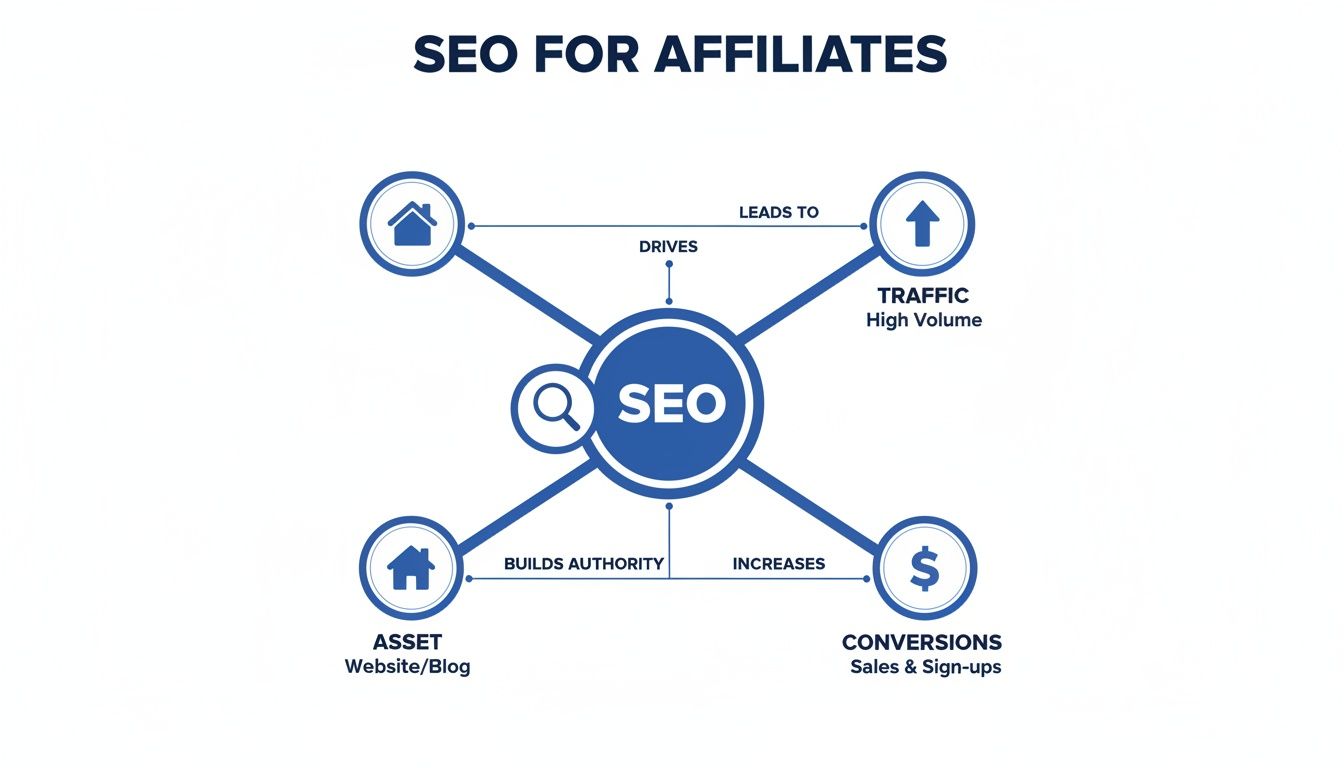
As you can see, SEO isn't just a single task. It's the engine that powers the entire affiliate flywheel, turning clicks into cash and building a real, long-term asset.
Mapping Keywords to the Buyer Journey
Every potential customer is on a path, and your job is to show up at the right moments with the right content. We can break this journey down into three key stages of intent.
- Informational Intent (“How do I fix X?”): These are your top-of-funnel folks. They have a problem and are looking for answers, not products. This is your chance to build trust.
- Keyword Examples: “how to improve home wifi signal,” “why is my laptop so slow”
- Content Match: Think detailed guides, tutorials, and "what is" articles. Be the helpful expert.
- Commercial Investigation (“What are my options?”): Now we’re talking. These searchers know they need a solution and are actively comparing products. This is the sweet spot where most affiliates make their money.
- Keyword Examples: “best mesh wifi system for 2 story house,” “Asus Zenbook vs Dell XPS 13”
- Content Match: This is prime real estate for in-depth reviews, "best of" lists, and direct comparison posts.
- Transactional Intent (“I’m ready to buy”): The user has made a decision. They’re just looking for the best place or deal to complete the purchase. These keywords are pure gold.
- Keyword Examples: “Netgear Orbi RBK752 discount,” “buy Macbook Air M2”
- Content Match: Deal pages, coupon articles, and reviews that focus on a specific model or pricing.
Your most profitable content will live in the commercial and transactional stages. While informational posts build an audience, commercial keywords are what pay the bills.
Uncovering Low-Competition Goldmines
Trying to rank in a saturated niche can feel like yelling into a hurricane. The smart move is to target long-tail keywords—those super-specific, lower-volume phrases that the big players often ignore. These are your entry points. You can often find some of the best niches for affiliate marketing by focusing on these underserved queries.
Here’s how to find them in the wild:
- Mine "People Also Ask" (PAA): Type a broad keyword into Google and study the PAA box. Every one of those questions is a content idea handed to you on a silver platter.
- Scour Reddit and Quora: Dive into subreddits and forums related to your niche. Look for the exact words people use when asking for recommendations. Phrases like “any good alternatives to…” or “what do you guys think of…” are pure keyword gold.
- Analyze Your Competitors' Weak Spots: Use an SEO tool to find keywords that smaller, low-authority sites are ranking for. If they can get on page one, you can almost certainly do it better.
A Real-World SaaS Example
Let's say you're an affiliate for a new project management tool. Targeting "project management software" is a fool's errand. It's way too broad and competitive.
Instead, you do your homework and uncover these gems:
-
best project management tool for small agencies(Commercial) -
Trello alternative with time tracking(Commercial) -
ClickUp vs Monday for remote teams(Commercial) -
Asana pricing plans explained(Transactional)
Each one of these keywords targets a very specific user with a very specific problem. By creating content laser-focused on these long-tail queries, you attract traffic that’s not just browsing—it’s ready to convert. That targeted approach is the heart of smart SEO for affiliate marketers.
Creating Affiliate Content People Trust and Click
Keyword research gets you in the game, but it's the quality of your content that actually wins it for you. You can nail the perfect long-tail keyword, but if your article is just a soulless, generic rehash of what’s already ranking, visitors will bounce and your commissions will flatline.
The real secret to effective SEO for affiliate marketers isn't just about traffic—it's about creating content that genuinely helps someone make a decision. This means you have to go way beyond just listing product features.
Your audience is craving authenticity. They want proof you’ve actually used the product, that you understand its quirks and flaws, and can give them a perspective they can't get from a polished manufacturer's website. In this game, trust is your most valuable currency, and great content is how you earn it.
The Anatomy of High-Converting Affiliate Posts
While you can get creative, there are a few tried-and-true content formats that consistently deliver the goods for affiliate marketers. Each one serves a slightly different purpose but they all share the same goal: guide the reader to a confident purchase.
- The In-Depth Single-Product Review: This is your deep dive. Go beyond the spec sheet and talk about the unboxing experience, the setup headaches, and the little quirks you discovered after a week of use. Your own photos and videos are non-negotiable here—they are the ultimate proof you’ve actually gotten your hands on the product.
- The "Best X for Y" Roundup: These are comparison powerhouses, perfect for targeting people who know their problem but need help finding the right solution. The key is to set clear, objective criteria for your comparison (like price, ease of use, and key features) and present the info in an easy-to-scan format, like a comparison table.
- The "Product A vs. Product B" Showdown: This format is pure gold for bottom-of-the-funnel keywords. You're talking to someone who has already narrowed it down to two final options. A direct, head-to-head comparison spelling out the pros and cons for specific types of users is incredibly effective at pushing them over the finish line.
Your Personal Experience is Your Secret Weapon
In an era of AI-generated fluff, your personal experience is the one thing that can't be replicated. It's your ultimate competitive advantage. Google's own Helpful Content System is specifically designed to reward content demonstrating real expertise and first-hand knowledge. This is fantastic news for authentic affiliates.
Don't just tell your readers a product is good; show them. Detail a specific, relatable problem you had and explain exactly how the product solved it. This kind of storytelling forges a connection that a sterile list of features never will.
For instance, instead of saying, "This coffee maker brews quickly," try something more personal: "I was skeptical, but this machine brewed a full 12-cup pot in under six minutes. That’s a lifesaver on chaotic weekday mornings when I’m trying to get the kids ready for school."
See the difference? One is a bland fact; the other is a relatable experience that builds instant trust.
On-Page SEO That Earns the Click
Amazing content deserves to be discovered. On-page SEO is all about optimizing your pages to rank higher and pull in more of the right kind of traffic. This isn't about spamming keywords; it’s about making your content clear for both users and search engines.
Writing Magnetic Titles and Descriptions
Think of your title tag and meta description as your sales pitch in the search results. They have one job: convince someone to choose your link over the nine others on the page.
- Title Tag Tips:
- Include your main keyword naturally, ideally near the start.
- Keep it under 60 characters so it doesn’t get awkwardly cut off.
- Use numbers, brackets, or intriguing words to stand out (e.g., "7 Best Webcams for Streaming [2024 Review]").
- Meta Description Tips:
- This is your ad copy. Make it an engaging summary of what's inside.
- Stay under 160 characters.
- Include your keyword and a clear call to action, like "Find the perfect one for your budget."
Structuring Content for Skimmers and Search Engines
Nobody wants to read a giant wall of text. Good structure makes your content easy to skim for readers and simple for search engines to crawl and understand.
A logical hierarchy of headings is all you need. Your main title is your <h1>. Your main sections should be wrapped in <h2> tags, and any subsections within those should use <h3> tags. This creates a clean outline of your article, which helps Google figure out what your page is about and how all the information is related. This simple practice is a fundamental part of good SEO for affiliate marketers, improving both the user experience and your chances of ranking.
Get Your Technical SEO House in Order
You can write the most compelling, persuasive, and downright brilliant content on the planet, but if your website is slow, confusing, or just plain broken, it’s all for nothing. Both users and Google will hit the back button without a second thought.
Technical SEO is the engine that actually powers your affiliate site. It’s what makes sure all your hard work creating content gets seen. Think of it as the foundation of your house—if it's cracked, everything you build on top of it is at risk.
Ignoring this stuff is easily one of the most expensive mistakes you can make in affiliate SEO. A clunky, slow experience sends all the wrong signals to Google, which can tank your rankings and obliterate your conversion rates. The good news? You don’t need to be a developer to get the basics right.
Even with all the buzz around AI, good old-fashioned organic traffic is still king, accounting for 46.98% of all site visits. And with mobile traffic dominating the web, keeping your site technically sound isn't just a good idea—it’s a matter of survival. You can dig into more SEO statistics at seranking.com to see the full picture.
Master Google’s Core Web Vitals
Core Web Vitals are a handful of specific metrics Google uses to judge a page's real-world user experience. It's basically Google's way of asking: "Is this page fast, responsive, and stable when it loads?" Nail these, and you're directly signaling to Google that your site is worth ranking.
There are three main pillars to focus on:
- Largest Contentful Paint (LCP): This is all about loading speed. It measures how long it takes for the most important part of your page (usually a big image or block of text) to show up. You want this to be under 2.5 seconds.
- First Input Delay (FID): This measures interactivity. How long does your site take to respond when a user first does something, like clicking a button? Keep it under 100 milliseconds.
- Cumulative Layout Shift (CLS): This one's about visual stability. You know when you try to click a button, but an ad loads and pushes it down the page? That's layout shift, and it’s super annoying. A low CLS score means your page is stable.
You can make a huge dent in these scores with some simple fixes. Compressing your images, choosing a quality web host, and getting rid of any unnecessary plugins will get you most of the way there.
Build a Logical Site Structure
A clean, logical site structure is like a well-organized library. It’s a win-win: Google's crawlers can easily find and index all your pages, and your human visitors can navigate your site without getting frustrated and leaving.
For most affiliate sites, a simple "silo" structure is the way to go. All this means is organizing your content into clear, logical categories that make intuitive sense.
Here’s a classic example for a tech review site:
- Homepage
-
/laptops/ -
/best-gaming-laptops/ -
/dell-xps-15-review/ -
/headphones/ -
/best-noise-cancelling-headphones/ -
/sony-wh1000xm5-review/
This kind of hierarchy makes your site dead simple to browse. Users find what they need, and Google clearly understands the topical relationships between your pages, which helps establish your authority. We cover this in more detail in our guide to optimizing affiliate links and site architecture.
A simple, logical site structure isn't just a "nice-to-have." It’s a fundamental signal to Google that your website is a high-quality, authoritative resource that's easy for users to navigate.
Win More Clicks with Schema Markup
Schema markup is a special kind of code you add to your site that helps search engines understand your content on a deeper level. The payoff is huge: your pages can earn "rich snippets" in the search results.
You’ve definitely seen these before—they're the search results with star ratings, prices, or FAQ dropdowns right there on the Google page. They make your listing impossible to ignore.
For affiliate marketers, two types of schema are pure gold:
- Review Schema: This lets you show those shiny star ratings directly in the search results. An article showing a 4.5-star rating is way more likely to get clicked than a plain text result sitting right next to it.
- Product Schema: This can display key info like price, availability, and brand. It’s perfect for single-product reviews or any page dedicated to one specific item.
Don't let the word "code" scare you. Many modern WordPress themes and plugins can implement schema for you with just a few clicks. It's a small technical step that can lead to a massive boost in your click-through rate, driving more of that ready-to-buy traffic right where you want it.
Building Authority with Smarter Link Building
Backlinks are still the currency of the web. Think of them as votes of confidence from one site to another. For an affiliate marketer, a strong backlink profile is what separates a top-ranking authority site from one that’s gathering dust on page five of Google. It’s a direct signal to search engines that other respected players in your niche actually trust and value what you have to say.
But let’s be clear: the game has changed. Forget about spammy forum comments or buying links from sketchy networks. Those old-school tactics are a one-way ticket to a Google penalty. Today, building real authority is about earning high-quality links, not just grabbing them from wherever you can.
The goal is to create content so valuable, so genuinely useful, that other site owners and journalists want to link back to it. You have to give them a reason. This is where "linkable assets" come into play.
Create Assets People Actually Want to Link To
A linkable asset is a piece of content on your site designed specifically to be a backlink magnet. It goes way beyond a standard blog post by providing a unique resource that others in your industry will find almost irresistible to reference. These are your link-building power tools.
Here are a few proven types of linkable assets that work exceptionally well for affiliate sites:
- Unique Data or Surveys: Run a small survey in your niche and publish the findings. Seriously, even a simple poll of 100 people can generate original data that bloggers and journalists will happily cite and link back to.
- Free Calculators or Tools: If you’re in the finance niche, a simple mortgage calculator can earn links for years. In the fitness space? A calorie calculator. These tools provide ongoing value and are a natural target for links.
- In-Depth Case Studies: Did you get a killer result using one of the products you promote? Document the entire process—the problem, the solution, and the data-backed results. A detailed case study is powerful social proof that others will want to share.
The most effective linkable assets solve a specific problem or answer a tough question in a way no one else has. Invest your time in creating one truly exceptional resource instead of ten mediocre blog posts.
Master the Art of Relationship-Based Outreach
Once you have a valuable asset, it's time to let the right people know it exists. This isn't about blasting thousands of inboxes with a generic template. It’s about building genuine relationships through strategic, personalized outreach. Your aim is to become a trusted source, not just another person begging for a link.
Two of the most effective ways to do this are guest posting and jumping into expert roundups.
Guest Posting on Authoritative Blogs
Guest posting is a classic for a reason: it works. By writing a high-quality article for a respected blog in your niche, you score a trifecta:
- You get your content in front of a new, highly relevant audience.
- You build your reputation as an expert in the field.
- You earn a powerful, contextually relevant backlink to your site.
The key is to target sites that are genuinely authoritative and relevant to your audience. A single link from a top-tier industry blog is worth more than 100 links from low-quality directories.
Contributing to Expert Roundups
Expert roundups are articles that compile insights from multiple specialists on a single topic (e.g., "20 Experts Share Their Best Productivity Tip"). You can find these opportunities by searching Google for “expert roundup” + [your niche].
When you contribute, you almost always get a mention and a backlink. But more importantly, it positions you alongside other established names in your industry. This instantly boosts your credibility and authority in a way that's hard to achieve on your own.
Turning Traffic into Commissions with CRO
Getting traffic is only half the battle. If all those hard-earned visitors land on your site and leave without clicking a single affiliate link, your SEO efforts are essentially wasted. This is where Conversion Rate Optimization (CRO) comes in. It’s the art and science of turning the traffic you already have into actual, measurable commissions.
It's not about finding more visitors; it's about getting more from the ones who are already there. You'd be surprised how simple tweaks to your layout, calls-to-action, and link placements can have a massive impact on your bottom line.
Even a small bump in your conversion rate, say from 1% to 2%, literally doubles your affiliate income without needing a single extra visitor.
Strategic Affiliate Link Placement
Where you put your links matters—a lot. Too many affiliates make the mistake of just dropping links randomly and hoping for the best. But the highest-converting spots are almost always predictable and backed by user behavior.
Your goal is to place links precisely where a reader's interest and purchase intent are at their absolute peak. This typically includes:
- Early in the introduction: Catch the readers who have already made up their minds and just need a quick link to click.
- Within comparison tables: Tables are absolute conversion goldmines. They let users quickly compare features and click through on the option that’s best for them.
- On compelling call-to-action (CTA) buttons: Ditch the plain text links. Use eye-catching buttons with action-oriented text like "Check Latest Price" or "Find Out More."
The best affiliate SEO strategy integrates CRO from the very beginning. Think about where a user is most likely to click before you even finish writing your content. This proactive approach is a hallmark of top-earning affiliates.
The Power of Accurate Tracking
You can't optimize what you don't measure. In affiliate marketing, guesswork is the enemy of profit. To truly scale your business, you need a crystal-clear, real-time view of what’s actually working. Which articles drive the most clicks? Which products are converting best?
This is where a dedicated platform becomes non-negotiable. Using a tool like LinkJolt gives you a central dashboard to track every single click and conversion. This data-driven approach allows you to confidently double down on your most profitable campaigns and content.
If you really want to go deeper, you can learn more about these conversion rate optimization best practices to fine-tune your entire strategy.
By systematically testing different CTAs, improving your page layouts, and analyzing your tracking data, you create a powerful feedback loop. Each small improvement builds on the last, turning your affiliate site into a highly efficient conversion machine.
Your Affiliate SEO Questions, Answered
Jumping into affiliate SEO always brings up a few key questions. Let's clear up some of the most common ones so you can build your strategy with confidence.
How Long Does This Actually Take?
Let's be real: patience is the name of the game here. For a brand-new website, you're typically looking at 6 to 12 months before you start seeing significant organic traffic and meaningful rankings. Anyone promising you page-one rankings overnight isn't telling you the whole story.
This timeline isn't set in stone, of course. It really depends on your niche's competitiveness, how consistently you're putting out great content, and whether you're building quality links. Instead of obsessing over a quick win, focus on laying a rock-solid foundation. Consistent, high-quality content paired with authoritative backlinks is the only proven path to long-term success.
Should I Use "Nofollow" or "Sponsored" for My Affiliate Links?
Yes, you absolutely need to qualify your affiliate links. The official best practice from Google is to use the rel="sponsored" attribute for any link that's part of a paid agreement—and that explicitly includes affiliate links.
Whilerel="nofollow"was the old standard and is technically still fine, usingrel="sponsored"is more specific and the correct, modern approach. It’s a simple tag that keeps your relationship with search engines transparent and helps you sidestep potential penalties down the road.
Can I Do This Without a Website?
Technically, you could try affiliate marketing on platforms like YouTube or Medium. But if you're serious about building a sustainable business, you need your own website. It’s non-negotiable.
Think of it this way: a website you own is a digital asset. It gives you complete control over your content, your brand, and how you make money. SEO for a platform like YouTube is powerful, but your website is the central hub. It’s where you build a long-term asset, capture email subscribers, and diversify your traffic—things you simply can't do effectively when you're building on someone else's land.
Ready to take control of your affiliate strategy? With LinkJolt, you get the tools to manage your links, track performance in real-time, and discover new partnership opportunities—all in one place. Start optimizing your affiliate campaigns with LinkJolt today!
Watch Demo (2 min)


Trusted by 300+ SaaS companies
Start Your Affiliate Program Today
Get 30% off your first 3 months with code LINKJOLT30
✓ 3-day free trial
✓ Cancel anytime