Recurring Commission Affiliate Programs: The 2026 Guide

Ollie Efez
December 26, 2025•14 min read•Updated Sep 16, 2026

Recurring commission affiliate programs pay a percentage of every subscription payment a referred customer makes, not a one-time bounty at signup. Across the 98 percentage-based campaigns in the 2026 SaaS Affiliate Benchmarks, the median rate is 20% of the sale, and 26% of the 121 campaigns in that dataset pay on renewals rather than only on the first sale. Every renewal is revenue that arrives without a new sale being made, and recurring is still the minority offer, which is exactly why affiliates hunt for the programs that have it.
The reason the model works is alignment, not arithmetic. A one-time payout rewards an affiliate for a signup and then stops caring whether that customer sticks around. A recurring commission ties the affiliate's income to retention, so both sides start optimizing for the same thing: customers who stay, upgrade, and grow.
This guide serves both sides of that deal. If you promote products, the next two sections cover what recurring programs really pay in 2026 and which ones are worth joining, including LinkJolt's own 30% lifetime program. If you run a SaaS, everything from the design section onward shows how to offer recurring commissions your unit economics can support.
What the Real Data Says About Recurring Commissions
Before designing anything, it helps to know what other SaaS programs actually pay. These figures come from the LinkJolt SaaS Affiliate Benchmarks, a September 2026 snapshot of 121 campaigns (98 percentage-based, 23 fixed) with test accounts and rejected conversions excluded:
- 20% median commission across the 98 percentage-based campaigns, with a 22.9% average and 20 to 25% as the most common band.
- 26% of campaigns pay recurring commissions. Recurring is a differentiator, not yet the default, which is exactly why offering it helps you stand out to good affiliates.
- 28% of the verified commission events inside those recurring programs are renewals, not first sales. That share comes from a small sample and is published as measured, but it is the part of an affiliate's income that arrives with no new sale behind it.
- 81% of campaigns pay a percentage of the sale; 19% pay a fixed amount (the fixed programs pay a median of $30 per sale).
Keep these numbers in mind as reference points. A "generous" program is not one with a shocking headline rate. It is one where the rate, the duration, and your margins can coexist for years.
Recurring Affiliate Programs Worth Joining in 2026
If you are on the affiliate side of the table, the data above translates into a simple filter: only 26% of SaaS campaigns pay recurring commissions, so a program that does is already ahead of most of the market. Before you join one, check four terms:
- The rate. 20 to 25% of the sale is the most common band in real SaaS programs; treat anything at or above that as competitive.
- The cap. A 12-month duration cap is a solid offer, 24 months is strong, and lifetime (no cap) is the best deal an affiliate can get.
- Renewal tracking. The program must commission renewals automatically from the payment processor. If payouts depend on someone running a spreadsheet each month, expect missed renewals.
- The payout rail. Look for automated payouts through Stripe Connect or a clear monthly schedule, plus a stated minimum threshold.
LinkJolt's own affiliate program checks all four. It pays 30% recurring commission on every Ultimate ($99/month) and Scale ($249/month) plan payment, for as long as the referred customer stays subscribed, with a 30-day cookie window and monthly payouts. At 30%, one Ultimate referral is worth $29.70 per month and one Scale referral $74.70 per month, every month they remain a customer. Join the LinkJolt affiliate program.
Beyond any single program, recurring commissions cluster where recurring revenue lives: SaaS tools, web hosting, email marketing platforms, and membership products. Two good hunting grounds: the step-by-step guide to finding affiliate programs in your niche, and marketplace directories like LinkJolt's Discovery marketplace, where SaaS merchants who are actively recruiting affiliates list their campaigns, recurring terms included.
Why Recurring Commissions Are a SaaS Game Changer
From here on, the guide is written for the merchant side: SaaS founders deciding whether to offer recurring commissions and how to run the program well. Affiliates can keep reading too, since knowing how good programs are built makes them easier to spot.
<img src="https://cdn.outrank.so/e2b9b79c-0a6e-4908-abd4-26760ca3a652/bdfc32b4-dd4e-41a5-834d-749b9f7fd6d7/recurring-commission-affiliate-programs-recurring-revenue.jpg" alt="A laptop displays "Recurring Revenue" text over a rising bar graph on a wooden desk." loading="lazy" style="max-width: 100%; height: auto; border-radius: 8px; margin: 1.5rem 0; display: block;" />
By tying an affiliate's earnings to ongoing subscription payments, you align their goals with your own. That alignment changes behavior in three concrete ways:
- They target better-fit leads. Churn now costs the affiliate money, so they stop chasing anyone with a pulse and start qualifying their audience the way your own sales team would.
- They promote long-term value. Content shifts toward the features that make customers stay, which supports retention instead of just trial volume.
- They act like partners, not referrers. Their income compounds with your product's success, so feedback, advocacy, and patience all improve.
This is one of the core principles behind building SaaS affiliate programs that actually scale: pay for the outcome you want (retained revenue), not the proxy (signups).
One-Time vs Recurring Commission Models at a Glance
For a subscription business, the recurring model is simply the one that matches how you earn.Designing a Commission Structure That Works
Your commission structure needs to attract serious partners while protecting your margins. That comes down to three decisions: percentage or fixed, what rate, and for how long.
Percentage vs Fixed Amount
The market has largely settled this one: 81% of SaaS campaigns pay a percentage. A percentage scales automatically when a referred customer upgrades, which gives affiliates a built-in reason to promote your higher tiers. Fixed amounts (median $30 per sale among fixed programs) make forecasting trivial and can work for low-priced products, but they cap the affiliate's upside and do nothing to reward high-value referrals.
Key takeaway: Default to a percentage of every subscription payment. Reserve fixed bounties for cases where your pricing is flat or your sales cycle makes percentage math confusing for partners.
If you want to pressure-test different rates and durations against your own pricing, the free commission structure builder and affiliate commission calculator let you model payouts before you commit to anything.
Anchoring Your Rate to LTV and CAC
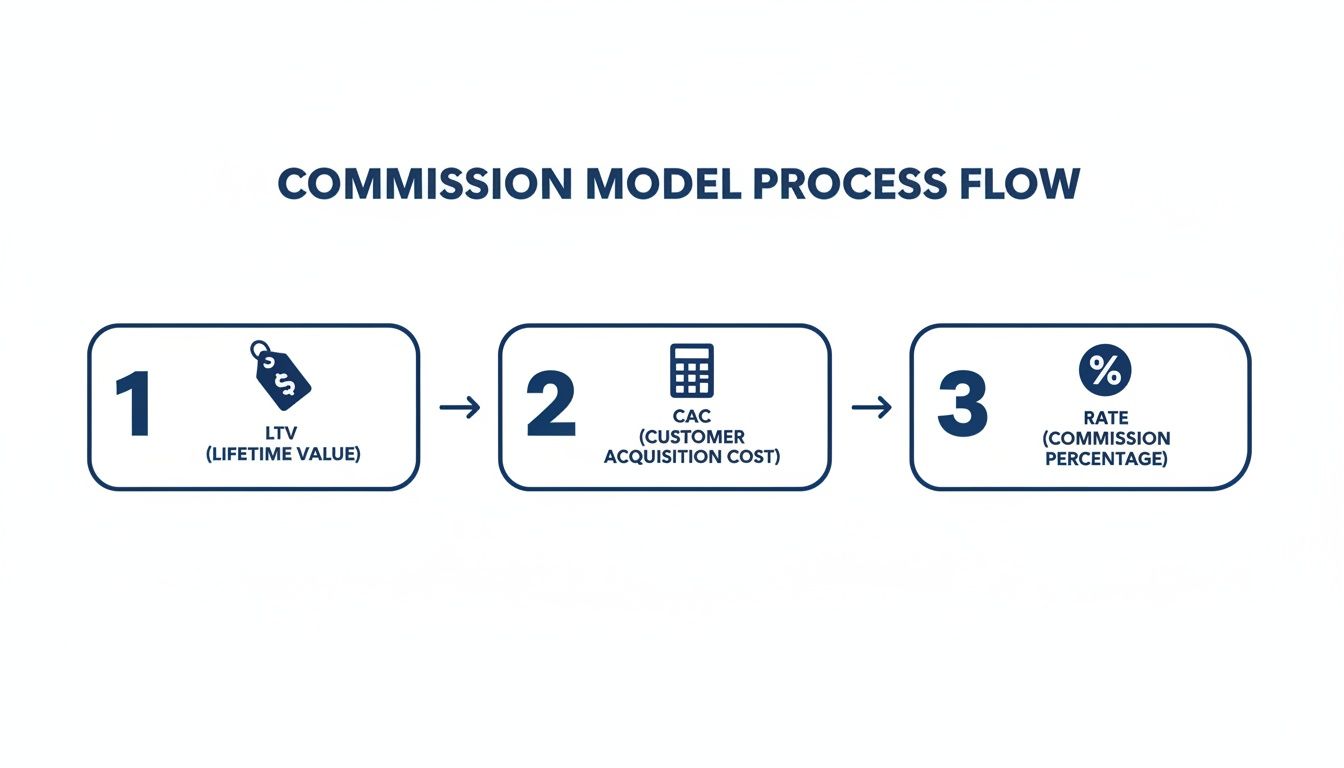
Do not pick a rate because a competitor uses it. Anchor it to two numbers you already track: customer lifetime value (LTV) and your target customer acquisition cost (CAC). The total commission you expect to pay for one referred customer should sit comfortably below your target CAC.
A quick worked example:
- Your product: a project management tool at $50/month.
- Average customer lifespan: 24 months, so LTV is $1,200.
- Target CAC: $300 (25% of LTV).
A 20% recurring commission pays the affiliate $10 per month. If you cap the commission at 24 months, your worst-case payout per customer is $240, safely under the $300 target. If the customer churns at month 10, you paid $100 for $500 of revenue. The commission self-adjusts to reality, which is exactly what a one-time bounty cannot do.
For a deeper look at where rates land across the market, see the full breakdown of affiliate commission rates.
Choosing a Duration: The Three Cap Models
How long should the affiliate keep earning? There are three honest options, and modern affiliate platforms support all three:
Lifetime commissions are the strongest magnet for top affiliates, and they are also the hardest to price, because you are committing a share of revenue you cannot yet forecast. A 12-month duration cap is a highly competitive offer on its own, and it keeps your liability bounded while you learn what referred-customer retention actually looks like on your product.
Whichever model you choose, write it down precisely in your program terms: when the clock starts, whether the first payment counts toward a payment cap (it should), and what happens on upgrades. Unstated rules here are the number one source of affiliate disputes.
Building Your Program's Technical Foundation
A generous structure fails without trustworthy plumbing. Affiliates promote programs they believe will pay them correctly, every month, without arguments. Three pieces make that true.
Tracking and Attribution
When a prospect clicks an affiliate's link, the platform stores the affiliate's ID (typically in a cookie plus a fallback like localStorage) and credits the affiliate if the visitor converts inside the attribution window. A 30-day window is the standard for SaaS and matches typical trial-to-paid cycles; last-click attribution (the most recent affiliate link wins) is the industry norm because it is simple and auditable.
Two details matter more than window length:
- Renewal-side tracking. The first sale is the easy part. The system must also recognize every subsequent subscription payment and attribute it to the original referral, or "recurring commissions" is just a promise on a landing page.
- A coupon fallback. Affiliate-specific promo codes let you attribute conversions even when a link click did not happen (podcasts, YouTube mentions, newsletters). Register each code to an affiliate so webhook data can match it automatically.
Payment Processor Integration
This is the single most important technical decision for a recurring program. Your affiliate platform must listen to your payment processor directly, via webhooks from Stripe, Paddle, or whatever bills your customers. A direct integration means every renewal invoice automatically triggers a commission calculation. No spreadsheet exports, no month-end reconciliation, no missed renewals.
Without processor-level integration, recurring commissions become a manual accounting job that grows with your MRR. Automation is not a convenience here, it is the only way the model works at scale.
This is exactly what LinkJolt is built for: it connects to your existing Stripe, Paddle or Polar account, watches subscription events, applies your rate and cap rules (duration or payment-count), and handles upgrades and refunds automatically. For what happens after a commission is approved, from approval flow to payout rails, see the guide on how to pay affiliates.
A Professional Affiliate Portal
Your partners need a home base: their links and coupon codes, real-time clicks and conversions, earnings history, and upcoming payouts. A clean portal signals that the program is run seriously, and it removes the "did my referral count?" support emails that erode trust. Payout rails matter too. Automated transfers through Stripe Connect, with a CSV export path for partners who prefer PayPal or Wise, covers nearly everyone without manual bookkeeping; the affiliate payout solutions page shows how those rails fit together.
How to Recruit and Onboard the Right Affiliates

A recurring program is only as good as the partners in it, and quality beats quantity every time. One affiliate with an engaged niche audience will outperform a hundred low-effort signups. It is worth noting that the benchmark data shows 83% of SaaS programs review every partner application manually rather than auto-approving, and that discipline is part of why their numbers work.
Where to Find Partners
- Your power users. Customers who already love the product make the most credible promoters, and they already understand it. Reach out personally, not with a blast email.
- Niche content creators. Bloggers, YouTubers, and newsletter writers whose audience matches your ideal customer profile. Relevance matters far more than reach.
- Marketplaces and directories. Affiliate discovery surfaces let interested promoters find your program. On LinkJolt, publishing your campaign to the Discovery marketplace puts it in front of affiliates who are actively looking for SaaS programs to join.
- Consultants and agencies. People whose clients would benefit from your product can become a steady source of qualified referrals.
Onboarding That Actually Activates Partners
The first week decides whether a new affiliate ever sends traffic. Give them a welcome kit inside the portal on day one:
Managing and Optimizing for Long-Term Growth
Launch is the starting gun, not the finish line. Recurring programs compound when managed and flatline when ignored.
The KPIs That Matter
- Affiliate conversion rate: clicks that become paying customers. Low rates usually mean audience mismatch, not a bad affiliate.
- Active partner share: how many signed-up affiliates drove any traffic this month. A large inactive pool points at onboarding or engagement problems.
- Retention of referred customers: the metric the whole model rests on. If referred customers churn faster than average, revisit which partners you recruit.
- Commission-to-revenue ratio: total payouts against referred revenue. This is your program's live CAC, and it should stay under your target from the design section.
Keep Partners Engaged
Do not let payout notifications be your only communication. A short monthly note with product updates, a top-performer shoutout, and one promotion idea keeps your program on partners' minds. Performance incentives work too: a temporary rate bump for partners who cross a monthly referred-revenue threshold rewards exactly the behavior you want.
Protect the Program from Fraud
Recurring programs attract abuse precisely because payouts compound. Use a platform with rule-based fraud detection that flags suspicious signals automatically, such as a self-referral, where the customer's email is the affiliate's own, before it turns into a recurring payout. Add two manual habits: review the traffic sources of your top earners periodically, and watch for partners whose referrals consistently churn right after the first commission. Clear program terms plus a manual approval step (like 83% of programs use) filters most bad actors before they get in.
Which Platforms Support Recurring Revenue Share for SaaS?
If you are evaluating tools (including for an AI SaaS, where usage-based upgrades make recurring attribution especially valuable), the checklist is short:
- Processor-native renewal tracking. The platform must consume Stripe or Paddle webhooks directly so every renewal is commissioned automatically.
- Real cap controls. Duration caps and payment-count caps should be settings, not support tickets.
- Upgrade and refund handling. Commissions should follow the subscription up, down, and back on refunds without manual edits.
- Sane economics. Platform pricing should not scale against you. LinkJolt charges 0% commission fees on affiliate-driven revenue, with flat plans starting at $19.99/month, and you can compare affiliate software transaction fees side by side before choosing.
For a comparison of the main options in the category, see the guide to the best affiliate marketing software.
Ready to build a recurring commission program on top of your existing billing? LinkJolt connects to Stripe, Paddle or Polar in a 5 to 10 minute setup, tracks every renewal automatically, supports duration and payment-count caps, and pays affiliates through Stripe Connect with 0% platform fees. Start your program today.
Watch Demo (2 min)


Trusted by 300+ SaaS companies
Start Your Affiliate Program Today
Get 30% off your first 3 months with code LINKJOLT30
✓ 7-day free trial
✓ Cancel anytime
Frequently Asked Questions
What is a recurring commission affiliate program?
A recurring commission affiliate program pays partners a percentage of every subscription payment a referred customer makes, not just a one-time fee at signup. The model fits SaaS because it ties affiliate earnings to retained revenue: in real 2026 benchmark data, 26% of SaaS campaigns pay on renewals, and inside those programs 28% of the verified commission events are renewal payments rather than first sales, so affiliates are rewarded for referring customers who stay.
What is a good recurring commission rate for a SaaS product?
Across the 98 percentage-based SaaS campaigns in the 2026 benchmarks, the median commission is 20% of the sale, the average is 22.9%, and 20 to 25% is the most common band. The right rate for your program is the one where the total expected payout per referred customer stays below your target customer acquisition cost, so anchor the percentage to your LTV and CAC rather than copying a competitor.
How long should recurring commissions last?
A 12-month duration cap is a strong, sustainable default for most SaaS programs, and 24 months is a competitive step up. The alternatives are payment-count caps (the affiliate earns on the first N payments, including the initial sale) and unlimited lifetime commissions, which are the most attractive offer to affiliates but carry open-ended liability. Choose based on margins and how confident you are in referred-customer retention.
Which recurring affiliate programs are worth joining?
Filter for subscription products (SaaS, hosting, email tools, memberships) and check four terms before joining: the rate (20 to 25% of the sale is the most common band), the cap (12 months, 24 months, or lifetime), automatic renewal tracking, and the payout rail. LinkJolt's own affiliate program pays 30% recurring commission on Ultimate and Scale plan payments for as long as the referred customer stays subscribed, with a 30-day cookie window and monthly payouts, and the Discovery marketplace inside LinkJolt lists SaaS campaigns actively recruiting affiliates.
How are commissions handled when a referred customer upgrades or downgrades?
With a percentage-based program on a processor-integrated platform, this is automatic: the commission is calculated from each actual payment, so it rises when the customer upgrades and falls when they downgrade. Refunds should reverse the related commission automatically. If a platform requires manual adjustments for plan changes, it will not scale with a subscription business.
Do recurring commissions work with annual billing?
Yes. Each successful renewal payment is commissioned, so an annually billed customer generates one larger commission per year instead of twelve monthly ones. Duration caps still apply by calendar time and payment-count caps by number of payments, so state clearly in your program terms how each cap treats annual plans.