How to Get Affiliates for Your SaaS A Practical Guide
How to Get Affiliates for Your SaaS A Practical Guide

Ollie Efez
February 04, 2026•21 min read

Before you even think about sending that first outreach email, you need to build an affiliate program that’s actually compelling. This is the foundational work—the stuff that makes top-tier partners want to join you. It’s about creating a structure so good that when you find the right affiliates, they have every reason to say yes and everything they need to hit the ground running.
Building a SaaS Affiliate Program Partners Actually Want to Join
Most people jump straight to recruitment when they think about how to get affiliates. That’s a mistake. The real first step is building the program itself. A solid foundation not only makes recruitment infinitely easier but also sets you up for long-term, sustainable growth. It's about crafting a partnership that feels valuable and supportive from the moment someone lands on your affiliate page.
This isn’t just a nice-to-have; it's a core growth strategy. Over 80% of brands are already using affiliate marketing to supercharge their sales and lead generation. The market is exploding, projected to hit $48 billion by 2027, because SaaS companies are realizing it's one of the best ways to drive scalable growth without a massive upfront marketing spend.
First, Define Your Program Goals
What, specifically, do you want this program to achieve? Answering this question will dictate your entire strategy, from the commissions you offer to the partners you recruit. Without clear goals, you’re just guessing.
Are you trying to...
- Drive direct sales? This is the most common goal, focused squarely on bringing in new paying customers. Your north-star metric here is conversion rate.
- Increase brand awareness? Maybe you just need to get your name out there. In this case, you’d track things like referral traffic volume and social media mentions.
- Generate qualified leads? This is all about getting new sign-ups for a free trial or demo, with the plan to nurture them into paying customers down the road.
This decision tree gives you a great visual of how your primary goal should shape the bones of your program.
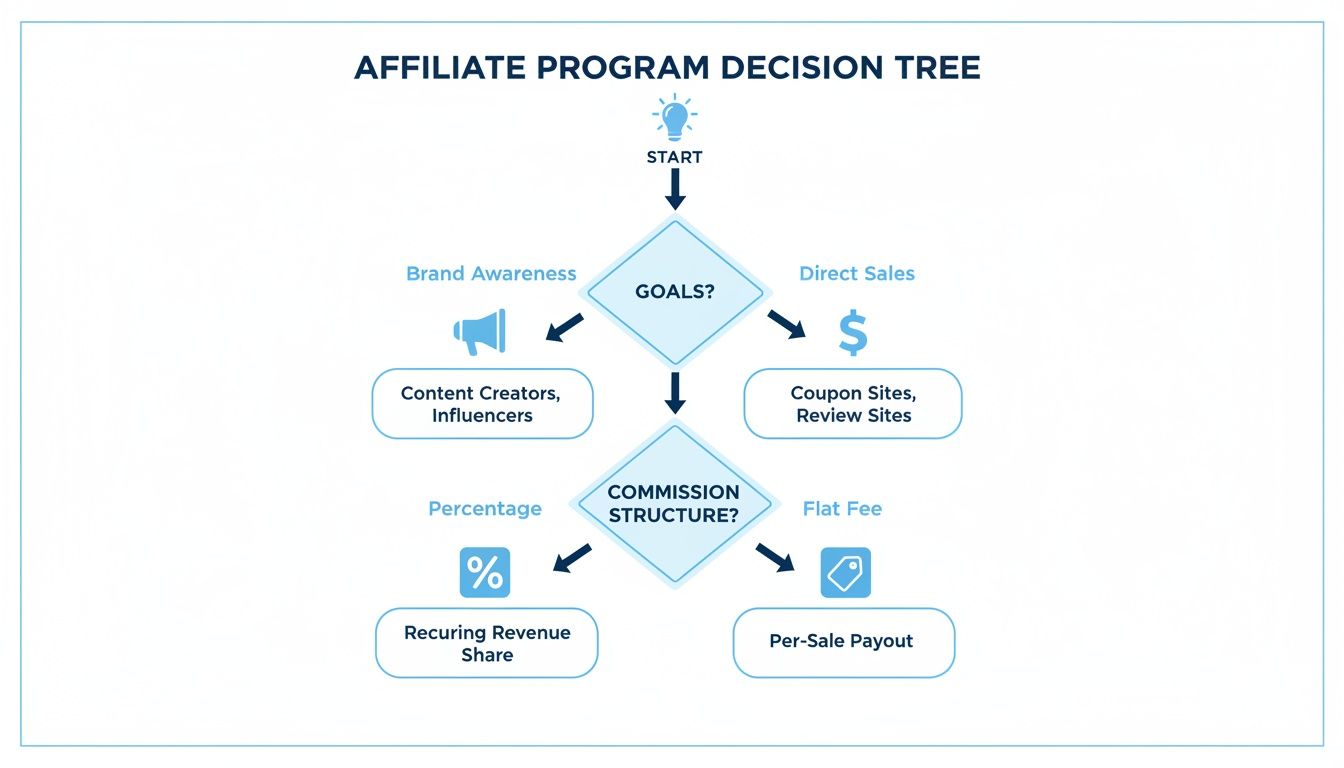
As you can see, a program gunning for direct sales is going to lean into higher, performance-based commissions. On the other hand, a brand awareness campaign might work better with simpler, fixed-fee structures.
Set a Competitive Commission Structure
Your commission is the main event. It's the number one motivator for any affiliate, so it needs to be right.
For SaaS, recurring commission is the gold standard. It just makes sense, perfectly aligning with the subscription business model we all operate on. A typical rate lands somewhere between 20-40% for the lifetime of the customer, and that’s what top partners have come to expect.
Offering a recurring commission shows you're invested in a long-term partnership. It tells affiliates that their effort to acquire a customer will pay dividends for months or even years, making your program far more attractive than one-off payout offers.
It always pays to see what others in your space are doing. Checking out well-designed programs, like ShortsNinja's affiliate program, can give you a feel for how to structure and present your offer to potential partners.
Choosing the Right SaaS Affiliate Commission Model
Here’s a breakdown of common commission structures to help you choose the best fit for your SaaS business model and goals.
Ultimately, a lifetime recurring commission is the strongest play for most SaaS companies. It signals that you see affiliates as true partners and gives them the biggest incentive to promote you over competitors.Create an Affiliate Toolkit
The best affiliates are busy people. The easier you make it for them to promote your product, the more they'll do it. A comprehensive toolkit removes friction and ensures they represent your brand the right way from day one.
A great toolkit, easily accessible in a dashboard like LinkJolt, should include:
- Pre-written copy: Think email templates, social media posts, and ad copy they can grab and go.
- Visual assets: Logos, banners, product screenshots, and short video clips.
- Product guides: Simple one-pagers and talking points that highlight key features and benefits.
- Tracking links: A dead-simple way to generate unique, trackable links for different campaigns.
Preparing these assets upfront signals to potential partners that you're professional, organized, and serious about helping them succeed. It's a critical piece of the puzzle when you're figuring out how to build a SaaS affiliate program that attracts the best in the business. This groundwork transforms a simple offer into a genuine business opportunity.
Finding and Recruiting High-Impact SaaS Affiliates
Alright, you've built the framework for your program. Now for the fun part: finding partners who can actually move the needle. Let's be clear, generic, mass-outreach campaigns are a waste of time. Successful affiliate recruitment is all about targeted, personal connection—finding the right people and making a case that feels valuable to them. Think of it as strategic relationship-building, not just a numbers game.

This isn’t about just finding anyone with a website. It’s about building a network of authentic advocates who genuinely believe in your SaaS.
Tap into Existing Affiliate Marketplaces
Affiliate marketplaces are absolute goldmines for recruitment. Why? Because they’re filled with people who are actively looking for new products to promote. These aren't cold leads; they’re individuals and businesses who already get the affiliate model and have audiences ready to go. You're not starting from scratch—you're tapping into a pre-qualified talent pool.
This is exactly why platforms like LinkJolt have a built-in discovery marketplace. It lets you list your program so motivated affiliates can find you, saving you countless hours of digging. The trick is to create a killer program listing that cuts to the chase:
- Your ideal partner profile: Are you looking for niche bloggers, YouTubers, or tech consultants? Get specific.
- Your commission structure: Don't bury the lead. A strong recurring commission rate is your biggest hook, so feature it prominently.
- What makes your product unique: A short, punchy value prop that grabs attention.
This inbound approach lets the best-fit partners come right to your door, making the initial discovery phase a whole lot easier.
Execute Targeted Outreach to Content Creators
While marketplaces are fantastic for inbound interest, direct outreach is how you land the game-changers. This means identifying content creators whose audience is a perfect mirror of your ideal customer profile. I'm talking about niche bloggers, podcasters, and YouTubers who are already reviewing or discussing tools in your industry.
A personalized email is everything here. Generic templates are deleted on sight. Your outreach needs to prove you've actually watched their videos or read their posts and that you genuinely understand their audience.
Pro Tip: Your outreach email should be less about your product and more about their audience. Frame the partnership as a way for them to provide more value to their community by introducing a tool that solves a real problem for them.
To nail this, you need to get good at finding contact info. A great resource on how to find anyone's email address can make your outreach far more effective. Remember, personalization is what separates a welcome introduction from spam.
Turn Your Best Customers into Advocates
One of the most overlooked—and powerful—sources of high-quality affiliates is right under your nose: your existing customer base. Your happiest users are already "selling" your product through word-of-mouth. An affiliate program just gives them a financial reason to do it more intentionally.
These customer advocates are incredibly effective because their recommendations are dripping with authenticity. They use the product, they love it, and they can speak to its value from firsthand experience. This isn't just a theory; programs built around customer advocacy consistently see higher conversion rates because the trust is already baked in.
Getting started is simple. Send a targeted email to your most engaged users—maybe those on a higher-tier plan or with a long history of activity. Let them know you're launching a partner program and invite them to be founding members. You'll be surprised how many are eager to sign up. There are a ton of different ways to find partners, and our guide on how to recruit affiliates dives much deeper into these tactics.
Partner with Complementary Agencies and Consultants
Finally, think beyond individual creators and look at other businesses serving your target market. Marketing agencies, business consultants, and even non-competing SaaS companies can be fantastic affiliate partners. For example, if you sell a project management tool, partnering with a marketing agency that helps clients streamline their workflows is a perfect fit.
The pitch here is a bit different. It's a B2B proposition focused on mutual growth.
- For them: It creates a new, passive, and recurring revenue stream.
- For you: It provides a steady flow of warm, highly qualified leads.
This strategy elevates your affiliate program from a simple marketing channel into a strategic partnership ecosystem, driving sustainable growth for everyone involved.
Creating an Onboarding Experience That Sets Affiliates Up for Success
Getting a potential partner to sign up is the starting line, not the finish line. The way you welcome and equip them in those first few days is what separates a passive partner from a top-performing advocate. A weak onboarding process creates confusion and kills momentum before it even starts.
A great one, on the other hand, builds excitement that translates directly into revenue.
The entire goal is to eliminate friction. You want your new affiliate to feel confident, capable, and genuinely excited to promote your SaaS from the moment they join.
Automate the Perfect Welcome
Right after signing up, your new affiliate is at their peak motivation. You need to capitalize on this with an automated welcome email sequence that delivers immediate value. This isn't just a generic "welcome" message; it's the beginning of their journey.
Your welcome sequence should nail a few key things right away:
- Confirm their acceptance: Let them know they’re officially on the team.
- Provide their unique referral link: This is their money-maker. Make it big, bold, and impossible to miss.
- Explain the commission structure simply: A quick reminder of how and when they get paid. No jargon.
- Show them where to find help: Link directly to your affiliate portal and support resources.
This first touchpoint sets the tone for the entire partnership. Make it clear, encouraging, and focused on action.
Design a Clean and Branded Affiliate Portal
Your affiliate portal is their home base. It’s where they’ll grab links, find marketing materials, and track their performance. If the portal is cluttered or confusing, you've just created a massive roadblock that can stop a new partner dead in their tracks.
Using a dedicated platform like LinkJolt gives you a huge advantage here, providing a clean, branded dashboard right out of the box.
Your affiliate portal should be an empowering resource, not a frustrating puzzle. If a partner has to spend more than 30 seconds figuring out how to get their link or check their earnings, your onboarding has failed.
The portal should feel like an extension of your own brand. It reinforces professionalism and shows that you take your affiliate program—and their partnership—seriously. When done right, it becomes a tool they actually enjoy using.
Equip Them with a Ready-to-Use Asset Library
Your best affiliates are busy content creators and marketers. The easier you make it for them to promote you, the more likely they are to actually do it. Arming them with a comprehensive toolkit from day one is non-negotiable.
Your onboarding should point them directly to this library, which should include essentials like:
- Logos and Banners: High-quality visuals in various sizes for their website or social media.
- Product Screenshots and GIFs: Showcases your SaaS in action, perfect for tutorials and reviews.
- Email Swipe Copy: Pre-written templates they can quickly adapt for their own email list.
- Social Media Posts: Ready-to-go copy for Twitter, LinkedIn, and other relevant platforms.
Providing these assets dramatically reduces the creative burden on your affiliates and ensures your brand looks consistent everywhere. It's a simple step that has a huge impact on how quickly—and effectively—they can get started.
How to Motivate and Scale Your Affiliate Network
An affiliate program doesn't just run itself. Getting partners to sign up is the easy part. The real challenge—and where the value truly lies—is building a network of active, motivated advocates who consistently drive real results for your SaaS.
A thriving program needs constant engagement and smart incentives. This isn't just a "nice-to-have"; it's essential for keeping your partners promoting your product and for scaling your efforts without burning out.

This proactive approach is critical in a market that's absolutely exploding. The affiliate marketing industry is on track to hit $17 billion globally, with some forecasts pushing that number to $38.35 billion by 2030.
With 74% of brands already pulling significant revenue from affiliates, a "set it and forget it" strategy just won't cut it anymore. Dig into these affiliate marketing growth statistics to see just how big this channel has become.
Implement Advanced Incentives and Gamification
A flat, recurring commission is a solid foundation, but it often isn't enough to keep your top performers hungry for more. To really light a fire under your network, you need to introduce incentives that reward exceptional performance and create a clear path for growth.
One of the most effective ways to do this is with a tiered commission structure. It gamifies the process, giving every affiliate a tangible goal to strive for.
Here’s what that could look like:
- Bronze Tier (1-10 sales/month): The standard 25% recurring commission.
- Silver Tier (11-25 sales/month): A nice bump up to 30% recurring.
- Gold Tier (26+ sales/month): Top performers are rewarded with 35% recurring.
This model gives everyone a clear roadmap to earning more. But don't stop there. Think about adding performance bonuses for hitting quarterly targets or launching friendly sales contests with public leaderboards. These simple additions can inject a ton of energy into your program, turning passive partners into active competitors.
The best affiliate programs make their partners feel like a true extension of the marketing team. This means celebrating their wins, arming them with the best tools, and creating financial incentives that directly reward their growth and loyalty.
Maintain Consistent and Valuable Communication
Silence is the ultimate killer of affiliate program momentum. If you're not communicating regularly, you're not staying top-of-mind. Partners need a steady stream of content, ideas, and support to be successful. An affiliate newsletter is your best friend here.
But don't just send out generic "updates." Pack your newsletter with genuinely useful, actionable content:
- New Feature Spotlights: Give them an early look at upcoming features so they can start planning their content.
- High-Converting Content Ideas: Let them know what's working for other partners or what topics are currently trending.
- Fresh Case Studies: Highlight a powerful customer story they can use as social proof in their own promotions.
- Updated Marketing Assets: Announce new banners, videos, or email templates they can grab and use immediately.
This kind of consistent support shows you're invested in their success. It shifts the dynamic from a simple transaction to a genuine partnership, which is the secret to long-term, sustainable growth.
Identify and Replicate Success with Analytics
Your affiliate dashboard is more than a sales tracker; it's a goldmine of data that should inform your entire scaling strategy. When you use tools like the LinkJolt analytics dashboard, you can quickly spot your top-performing affiliates and—more importantly—figure out why they're so successful.
You need to become a detective and dig into the data to answer a few key questions:
- Which channels drive their best traffic? Is it a specific blog post, a YouTube review, or their email list?
- What messaging are they using? Look at their landing pages and promotional copy to see what angles are resonating with their audience.
- Are their referrals converting to higher-tier plans? This is a huge indicator that they're attracting high-quality, valuable customers.
Once you spot these patterns, you can turn them into a playbook. Share these insights with your entire network through your newsletter or a dedicated "partner resources" section. By systematically identifying what works and sharing it, you can lift the performance of your entire program and build a truly scalable growth engine.
Tracking Performance and Protecting Your Program from Fraud
You can recruit the best affiliates on the planet, but without solid data and security, you're flying blind. Pouring resources into a program you can't accurately measure is a recipe for disaster. This is where the less glamorous—but absolutely critical—technical work comes in.
Your program's entire integrity boils down to one thing: bulletproof conversion tracking. Every single click, trial sign-up, and new subscription has to be attributed to the right partner, every time. Get this wrong, and you’ll either underpay your best affiliates (killing their motivation) or overpay for traffic that never converted. It's not just a technical detail; it's the foundation of trust for your entire program.
Key Performance Indicators That Actually Matter
It’s easy to drown in data. The trick is to focus on the handful of metrics that actually drive growth. While vanity numbers like clicks are interesting, you need to track the KPIs that have a direct impact on your bottom line. These are the numbers that tell you if your affiliate channel is truly healthy.
Your affiliate dashboard should be your mission control, giving you a clear view of these critical indicators:
- Conversion Rate (CR): The percentage of clicks that turn into a desired action, like a trial sign-up. This is the ultimate measure of an affiliate's traffic quality.
- Affiliate-Generated Revenue: The total sales driven by your partners. This is your top-line indicator of program success.
- Average Order Value (AOV): The average spend of a customer referred by an affiliate. This helps you spot partners bringing in high-value users.
- Customer Lifetime Value (LTV): Absolutely crucial for SaaS. This shows the total revenue a customer generates over time, proving the long-term value of your affiliate channel.
These insights are vital. B2B affiliate programs, especially in SaaS, have seen a 17% participation surge as companies chase cost-effective growth. With businesses averaging a $6.50 return for every dollar spent on affiliate marketing, precise tracking is non-negotiable for proving that ROI. You can find more data on these trends and discover additional affiliate marketing statistics to learn about the latest industry insights.
Proactively Protecting Your Program from Fraud
As your program grows, it will inevitably attract a few bad actors. Affiliate fraud isn't a possibility; it's a reality you have to prepare for. Fraudulent activities can drain your budget, poison your data, and damage your brand's reputation.
An effective anti-fraud strategy isn't about reacting to problems; it's about building a system that prevents them from happening in the first place. Your goal is to make your program an unattractive target for fraudsters.
Modern affiliate platforms like LinkJolt come with built-in protections designed to automatically flag and block suspicious activity. This automated system is your first and most important line of defense. If you want to dive deeper, you can also learn more about how to track affiliate links and spot irregularities in our detailed guide.
Here are the common fraud tactics to keep on your radar:
By combining vigilant monitoring with the automated tools in your affiliate software, you create a secure environment. This lets you invest in your program with confidence, knowing you’re paying for real, high-quality customers who will help your SaaS grow for the long haul.Got Questions About Finding SaaS Affiliates? Let’s Clear Things Up.
As you start piecing together your affiliate program, you're going to have questions. Everyone does. You’ll be making key calls on commissions, recruitment, timelines, and the tech that holds it all together. Getting these decisions right from the start is the difference between a thriving channel and a frustrating waste of time.
Let’s tackle some of the most common questions that pop up for SaaS founders and marketers, with real-world answers to get you on the right track.
How Much Commission Should I Really Be Offering?
This is the big one, because your commission rate is the engine of your program. For SaaS, you’ll want to offer a recurring commission between 20% and 40%. Anything less, and you'll struggle to attract serious partners who know their worth. This structure is a perfect match for the subscription model, giving affiliates a powerful incentive—long-term, passive income—to keep sending you great customers.
The exact number you land on needs to be sustainable. Look at your Customer Lifetime Value (LTV) and Customer Acquisition Cost (CAC) to make sure the math works. You might decide to offer a higher percentage on self-serve plans to bring in high-volume affiliates, while a slightly lower rate could make more sense for your high-touch enterprise plans.
Pro Tip: Want to really light a fire under your best partners? Use a tiered model. You could offer 25% for the first 10 sales, then bump it up to 30% for sales 11-25. It gamifies the process and gives your top performers a clear path to earning more.
Where Are All the Good Affiliates Hiding?
You can’t just build a program and hope they show up. Finding the right partners is a mix of making yourself discoverable (inbound) and actively seeking out the right people (outbound).
For your inbound strategy, the first step is simple: create a clean, easy-to-find "Partners" or "Affiliates" page on your website. This is your welcome mat. Next, get your program listed in an affiliate marketplace, like the discovery platform built right into LinkJolt. This exposes your offer to a pool of marketers who are already looking for great SaaS products to promote.
Your outbound efforts are all about personalized, direct outreach. Forget spray-and-pray. Your top targets should be:
- Content Creators: Think bloggers, YouTubers, and podcasters who live in your niche. Are they reviewing software? Are they creating tutorials for your ideal customers? Get them on your list.
- Your Happiest Customers: These are your most authentic advocates waiting to happen. A personal invitation to your affiliate program can turn their natural word-of-mouth into a scalable marketing engine.
- Niche Communities: Where do your customers hang out online? Find the active niche forums, Slack channels, and Facebook Groups. The influential voices in those communities are prime affiliate candidates.
The golden rule for outbound is personalization. Show them you've done your homework, understand their audience, and can explain why a partnership makes perfect sense for them.
How Long Until I Actually See Results?
Let's set some real-world expectations here. While you can get the technical side of an affiliate program running in a few days, this is not an overnight revenue channel. Be prepared for a ramp-up period. It generally takes a solid 3 to 6 months to see consistent, meaningful revenue rolling in.
Why? The first few months are all about recruitment and solid onboarding. Your first affiliates need time to truly learn your product, create high-quality content like in-depth blog posts or video reviews, and start ranking that content to drive converting traffic.
Patience is key. Focus on giving your early partners incredible support. Their first wins become the case studies and social proof you need to attract the next wave of top-tier affiliates.
What Are the Absolute Must-Have Tools for This?
Trying to run a modern affiliate program with a spreadsheet and manual bank transfers is a complete non-starter. It’s a recipe for disaster—it’s clunky, full of errors, and screams to potential partners that you're an amateur.
You need a dedicated affiliate management platform. Period. This software is the operational backbone that handles the mission-critical tasks:
- Generating unique tracking links for every single affiliate.
- Accurately tracking clicks and conversions so everyone gets paid correctly.
- Automating commission payouts to keep your partners happy and paid on schedule.
- Providing clear performance dashboards for both you and your affiliates.
When you’re shopping for a platform, look for one that offers a branded partner portal, lets you set up flexible commission structures, and has robust fraud protection. These aren't nice-to-haves; they are non-negotiable for running a professional, secure, and scalable program that top affiliates will actually want to join.
Ready to stop guessing and start building a powerful affiliate program? LinkJolt gives you all the tools you need to recruit, track, and pay affiliates with ease. Launch your program in minutes and watch your revenue grow. Start your free trial today!
Watch Demo (2 min)


Trusted by 300+ SaaS companies
Start Your Affiliate Program Today
Get 30% off your first 3 months with code LINKJOLT30
✓ 3-day free trial
✓ Cancel anytime