How to Calculate Commission on Sales Accurately

Ollie Efez
November 23, 2025•20 min read
Calculating commission on sales really boils down to one simple formula: Total Sales Revenue × Commission Rate = Total Payout. It's the bedrock of any sales compensation plan.
For example, if one of your reps closes $50,000 in sales and you have a 5% commission rate, they’ve earned $2,500. Getting this basic math down is the first, most critical step before you can build a compensation plan that actually motivates your team.
Understanding Commission Calculation Fundamentals
Before you start layering on complexities like tiered rates or split commissions, you have to get comfortable with the core components. Think of it like learning the alphabet before trying to write a novel. Every single commission plan, no matter how intricate, is built from a handful of key terms that dictate how and when a salesperson gets paid.
When everyone—from the newest sales rep to senior management—understands these fundamentals, it prevents confusion and builds trust. A clear foundation makes it much easier to design a structure that perfectly aligns individual sales efforts with your company’s bigger financial goals.
The Core Components of Commission
At its heart, every commission calculation needs just a few key pieces of information. Getting the definitions right from the start is absolutely crucial for accuracy. To really build a solid plan, it helps to first understand the most relevant sales performance metrics and KPIs.
Before we get into specific commission types, let's break down the essential terms you'll be working with. Think of this table as your quick reference guide.
Key Components of a Commission Calculation
This straightforward approach is the most common method you'll find anywhere. If a salesperson hits $100,000 in sales with a 5% commission rate, they take home $5,000. It's simple, but its effectiveness is why it remains the standard for so many sales teams.
Generally, you'll see average commission rates falling somewhere between 5% to 20%, though this can vary wildly depending on the industry.
Key Takeaway: The relationship between the commission base and the commission rate is the engine of your entire compensation plan. Defining these two elements with absolute clarity in your sales agreement is the single most important thing you can do to avoid disputes down the road.
If you're new to this, it’s also a good idea to get a firm grasp on the definition of a sales commission and see how it functions in different sales environments. This groundwork will set you up perfectly for the more advanced models and real-world scenarios we'll tackle next.
What Are the Different Types of Commission Plans?
A one-size-fits-all commission plan just doesn't cut it. Your business isn't a carbon copy of another, and your goals are unique. Maybe you need to light a fire under your top performers to have a record-breaking quarter. Or perhaps your focus is on locking in loyal customers for the long haul. Some businesses just need to move a specific product, fast.
That's why savvy companies mix and match different commission models to get their sales team pulling in the same direction as their big-picture strategy. Let's break down the most common structures, with some real-world examples, so you can figure out how to calculate commission on sales in a way that actually motivates your people.
Tiered Commissions: For Your Heavy Hitters
The tiered commission model is built for one thing: rewarding your absolute best salespeople. Instead of a flat rate, the commission percentage climbs as a rep sells more. It’s a brilliant way to get them to sprint through the finish line each month instead of coasting once they’ve hit their quota.
This model is a game-changer for high-growth companies or any sales team where you see a huge gap between your average reps and your superstars. It gives them a clear ladder to climb, with their earnings potential exploding as they put in the work.
Let's walk through a real-world scenario.
Imagine you run a SaaS company and set up these monthly tiers for your sales team:
- Tier 1: 8% on the first $50,000 in sales
- Tier 2: 10% on sales from $50,001 to $100,000
- Tier 3: 12% on all sales above $100,000
Now, say one of your reps has a killer month and closes $125,000 in new business. You don't just hand them 12% of the total. The magic is in calculating the commission for each tier separately.
Here's how that math shakes out:
- Tier 1 Payout: $50,000 × 8% = $4,000
- Tier 2 Payout: $50,000 × 10% = $5,000
- Tier 3 Payout: $25,000 × 12% = $3,000
Their total commission comes out to $12,000 ($4,000 + $5,000 + $3,000). That's a full $2,000 more than they would've made on a flat 8% rate, which is a massive incentive to push beyond the first target.
My two cents: When you’re setting up tiers, make sure the jump between them feels both exciting and achievable. If the next level feels like a million miles away, people won't even try. The sweet spot is a challenge that feels just within reach.
Recurring Commissions: For the Subscription Game
If you're in a business that runs on subscriptions—think SaaS platforms, marketing agencies, or any service with monthly retainers—you know that keeping customers is just as vital as finding them. This is where the recurring commission model shines.
With this structure, a salesperson earns a commission on the initial deal and then continues to earn a piece of the pie on renewal payments. This might last for the first year or even for the entire lifetime of the customer. It’s a powerful way to get your sales team thinking about long-term value, not just quick wins.
It beautifully aligns their personal goals with the company's need for predictable, stable revenue. Reps start hunting for customers who are a perfect fit, not just a fast signature, because they know churn will hit them directly in the wallet.
Here’s a quick breakdown:
A salesperson sells a software subscription for $500 a month. Your company offers a 20% commission on the first payment and a 10% recurring commission for the first 12 months.
- Upfront Commission: $500 × 20% = $100
- Monthly Recurring Commission: $500 × 10% = $50
Assuming that customer sticks around for the whole year, the salesperson's total earnings from that one deal add up.
- Total Commission Over a Year: $100 (initial) + ($50 × 11 more months) = $650
Suddenly, every sale becomes an annuity. Your reps are now personally invested in keeping that customer happy and successful.
Flat-Fee Commissions: When Simple is Best
Sometimes, you just need to keep things simple. A flat-fee commission pays a fixed dollar amount for every single unit sold, no matter the price. This approach is perfect if you sell a limited range of products with similar price points or if your main goal is just to drive pure sales volume.
It’s dead simple to understand and calculate, which means no confusion and predictable paychecks for everyone. You see this a lot in industries like telecom (think, a set fee per new phone plan sold) or even real estate, though it's often blended with other models there.
Picture this:
A company selling high-end water filtration systems offers a straight $300 commission for every system sold. It doesn’t matter if it was the entry-level model or the premium version with all the bells and whistles. The payout is the same.
If a salesperson moves 15 systems in a month, the math is a breeze:
- Total Commission: 15 units × $300/unit = $4,500
The best thing about this model is its clarity. Reps know exactly what they're getting for each sale, which can be a huge motivator in fast-paced sales environments. The only catch is that it doesn’t naturally encourage upselling, so you might need other incentives if that’s a priority.
Comparing Commission Structures at a Glance
So, which structure is right for you? It all comes down to what you're trying to achieve. This table lays out the basics to help you find the best fit for your business goals.
At the end of the day, each of these models is a tool designed for a specific job. Once you get a handle on the mechanics and what drives your team, you can start building a compensation plan that truly pushes your business in the right direction.
Handling Complex Commission Scenarios
Real-world sales are rarely as simple as a clean formula. Deals get complicated, customers change their minds, and sometimes, closing a sale is a true team effort. This is where knowing your stuff on complex commission scenarios becomes critical for keeping your compensation plan fair and your team fired up.
If you ignore these gray areas, you're just asking for disputes and demotivated reps. A clear, documented process builds trust and shows your team you've actually thought through the realities of their work. Let's break down the most common tricky situations and how to handle them.
This diagram gives a great visual of how some of these models compare, showing the flow from tiered structures to recurring and flat-rate payouts.
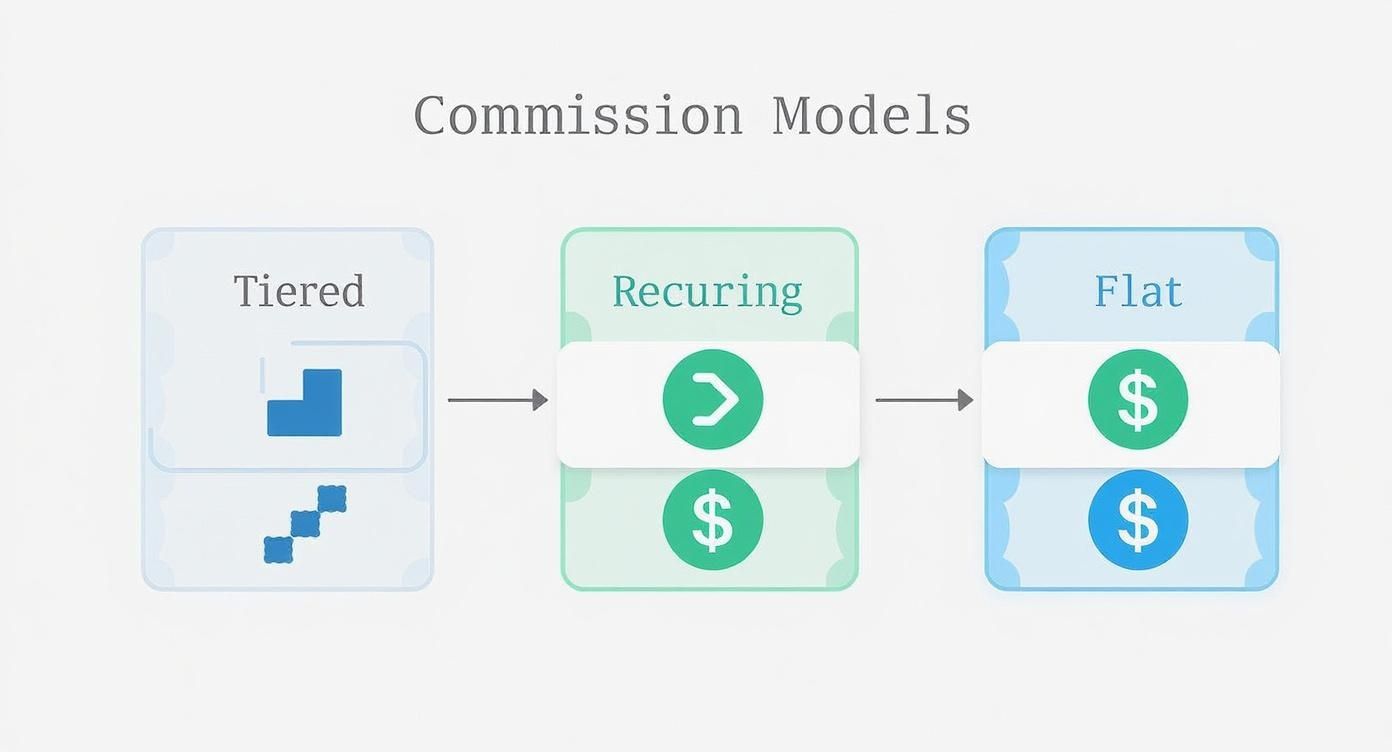
You can see how each model is designed to drive different behaviors—whether it's climbing tiers for bigger rewards or locking in that sweet, long-term recurring revenue.
Untangling Split Commissions
It’s pretty common for multiple reps to have their hands in a big deal. Maybe an SDR dug up the lead, an Account Executive nurtured it, and a sales engineer nailed the final demo. When that happens, a single commission check just isn't going to work.
The secret to split commissions is simple: define the split before the deal closes. Your commission policy needs to spell out exactly how credit is divided based on each person's role or contribution. A 50/50 split is easy, but you can get more granular and assign percentages based on who did what.
Let's look at a real-world example:
An SDR and an AE partner up to close a $40,000 deal. The total commission is 10% ($4,000), and your company policy sets a 30/70 split for SDRs and AEs.
- SDR's Share: $4,000 × 30% = $1,200
- AE's Share: $4,000 × 70% = $2,800
Having this structure locked in beforehand prevents arguments and makes sure everyone feels valued. Without it, you’re just creating internal friction that can poison a collaborative sales floor.
Managing Returns and Chargebacks
Nothing stings quite like paying out a commission only to see the sale disappear a month later. Customer returns, cancellations, and credit card chargebacks are just part of doing business. Your commission plan needs a fair way to handle these reversals, which we call commission clawbacks.
A clawback provision is a clause in your sales agreement that lets the company reclaim commission from a sale that gets reversed. The policy should be super specific about the time frame, like 90 days, during which a commission is subject to a clawback.
My two cents: Be transparent about this from day one. Clearly explain your clawback policy during onboarding. Sales reps need to understand that their commission is tied to secured revenue, not just a signature on a contract. This also encourages them to find good-fit customers, which naturally reduces churn.
Imagine a rep earned a $1,500 commission on a $15,000 sale in May. But in June, the customer cancels their subscription and gets a full refund.
- That $1,500 commission would be deducted from the rep's June payout.
- If their total June commissions were $6,000, their final check would be for $4,500.
This keeps compensation tied to actual, realized revenue for the company. It’s fair for everyone.
Navigating Commission Draws
For roles with really long sales cycles—think enterprise software or big real estate deals—a draw against commission can be a lifesaver. It’s basically an advance payment, kind of like a base salary, that the salesperson repays from their future earned commissions. It provides a predictable income stream while they work on closing those huge, infrequent deals.
There are two main flavors of draws:
- Recoverable Draw: This is the most common. The company pays the rep a set amount, say $3,000 a month. Once they start earning commissions, the first part of their earnings goes to "repay" the draw. Anything on top is theirs to keep.
- Non-Recoverable Draw: This is less of a loan and more of a guaranteed salary. The rep gets the draw amount no matter what they earn in commission, and they don't have to pay it back.
When you're figuring out your commission model, getting a handle on key financial metrics is a must. Some models, for example, base payouts on how profitable a sale is, which means having a solid grip on understanding gross profit.
Here’s how a recoverable draw plays out:
A new salesperson is on a $2,500 monthly recoverable draw. In her third month, she closes a great deal and earns $7,000 in commission.
- Total Draw Paid (over 3 months): $2,500 × 3 = $7,500
- Commission Earned: $7,000
- The Math: $7,000 (Commission) - $7,500 (Draw) = -$500
In this scenario, her commission covered most of the draw, but she still has a $500 deficit to pay back from her next big win. If her commission had been $10,000, she would have repaid the $7,500 draw and taken home the extra $2,500. This system gives reps a safety net during ramp-up while still protecting the company's cash flow.
Best Practices for Tracking and Reporting

Getting your commission math right is only half the battle. If your tracking is sloppy and your reports are a mess, you'll destroy trust and motivation, no matter how generous the plan is. Think of it this way: solid tracking and transparent reporting are the foundation of a healthy, high-performing sales culture.
When your salespeople can clearly see how their hard work turns into real money, they stay focused and driven. This isn't just about paying people correctly; it's about building a system that feels fair and professional for everyone.
Establish a Formal Commission Agreement
Before anyone even thinks about making a sale, get a formal commission agreement signed. This document is your single source of truth, and it's your best tool for heading off arguments before they start.
Don't rely on a handshake deal. That's just asking for trouble down the road. A proper agreement spells everything out, leaving no room for "I thought you meant..." conversations.
Make sure your agreement explicitly covers:
- Commission Rates: Every single rate, including any tiers, bonuses, or special incentives for certain products.
- Payout Schedule: Be specific. Is it monthly? The last Friday of the month? Lay it all out.
- Calculation Basis: Is commission based on total revenue or gross margin? Define it clearly.
- Clawback Policy: The exact terms for handling returns, cancellations, and chargebacks.
- Dispute Resolution: The step-by-step process a rep must follow if they think there’s a mistake in their pay.
A well-written commission agreement is your best defense against misunderstandings. It protects both the company and the salesperson by making the rules of the game crystal clear before it even starts.
Choose the Right Tracking Method
How you track everything will really depend on the size of your team. What works for a three-person startup will completely fall apart for a 30-person sales force. The goal is to find a method that gives you accuracy and visibility without creating a massive administrative headache.
Spreadsheets for Small Teams For a small team with a straightforward commission structure, a well-organized spreadsheet can do the trick. You can use separate tabs for raw sales data, individual rep calculations, and a summary dashboard. Tools like Google Sheets are great because they allow for real-time collaboration.
Dedicated Software for Growth But as your team gets bigger or your commission plan gets more complex (think multiple tiers, splits, and overrides), spreadsheets quickly become a huge liability. Human error is pretty much guaranteed. This is the point where dedicated commission tracking software becomes a must-have. Platforms like LinkJolt automate the whole process, saving you countless hours and preventing costly mistakes.
If you just want to run some numbers quickly, you can use an affiliate commission calculator to model different scenarios and see potential payouts.
Deliver Clear and Consistent Commission Statements
Never, ever just drop a payment into a salesperson's bank account without an explanation. Every single payout needs to come with a detailed commission statement that shows exactly how you arrived at that number. This level of transparency is non-negotiable if you want to build trust.
A good commission statement is more than a payslip—it’s a performance report. It shows reps which deals made them money, how different commission tiers were applied, and what, if any, deductions were made.
Your statements should always include:
- Total Sales Volume: The total sales credited to them for that period.
- Commissionable Earnings: The portion of those sales that is eligible for commission.
- Line-by-Line Breakdown: A list of each individual sale, the rate applied, and the commission earned from it.
- Adjustments: Any deductions for draws, returns, or splits, all clearly explained.
- Final Payout: The grand total they are receiving.
Providing this level of detail empowers your team. It helps them verify their pay, understand their performance, and figure out how to earn even more next month. Regular, transparent reporting turns compensation from a mystery into a powerful motivational tool.
Why Bother Automating Commission Calculations?
Let's be honest: manual commission tracking is a ticking time bomb. Sure, a spreadsheet might work when you're just starting out with a couple of reps. But as your team grows and your commission plans get more complex, that trusty spreadsheet quickly devolves into a tangled mess of VLOOKUPs, fragile formulas, and hidden errors.
I've seen it happen countless times. A single misplaced decimal or a broken cell reference leads to a major payroll headache. You either overpay and hurt your bottom line, or you underpay and completely demolish team morale.
And it’s not just about the mistakes. The sheer amount of time it takes is staggering. Your finance or sales ops people can easily lose days every single month just trying to reconcile sales, apply the right commission rates, and figure out splits or clawbacks. It's a soul-crushing, tedious process that pulls them away from work that actually pushes the business forward.
Get Rid of Costly Human Errors for Good
The biggest weakness of any manual process is that it relies on humans, and humans make mistakes. Even your most careful, detail-oriented employee can slip up. When that happens with commissions, it costs you real money and, more importantly, trust.
This is where automation is a game-changer. An automated system runs on the rules you set. Once you plug in your tiered rates, recurring payout logic, and any split commission rules, the platform does the math perfectly. Every single time.
Removing manual data entry from the commission process eliminates the #1 point of failure. You get 100% accurate payouts, which protects your financials and ensures your team has complete confidence in their paychecks.
Supercharge Team Morale with Real-Time Transparency
Top-performing salespeople are driven by momentum. Nothing kills that momentum faster than uncertainty about their pay. When they have to wait until the end of the month for a statement they can't easily decipher, it creates doubt and forces them to become "shadow accountants." They end up wasting precious selling time maintaining their own spreadsheets just to double-check your math.
Automation completely flips the script. Instead of a confusing report at the end of the month, modern platforms give reps a live dashboard. They can see their earnings update in real-time as they close deals. This immediate feedback turns commissions from a boring historical document into an exciting live scoreboard.
This kind of transparency isn't just a nice-to-have; it shows your team you value their work and have a fair system in place. If you want to explore this further, you can learn more about how dedicated commission management software builds a culture of trust.
Win Back All That Wasted Administrative Time
Think about what your team could accomplish with all the hours they’d get back if they weren't wrestling with spreadsheets each month. Automating your commissions turns a painful, time-sucking chore into a smooth, hands-off process.
This newfound freedom lets your people focus on what they're best at:
- Your finance team can shift from tedious data entry to high-level strategic planning.
- Your sales managers can spend their time coaching and developing their team instead of mediating payment disputes.
At the end of the day, automating how you calculate commission on sales is a smart investment in your company's accuracy, efficiency, and culture. It builds a rock-solid foundation of trust and frees everyone up to focus on growing the business.
Common Questions About Sales Commission
When you're setting up a sales compensation plan, you'll inevitably run into a few tricky questions that pop up time and time again. Getting these details right is just as important as picking the right commission model in the first place. Clear policies prevent confusion, build trust with your team, and keep the whole system running fairly.
Let's dive into some of the most common gray areas people ask about when figuring out sales commissions and give you some practical ways to handle them.
How Do You Handle Different Commission Rates for Different Products?
This is a classic situation, especially if you sell a mix of products with wildly different profit margins. The trick is to calculate the commission for each product line on its own and then add them all up for the final payout.
The formula is pretty simple: (Product A Sales × Product A Rate) + (Product B Sales × Product B Rate) = Total Commission
Let's say one of your reps sells $20,000 of your main software product, which earns them a 10% commission. In the same month, they also sell $5,000 of a lower-margin add-on service that only gets a 5% commission.
Here’s how that breaks down:
- Software Commission: $20,000 × 0.10 = $2,000
- Service Commission: $5,000 × 0.05 = $250
- Total Payout: $2,000 + $250 = $2,250
For this to work without turning into an administrative headache, you absolutely need your sales data tracked accurately in your CRM.
Should Commission Be Based on Revenue or Gross Profit?
This is a big strategic decision that really boils down to what you want to incentivize.
Paying commission on total revenue is simple and direct. It’s a great way to motivate reps to go after pure sales volume. The downside? It can sometimes encourage deep discounts that eat into your profitability.
On the other hand, basing commission on gross profit (Revenue - Cost of Goods Sold) gets your sales team thinking just like business owners. This model directly ties their paycheck to the company's bottom line, encouraging them to sell smarter, more profitable deals—not just bigger ones. It's often the best fit when reps have some wiggle room on pricing or when product margins vary a lot.
When Is the Right Time to Pay Sales Commission?
Whatever you decide, make sure your payout schedule is spelled out crystal clear in your official commission agreement. There’s no room for guessing here.
A few common approaches include:
- Monthly or Quarterly: This is a popular choice because it gives your salespeople a predictable, stable income, which is a huge morale booster.
- Upon Receipt of Client Payment: This approach protects your company’s cash flow. You’re not paying commissions on money that hasn't actually hit your bank account yet.
The sweet spot is finding a rhythm that keeps your business financially healthy while also making sure your team feels rewarded and motivated.
Key Insight: Many businesses use a hybrid model. They'll calculate commissions monthly to give reps a clear view of their earnings, but they only pay out that commission once the client's payment has been received. This gives you the best of both worlds: transparency for the rep and security for the business.
How Are Taxes Handled on Commission Payments?
Think of commission as supplemental income—it’s subject to all the usual payroll taxes, like federal, state, and FICA. The employer is responsible for withholding these taxes directly from the payment.
Often, this is done using the percentage method, where federal taxes are withheld at a flat 22%. Another way is the aggregate method, which lumps the commission in with the employee's regular salary and withholds taxes based on their W-4 elections. The most important thing is for both you and your salespeople to be on the same page about these tax obligations from day one.
Ready to stop wrestling with spreadsheets and eliminate costly errors? LinkJolt automates your entire commission process, from tracking complex tiered rates to processing global payouts with zero fuss. See how you can build a more transparent and efficient commission system by visiting https://linkjolt.io today.
Watch Demo (2 min)


Trusted by 300+ SaaS companies
Start Your Affiliate Program Today
Get 30% off your first 3 months with code LINKJOLT30
✓ 7-day free trial
✓ Cancel anytime
Frequently Asked Questions
What is the basic formula for calculating sales commission?
The foundational formula is Total Sales Revenue multiplied by Commission Rate equals Total Payout. For example, if a sales rep closes 50,000 dollars at a 5 percent rate, the payout is 2,500 dollars. This straightforward calculation is the bedrock of any compensation plan and must be fully understood before adding complexity like tiered rates or split commissions.
What are the core components of a commission calculation?
Every commission calculation has three elements: the commission base, which is the amount eligible for commission such as total revenue or gross profit; the commission rate, which is the percentage or fixed amount applied to that base; and the payout, which is the final dollar figure the salesperson earns. Defining all three with absolute clarity in a written agreement prevents disputes down the road.
What commission rates are typical across industries?
Average commission rates generally fall between 5 and 20 percent, though the range varies significantly by industry, deal size, and whether the sale is a one-time transaction or a recurring subscription. Higher-value or longer-cycle deals often carry higher percentage rates because the effort per sale is greater. Reviewing industry benchmarks before setting rates helps attract competitive salespeople without overpaying relative to the market.
How do you design a commission plan that motivates a sales team?
An effective commission plan aligns individual sales behavior with the company's financial goals. The commission base should reward the outcomes the business cares about most, such as gross profit rather than gross revenue if margins vary by product. When every member of the team from new reps to senior management understands how commissions are calculated, it builds trust and makes the compensation system a genuine motivator rather than a source of confusion.