Detecting fraudulent transactions: Safeguard Your SaaS Revenue Now
Detecting fraudulent transactions: Safeguard Your SaaS Revenue Now

Ollie Efez
December 27, 2025•19 min read
Detecting fraudulent transactions is all about sniffing out and stopping shady activities before they hit your bottom line. It’s a mix of art and science—analyzing user behavior, transaction data, and payment info to spot the weird patterns that scream "scam." Get it right, and your marketing budget pays for real growth, not clever cons.
Why Affiliate Fraud Is Draining Your Marketing Budget

Picture this: you've launched a killer affiliate program, but your marketing spend is vanishing into thin air. You're paying out commissions for fake sign-ups instead of landing actual customers. This isn't just a technical glitch; it's a direct assault on your revenue.
For SaaS founders, an affiliate program can be a rocket ship for growth. But without a watchful eye, that rocket ship can quickly turn into a money pit.
The core problem? Fraudsters are pros at exploiting the trust that affiliate marketing is built on. They use a whole bag of tricks, from simple click spamming to sophisticated schemes involving stolen credit cards and synthetic identities, all to generate bogus commissions. Every fraudulent payout is a dollar you could have spent acquiring a real, long-term customer.
The Hidden Costs of Inaction
Letting affiliate fraud slide does more than just bleed your marketing budget dry. It kicks off a chain reaction of problems that can seriously damage your business's health and reputation. The cash you lose upfront is obvious, but the ripple effects are often way worse.
These hidden costs pile up fast:
- Skewed Performance Metrics: Fake conversions and junk traffic completely warp your data. This makes it impossible to know which campaigns are actually working or where to put your money next.
- Wasted Operational Resources: Your team gets bogged down chasing ghosts. Instead of focusing on growth, they're stuck investigating suspicious activity, dealing with chargebacks, and fielding angry emails.
- Reputational Damage: Getting tangled up in fraudulent activity can tarnish your brand's name with payment processors, ad networks, and even the good affiliates you want to work with. They'll start to wonder if partnering with you is worth the risk.
And this problem is getting bigger, fast. Consumer fraud losses in the U.S. shot up by 25% year over year, hitting an eye-watering $12.5 billion. For affiliate programs, that trend is a massive red flag. Only a third of companies manage to catch fraud during onboarding; the rest find it much later, usually after the damage is already done. This is why having a solid detection system isn't a "nice-to-have"—it's critical. You can dig into more financial fraud trends to see just how big this challenge is.
Key Takeaway: Detecting fraudulent transactions isn't just about saving a few bucks on commissions. It’s about protecting the integrity of your entire growth engine, making sure your data is clean, and safeguarding your brand's reputation in a cutthroat market.
This guide will give you a no-nonsense, practical framework for fighting back. We'll walk through the common fraud tactics, the data signals you absolutely have to monitor, and how to blend simple rules with smart automation. By the end, you'll know how to make sure every dollar you spend on commissions is driving real, sustainable growth.
Understanding Common Affiliate Fraud Tactics
Before you can effectively shut down fraudulent transactions, you have to learn to think like a fraudster. Understanding their playbook is the first and most critical step in building a solid defense.
Affiliate fraud isn't a single action. It’s a collection of shady techniques designed to game your system and illegitimately pocket commissions. These tactics range from crude, high-volume schemes to sophisticated manipulations that are nearly impossible to spot without the right tools and a keen eye.
By breaking down the most common methods, you can start building a clear picture of the threats you’re up against. This knowledge is what separates a reactive, damage-control approach from a proactive, protective one.
Click and Traffic Fraud
At its core, click fraud is all about faking user interest to either get paid per click or to create the illusion of a high-performing channel. Scammers use automated scripts, click farms, or vast botnets to generate thousands—sometimes millions—of illegitimate clicks on their affiliate links.
Imagine an affiliate driving 10,000 clicks to your site overnight, all originating from a single block of IP addresses. These aren't potential customers; they're ghosts in the machine, programmed to inflate click metrics and nothing more.
This kind of fraud completely pollutes your marketing analytics, making it impossible to gauge the true performance of your campaigns. You end up wasting ad spend and making terrible business decisions based on faulty data.
Pro Tip: Keep a close eye on your time-to-convert (TTC) metric. Real users take time to browse, read, and evaluate a product before signing up. Clicks that lead to a conversion almost instantaneously are a massive red flag for automated bot activity.
Conversion and Transaction Fraud
This is where the real financial damage happens. Conversion fraud involves using stolen credit cards, fake identities, or disposable payment details to complete sign-ups or purchases, which triggers a commission payout.
For example, a fraudster might get their hands on a list of stolen credit card numbers and use them to sign up for dozens of free trials of your SaaS product through their affiliate link. They collect the commission for each "new customer," and you're left holding the bag when the inevitable chargebacks roll in. Too many chargebacks can seriously damage your standing with payment processors like Stripe or Paddle.
Another sneaky variation is incentive fraud. This is where an affiliate offers users a reward for signing up that violates your program's terms (like "get $10 cash for starting a trial"). This leads to a flood of low-quality leads that churn the second they get their reward, leaving you with useless "customers."
Here’s a quick-reference table to help you spot the early signs of trouble.
Common Affiliate Fraud Types and Key Indicators
This table isn't exhaustive, but it covers the most common schemes you'll encounter. Getting familiar with these patterns is the first step toward building a more resilient detection system.Cookie Stuffing and Attribution Theft
Cookie stuffing is one of the more insidious tactics. The fraudster uses pop-ups, hidden iframes, or even malicious browser extensions to drop their affiliate tracking cookie onto a visitor's browser without a legitimate click.
If that user later finds your site on their own—days or even weeks later—and makes a purchase, the commission is wrongly awarded to the fraudster. They did absolutely nothing to influence the sale, effectively stealing the commission from either you or the legitimate affiliate who actually deserved it.
Spotting this requires looking for affiliates who get credit for sales but show almost no corresponding referral traffic in your analytics. Their conversion rates might look fantastic on paper, but the clicks simply aren't there to back it up. By familiarizing yourself with these schemes, you can better tune your systems for detecting fraudulent transactions and protect your program's integrity.
Building Your First Line of Defense with Rule-Based Detection
While the complex, headline-grabbing fraud schemes get all the attention, a surprising amount of affiliate fraud is actually pretty simple. You don't need a massive, AI-powered system right out of the gate. The first, most critical step is to build a simple but sturdy firewall using rule-based detection.
Think of this as your front line. It’s designed to stop the most common, low-effort attacks dead in their tracks. The whole approach is built on "if-then" logic that automatically flags suspicious activity using the data you already have. It’s practical, effective, and you can start implementing it today.
But for any of this to work, you have to be looking at the right data in the first place. These signals are what give you the context to tell a real customer from a fraudster.
Identifying Key Data Points to Monitor
To start catching fraud, you need to focus on a few high-impact data sources. These are the digital breadcrumbs that lazy fraudsters often forget to cover up, giving you glaring signals to build your rules around.
You can pull most of this information straight from your affiliate platform, payment processor (like Stripe or Paddle), and your own application logs. The real magic happens when you cross-reference these sources to get a more complete picture of every single transaction.
Here are the key signals to zero in on:
- IP Address Data: Is the user's IP coming from a known data center or a high-risk country? Does the user's location even remotely match the affiliate's location? A mismatch is a classic red flag.
- Device Fingerprints: Are you seeing a flood of conversions coming from the exact same device? This unique ID for a user's browser and device is a dead giveaway that one person is churning out fake accounts.
- Email Domain Analysis: Are sign-ups pouring in from disposable or temporary email providers (think
mailinator.com)? These are almost always a sign of junk conversions. - Transaction Velocity: How fast are those conversions happening? A sudden, unnatural spike from a single affiliate is a textbook sign of bot activity.
Monitoring these points gives you the raw material for effective rules that act like tripwires. This proactive approach is a cornerstone of any good affiliate fraud prevention strategy.
Crafting Your Initial Set of Fraud Rules
Once you know what data to look at, it’s time to write your first set of rules. Think of them as simple logic statements that your system checks with every new affiliate-driven conversion.
Start small. A few specific, high-confidence rules targeting the most blatant fraud patterns are all you need. You can always add more complexity later on.
Here are a few practical examples you can adapt and use right now:
- High-Frequency IP Rule:
IFan affiliate generates more than 5 conversions from the same IP address within a 24-hour period,THENflag all related transactions for manual review. - Disposable Email Rule:
IFa new sign-up uses an email from a known disposable provider,THENautomatically hold the commission and flag the affiliate's account. - Geographic Mismatch Rule:
IFthe IP address country of a referred customer doesn't match the affiliate's registered country,THENassign a low-level risk score to that transaction.
Expert Insight: Don't aim for a perfect system on day one. Your goal is to catch the low-hanging fruit. I've seen a few well-crafted rules eliminate over 80% of the most common, unsophisticated fraud attempts. This frees up your time to focus on growing your program, not chasing ghosts.
These rules aren't meant to be the final judge and jury. They're an automated alert system, pointing you directly to the transactions that actually need a closer look.
This is more important now than ever. With e-commerce payment fraud projected to jump by 141% to $107 billion by 2029, and business email compromise being a top threat for 63% of organizations, you can't afford to be passive. Setting up strong, rule-based checks is your first critical move.
By creating this foundational defense, you put up a significant barrier. You force fraudsters to work harder, and most of the time, they'll just give up and move on to an easier target. This leaves your affiliate program healthier, more profitable, and far more secure.
Advancing Your Strategy with AI and Machine Learning

While a solid set of rules gives you a great first line of defense, the most sophisticated fraudsters are always finding new ways to slip through static defenses. This is where you need to layer in artificial intelligence and machine learning. It's a game-changer that moves you beyond simple "if-then" logic to spot the subtle, weird patterns that fixed rules will always miss.
The real power here comes from behavioral analytics. Instead of just looking at isolated data points, AI models analyze the entire context of a user's journey. They connect the dots between dozens of seemingly unrelated signals to flag behavior that just doesn't feel right.
Moving Beyond Static Rules
Static rules are powerful, but they're also brittle. They can only catch what you already know to look for. The moment a fraudster finds a new loophole, your rules are completely blind to it until you manually update them—and by then, the damage is often done.
Machine learning, on the other hand, is dynamic. It learns from new data in real-time, constantly refining its understanding of what's normal versus what's suspicious. That adaptability is its biggest advantage.
Let’s look at a classic scenario:
- An affiliate refers a new "user" who signs up for a trial.
- The time between the click and the conversion is less than three seconds.
- This new "customer" never logs into the account again after that initial signup.
A basic rule-based system might not catch this, but an ML model trained on real user behavior would immediately flag this sequence as highly improbable for a legitimate customer. That's the kind of nuanced detection that gives you a real edge.
Key Insight: Machine learning doesn't just look at what happened; it understands how it happened. It analyzes the speed, sequence, and relationships between actions to build a much deeper, more accurate picture of user intent.
Key Areas Where AI Excels
AI and machine learning aren't just buzzwords; they deliver tangible advantages in specific, high-impact areas of fraud detection. Weaving these models into your system can dramatically boost both the accuracy and efficiency of your prevention efforts.
Here's where they really shine:
- Anomaly Detection: AI algorithms are brilliant at establishing a baseline of normal user behavior for your platform. From there, they can instantly flag outliers, like a user signing up from a location thousands of miles away from their billing address.
- Predictive Scoring: Instead of a simple pass/fail, ML models can assign a risk score to every single transaction. This lets you automatically approve low-risk conversions while flagging moderate and high-risk ones for a human review, making your team's time much more effective.
- Network Analysis: More advanced models can map out the hidden relationships between different accounts, devices, and payment methods. This is how you uncover sophisticated fraud rings where multiple, seemingly separate accounts are all secretly controlled by a single bad actor.
This is especially critical when dealing with new affiliates. A staggering 67% of all fraud is linked to just 7% of payments made to newly added payees. With international wire fraud attempts surging 40% in value, using advanced analytics to scan for these patterns is non-negotiable. Platforms like LinkJolt can block suspicious referrals before any commissions are paid out.
Practical Implementation in Your Program
Adopting AI doesn't mean you have to go out and hire a full data science team tomorrow. Modern affiliate platforms are increasingly building these capabilities right in, giving you enterprise-grade protection without the massive overhead. For a deeper dive into the specific tools available, you can explore advanced features for AI and machine learning in fraud detection.
The goal is to build a layered defense. Your rule-based systems will catch the obvious, low-hanging fruit, while your machine learning models handle the more sophisticated and elusive threats. This intelligent, evolving shield works alongside your static rules to create a truly robust system for detecting fraudulent transactions. You can also read our guide on https://www.linkjolt.io/blog/fraud-detection-in-online-payments to see how these concepts apply more broadly.
Creating Your Investigation and Response Plan
Successfully detecting a fraudulent transaction is a huge win, but honestly, it's only half the battle. An automated alert is just a starting point. What you do next—the investigation and response—is what truly protects your business and maintains the integrity of your affiliate program.
Without a clear, repeatable plan, you're just reacting. Guesswork and emotional decisions can lead you to ban a legitimate partner or let a real fraudster slip through the cracks. A documented process is your playbook; it turns a red flag into a series of confident, decisive actions.
The Initial Investigation Phase
When an alert fires, your first instinct might be to shut the affiliate down immediately. Resist that urge. The goal here is to methodically gather evidence and build a clear picture of what’s actually happening. This initial deep dive is all about verifying the suspicion with concrete data before you even think about reaching out.
Your investigation checklist should be straightforward and data-driven.
- Review Transaction Data: Jump into your payment processor like Stripe or Paddle. Are you seeing a cluster of chargebacks, failed payments, or cards flagged for fraud that trace back to the suspicious conversions?
- Analyze User Behavior: Now, pivot to your application's analytics. Did these so-called "customers" ever log back in after signing up? Are their session durations unnaturally short, or did they churn immediately? A pattern of zero engagement is a massive red flag.
- Cross-Reference Affiliate Data: Pull up the affiliate's history in your management platform. Is this a brand-new partner with a sudden, massive spike in performance? Check the IP addresses of the referred customers—are they all clustered in an unlikely location or coming from a known data center?
This process is about connecting the dots. A single anomaly might just be a fluke, but when multiple data points all scream "suspicious," you’ve got a solid case on your hands.
Building a Fair Escalation Process
Once you have your evidence, you need a clear path for what comes next. A tiered approach ensures your response is proportional to the severity and certainty of the fraud. Rushing to a permanent ban can burn bridges with legitimate partners who might have just made an honest mistake.
A well-defined escalation workflow brings consistency and fairness to the table.
- Commission Suspension: This is your immediate first step. If the evidence is strong, temporarily freeze commission payments for the flagged transactions. This move contains the financial damage while you investigate further.
- Affiliate Communication: Next, reach out with a calm, professional, and data-backed email. Avoid accusatory language. Simply state the patterns you've observed ("We noticed an unusual number of sign-ups from a single IP block...") and ask for an explanation. This step is crucial for separating malicious actors from partners who may have unintentionally violated a term.
- Account Suspension or Ban: If the affiliate is unresponsive, gives you a flimsy excuse, or the evidence of intentional fraud is overwhelming, a permanent ban is the final step. This action should be reserved for the most clear-cut cases of abuse.
Crucial Takeaway: Document everything. Every piece of data you analyze, every email you send, and every action you take needs to be recorded. This documentation is your shield in case of a dispute and is invaluable for refining your process over time.
To see how this plays out on a massive scale, just look at how Visa's GenAI-powered VAIA blocks a $40B fraud surge. Their advanced detection capabilities are a powerful reminder of how critical a well-oiled response plan is at the enterprise level.
By establishing this clear workflow, you create a system that is not only effective at stopping fraud but also transparent and defensible. It empowers your team to handle these sensitive situations with confidence, minimizing financial loss and protecting the long-term health of your entire affiliate program.
Tracking the Health of Your Affiliate Program
A robust fraud detection system is great, but how do you prove it’s actually working? You need to measure its impact. Tracking the right key performance indicators (KPIs) is the only way to know if your efforts are effective, efficient, and ultimately, profitable.
These metrics move you from guessing to knowing. By consistently monitoring a few key numbers, you can objectively prove the ROI of your prevention strategy, refine your rules over time, and build a much healthier affiliate program.
Core Metrics for Fraud Detection
Start by focusing on three essential KPIs. These will give you a clear, high-level view of your system's performance and help you spot areas for improvement.
- Fraudulent Transaction Rate: This is the most direct measure of your system's effectiveness. Calculate it by dividing the number of confirmed fraudulent transactions by the total number of affiliate transactions over a specific period. The goal is to keep this number as low as you possibly can, ideally below 1%.
- False Positive Rate: This KPI tells you how often your system incorrectly flags legitimate transactions as fraudulent. You get this number by dividing the number of incorrectly flagged transactions by the total number of flagged transactions. A high rate here means you might be blocking real customers and frustrating good affiliates.
- Chargeback Rate: Your payment processor provides this data. It’s the percentage of transactions that are disputed by customers. A high chargeback rate tied to a specific affiliate is a massive red flag for conversion fraud using stolen credit cards.
By tracking these numbers, you create a feedback loop. A rising Fraudulent Transaction Rate might mean you need to tighten a rule, while a spike in False Positives could indicate a rule is too aggressive and needs to be relaxed.
This visual shows the standard process flow for handling flagged transactions, from initial investigation to final resolution.
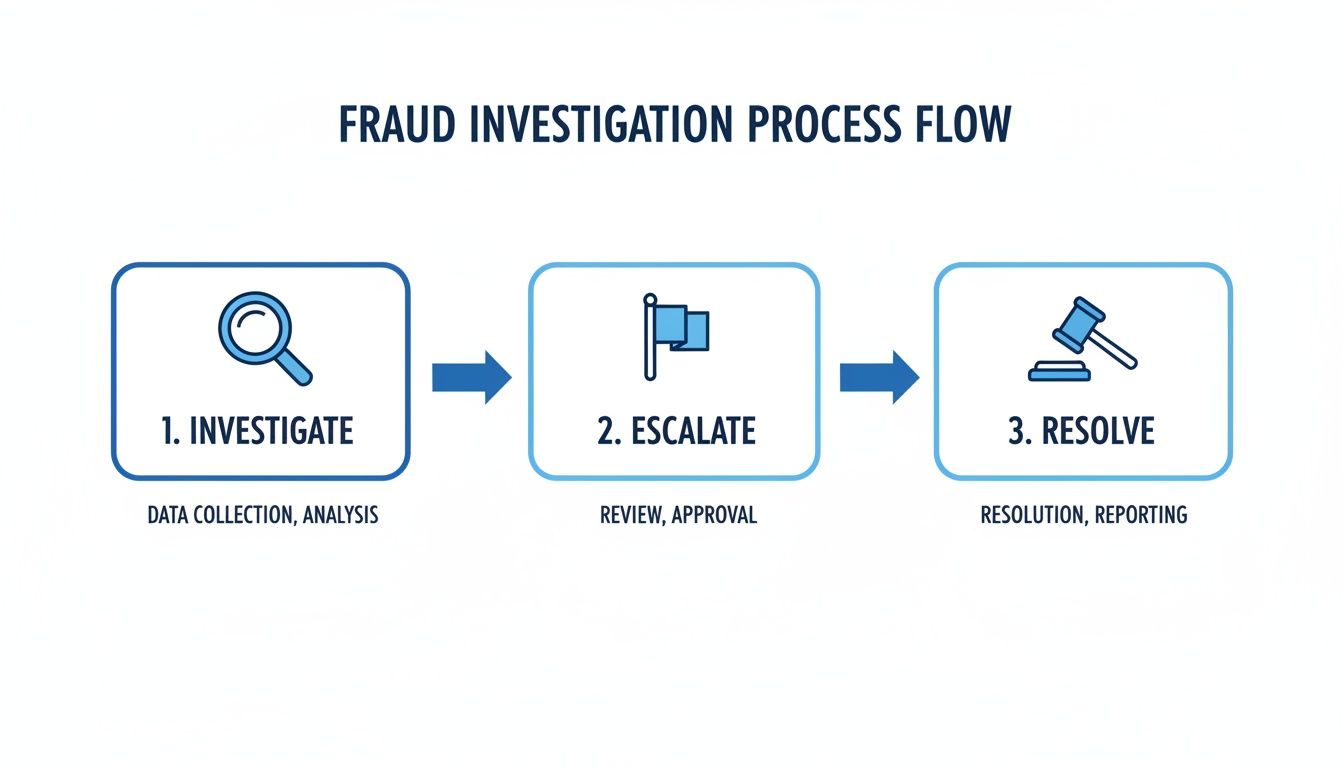
This simple workflow ensures every flagged transaction is handled consistently, which is critical for calculating your KPIs accurately. It turns raw alerts into the structured data needed to measure your program's health and make informed decisions.
Got Questions? We've Got Answers
If you're new to tackling affiliate fraud, you're not alone. Most SaaS founders run into the same questions when they start digging in. Here are some straightforward answers to the most common ones.
How Much Fraud Is Considered Normal?
While zero fraud is the goal, it's not the reality. In a healthy, well-run affiliate program, you should aim to keep your fraudulent transaction rate below 1%.
If you notice your numbers creeping above that benchmark, it's a clear sign that you need to take a closer look at your detection rules and tighten things up. Staying consistently below that 1% threshold is a good indicator that your defenses are working as they should.
What Is the Difference Between Rule-Based and AI Detection?
Think of it like this: rule-based detection is your front-door security guard with a very specific checklist. It's fantastic at catching the obvious, known threats—things like a flood of sign-ups coming from the same IP address. It's your essential first line of defense.
AI-powered detection, on the other hand, is more like a seasoned detective on the case. It's not just looking for specific violations on a list. Instead, it analyzes behavior, context, and subtle connections between data points to spot new and sophisticated patterns that a fixed checklist would completely miss.
Key Takeaway: You don't choose one over the other. The best fraud prevention systems layer them both. Rules are there to catch the common, low-hanging fruit, while AI adapts to uncover the more complex, evolving tactics designed to bypass those simple checks.
How Do I Start Without a Big Budget?
You absolutely don't need an enterprise-level budget to start fighting back against fraud. The best place to begin is with the tools you already have. Your payment processor—whether it's Stripe or Paddle—and your own application analytics are goldmines of data.
Start with a few simple, high-impact rules that cost nothing but a bit of your time to implement:
- Flag disposable emails: Immediately block any sign-ups that come from known temporary email services.
- Monitor IP velocity: Set up an alert for when you see too many conversions from a single IP address in a short period.
- Check for geographic mismatches: If a customer's location is in a completely different part of the world from the affiliate's, it's worth a closer look.
These initial steps can wipe out a huge chunk of low-effort fraud and give you a solid foundation to build on as you grow.
Ready to automate your defense and protect your revenue? LinkJolt provides built-in fraud protection to help you stop suspicious activity before it costs you. Manage, track, and secure your affiliate program with confidence. Start your free trial today.
Watch Demo (2 min)


Trusted by 300+ SaaS companies
Start Your Affiliate Program Today
Get 30% off your first 3 months with code LINKJOLT30
✓ 3-day free trial
✓ Cancel anytime