A Guide to Attribution Marketing Software
A Guide to Attribution Marketing Software

Ollie Efez
January 05, 2026•21 min read

Attribution marketing software is what connects the dots between your marketing spend and actual business results, like a sale or a new lead. It takes you out of the world of guesswork and into data-backed reality.
Think of it as the instant replay system for your entire marketing strategy. It shows you exactly which channels and campaigns made the critical plays that led to a customer converting, giving you the clarity to double down on what works.
Why Attribution Software Is a Game Changer
Let's imagine your marketing channels are players on a soccer team. Each one has a role in getting the ball into the net—a conversion.
An Instagram ad might make the initial pass to an undiscovered prospect. A series of insightful blog posts dribbles the ball downfield, building interest and trust. Finally, a perfectly timed email campaign takes the shot and scores the goal. Without an instant replay, how would you know who the MVP was? Or who provided the crucial assist?
That replay is exactly what attribution marketing software provides. It’s a tool that tracks every customer interaction—or touchpoint—across all your channels and assigns credit to the ones that influenced the final decision. You can finally move beyond gut feelings and see a clear picture of what’s actually driving growth.
This solves one of the oldest and most frustrating problems in marketing: knowing which half of your advertising budget is being wasted. With clear attribution, you can confidently shift your resources to high-performing channels and fix or cut the campaigns that are falling flat.
From Guesswork to Growth
Businesses flying blind without attribution might see overall revenue go up, but they can't tell you why. This leads to some really poor decisions, like slashing the budget for a blog that seems quiet but is actually introducing most of your highest-value customers at the top of the funnel.
You can learn more about how this connects directly to your bottom line in our guide on what is revenue attribution.
In stark contrast, a business using attribution software makes strategic, evidence-based moves. They can see that while a Google Ad often gets the final click (last touch), it’s the blog posts that are doing the heavy lifting of generating initial interest (first touch). This insight leads to smarter, more effective marketing across the entire customer journey.
The market reflects this massive shift toward data-driven strategy. The global marketing attribution software market was valued at around USD 4.74 billion in 2024 and is expected to hit USD 10.1 billion by 2030. While large enterprises currently hold over 66% of the market share, the fastest growth is coming from small and mid-sized businesses who are plugging these tools into their existing platforms. You can dive deeper into these trends in the full report from Grand View Research.
Marketing With vs Without Attribution Software
To really drive the point home, let’s look at a side-by-side comparison. The difference in approach and results between a business using attribution software and one that isn't is night and day.
Ultimately, attribution software transforms marketing from an art into a science. It gives you the clarity you need to stop just spending money and start investing it wisely for predictable, scalable growth.How Different Attribution Models Work
Picking your attribution software is just the start. The real magic happens when you decide which story you want it to tell. Think of attribution models as different lenses for looking at your customer's journey—each one brings certain touchpoints into focus, giving you a completely different perspective on what’s actually driving sales.Imagine a customer’s path to buying is like a soccer game. Several players (your marketing channels) pass the ball back and forth before one of them scores a goal. An attribution model is just the rulebook you use to decide who gets credit for that goal.
Single-Touch Attribution Models
The simplest models are single-touch, which give 100% of the credit for a sale to a single interaction. They're incredibly easy to understand, but they can sometimes paint an overly simple picture of a complex journey.- First-Touch Attribution: This model gives all the glory to the very first interaction a customer had with your brand. It’s like giving all the credit to the friend who first mentioned a new restaurant, even if you later saw ads and read reviews before finally booking a table. This model is perfect for figuring out which channels are your best conversation starters—the ones filling the top of your funnel. To go deeper, check out our guide on first-click attribution.
- Last-Touch Attribution: On the flip side, this model gives 100% of the credit to the final touchpoint before a conversion. This is like crediting the last-minute Instagram ad you saw right before you booked that restaurant. It’s great for identifying which channels are your "closers," but it ignores all the hard work that warmed up the customer in the first place.
This concept map shows how attribution software connects the dots between different marketing channels and the final sale.
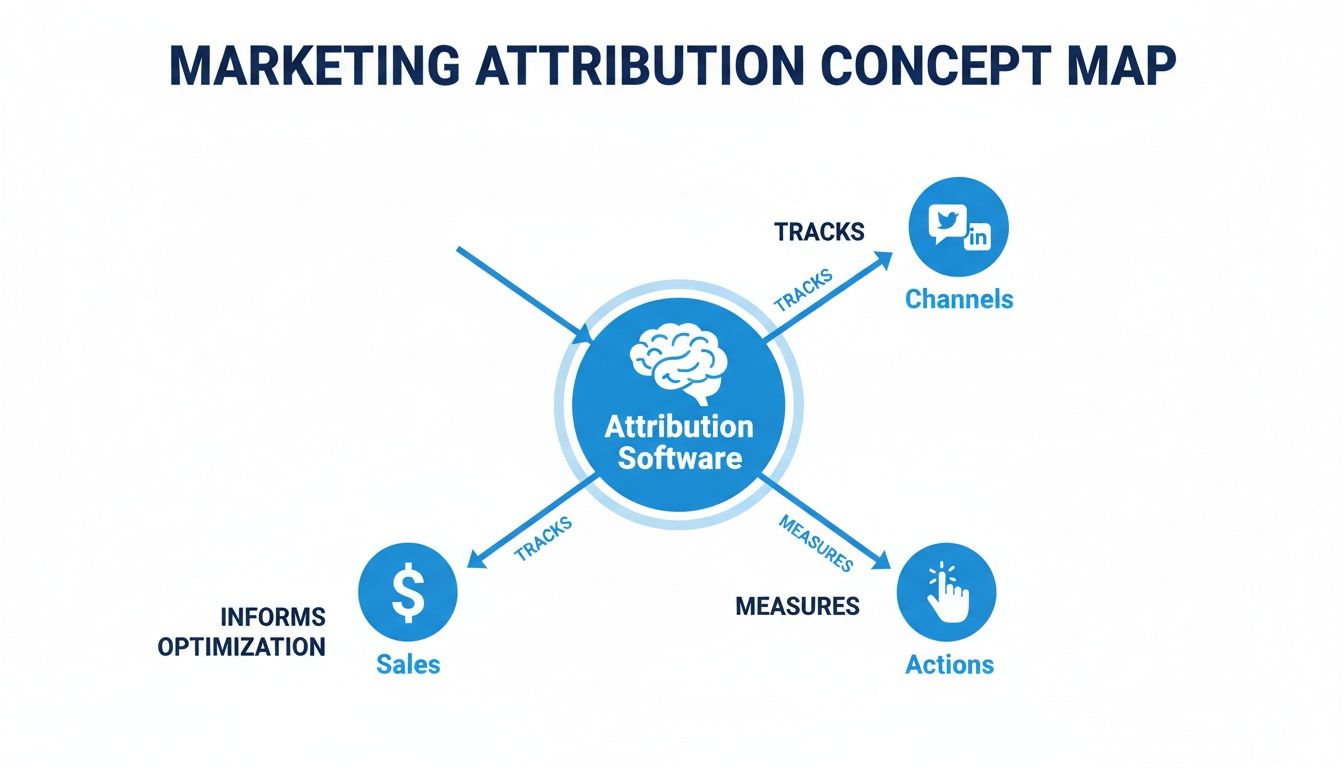
As you can see, true attribution isn't about finding a single hero channel. It's about understanding how all your efforts work together to drive revenue.
Multi-Touch Attribution Models
For businesses with longer sales cycles, where customers interact with you multiple times, multi-touch models offer a far more realistic view. They work by distributing credit across several interactions, recognizing that the final decision was a team effort.Spreading credit across various interactions helps you understand the entire customer journey, not just the first hello or the final handshake. This holistic view is critical for optimizing every single stage of your marketing funnel.
This approach is vital because single-touch models often fail to properly value the sustained engagement that happens in the middle of the funnel. Using the right multi-touch model ensures you give proper credit to the mid-funnel marketing efforts that are crucial for nurturing leads over time.
Common Multi-Touch Models Explained
There are several multi-touch models, each distributing credit in its own unique way to tell a slightly different story about your customer's path.- Linear Model: This is the most straightforward of the bunch. It splits credit equally among every single touchpoint. If a customer saw a social media post, read a blog, then clicked an email, each touch gets 33% of the credit. It’s democratic, but it doesn't weigh the relative impact of each interaction.
- Time-Decay Model: This model gives more credit to the touchpoints that happened closer to the conversion. That blog post they read three weeks ago gets less credit than the email they clicked yesterday. It’s ideal for longer sales cycles, as it gives more weight to the final nudges that got the customer across the finish line.
- U-Shaped Model: This model highlights two key milestones: the first touch that introduced the lead and the lead-creation touch (when they filled out a form, for example). It typically assigns 40% of the credit to each of these bookends, spreading the remaining 20% across all the interactions in between.
- W-Shaped Model: An evolution of the U-shaped, this model adds a third major milestone: the opportunity creation touchpoint. It gives 30% of the credit each to the first touch, lead creation, and opportunity creation, with the final 10% sprinkled across the other interactions. This is a favorite for B2B companies with very distinct sales stages.
Choosing the Right Attribution Model
So, which model is best? It all comes back to your business goals and sales cycle. This table breaks down which model might be the best fit for different scenarios.
Ultimately, there's no single "correct" model—the right one depends entirely on what you're trying to achieve. Whether your goal is boosting brand awareness or driving final sales, selecting the right attribution model inside your software is what will give you the specific insights you need to grow.What to Look For: Key Features of Top Attribution Software
Picking the right attribution marketing software is a lot like choosing the right lens for a camera. A basic lens will show you the picture, but a great one brings critical details into sharp focus, revealing insights you’d otherwise miss. While platforms vary, a few core features separate a simple analytics tool from a true attribution powerhouse.
These are the non-negotiables that work together to give you a complete, actionable view of your marketing performance, turning messy data streams into clear, strategic decisions.

A good interface isn't just about pretty charts; it's designed to tell a clear story about which channels are actually driving business growth.
Multi-Touch Attribution Models
The absolute bedrock of any serious attribution software is the ability to support multiple attribution models. As we covered, single-touch models like first-click or last-click only give you a tiny piece of the story. A top-tier platform has to let you swap between different lenses to see the full picture.
You need software that offers a full menu of models, including:
- Linear: Spreads credit evenly across every touchpoint for a balanced view.
- Time-Decay: Gives more credit to the most recent interactions, which is perfect for longer sales cycles.
- U-Shaped & W-Shaped: Puts extra weight on the most important milestones, like the first touch and the moment a lead is created.
The real magic happens when you can compare these models against each other. That’s what helps you truly understand the customer journey, from that first spark of awareness to the final sale.
Cross-Device and Cross-Platform Tracking
Let's be real: your customers don't live on a single device. They might see a TikTok ad on their phone, research your brand on their work laptop, and finally buy from their tablet at home. Without cross-device tracking, your software sees three different people, and your attribution data becomes completely useless.
Key Takeaway: Effective cross-device tracking stitches a user's journey into a single, cohesive story. It ensures you’re tracking the actual person, not just their devices, giving you a far more accurate picture of how your channels perform.
This feature is non-negotiable if you want an accurate read on your marketing ROI. It pieces together that fragmented journey so the mobile ad that generated initial awareness gets the credit it deserves, even if the purchase happens on a desktop two weeks later.
Real-Time Dashboards and Reporting
The marketing world moves fast. Waiting around for weekly or monthly reports just doesn’t cut it anymore. A must-have feature of modern attribution marketing software is a real-time dashboard that gives you an immediate, up-to-the-minute view of your campaign performance.
This instant feedback loop is a game-changer, letting you:
- Cut the Losers: Quickly spot ads that are burning through your budget without results and pause them before they waste another dollar.
- Double Down on Winners: See which campaigns are driving the most revenue and push more budget their way right now to maximize returns.
- Keep a Pulse on Metrics: Constantly monitor your cost per acquisition (CPA), return on ad spend (ROAS), and customer lifetime value (LTV).
Beyond just the models, the best attribution software also provides comprehensive social media analytics and reporting, giving you deeper insights into how those specific campaigns are performing. This level of detail ensures every marketing dollar is accounted for.
Seamless Integrations with Your Tech Stack
An attribution platform can't live on an island. Its true power is unlocked when it connects to all the other tools you use to run your business. Seamless integrations are the glue that creates a single source of truth for all your data.
Look for native, easy-to-set-up integrations with:
- CRM Platforms: Tools like Salesforce and HubSpot are vital for connecting marketing touches to the actual sales pipeline and closed-won deals.
- Ad Platforms: Direct connections to Google Ads, Meta (Facebook), LinkedIn, and others are necessary to pull in accurate spend and impression data automatically.
- Payment Processors: Integrating with Stripe or Paddle closes the final loop, tying every marketing action directly to a transaction.
Without these connections, you're stuck manually exporting CSVs and stitching data together in spreadsheets—a process that’s not only a massive time sink but also a breeding ground for costly errors.
Robust Affiliate Management Capabilities
For many businesses, especially in SaaS and e-commerce, affiliate and partner marketing is a huge revenue driver. The problem is, it's often managed in a separate system, totally disconnected from the bigger attribution picture. This is a massive mistake.
The best attribution platforms include integrated affiliate management. This is critical because it treats your partners as an integral part of the customer journey, not an isolated channel. By bringing affiliate tracking into the fold, you can accurately measure how partner referrals influence other channels and understand their true ROI within a multi-touch model.
This ensures every blog review, podcast mention, or influencer shout-out is credited correctly.
Integrating Affiliate Tracking into Your Attribution Strategy
It's tempting to treat affiliate marketing like its own little world, a channel that operates with a separate set of rules and platforms. But when you look closer, it's an incredibly rich network of touchpoints. A single affiliate might introduce your brand through a blog review, a podcast shout-out, a YouTube tutorial, or a simple social media post.
If you don't integrate that activity into your main attribution strategy, you're flying blind. You’ll see sales come in from affiliates, sure, but you won't ever understand the full story. The real impact your partners have—how they tee up sales for other channels and contribute across the entire customer journey—gets lost in a data black hole.
This is where specialized affiliate management becomes a critical piece of your attribution marketing software. By pulling partner performance into your main analytics dashboard, you can finally connect the dots and see the true ROI of your program.
Why Siloed Affiliate Data Is a Problem
When your affiliate platform is disconnected from your core attribution system, you only get one part of the picture: the last click. This creates huge blind spots that can cost you money and hide your best growth opportunities.
Let’s say an affiliate writes an incredibly detailed product review that serves as a customer's very first introduction to your brand. They might not click and buy right away, but weeks later, they see a retargeting ad and finally convert.
A last-click model would give 100% of the credit to that retargeting ad, completely ignoring the crucial role the affiliate played in building awareness and trust from the get-go. This leads you to undervalue your most effective top-of-funnel partners.
Misattributing credit like this has serious consequences. You might end up cutting ties with a high-value affiliate because their direct conversions look low, all while they're actually setting up wins for your other channels.
Unifying Affiliate and Marketing Attribution
Modern attribution software fixes this by integrating directly with affiliate tracking systems. This creates one unified view where affiliate touchpoints are logged and measured just like any other interaction, whether it's a Google Ad click or an email open.
This unified approach lets you:
- Credit the Entire Journey: Apply multi-touch models (like Linear, U-shaped, or Time-Decay) to your affiliate channel, giving partners credit for assisting conversions, not just for closing the deal.
- Identify Your True MVPs: Discover which affiliates are introducing your most valuable, high-LTV customers, even if they aren't the ones getting that final click.
- Optimize Partner Efforts: See how affiliate traffic interacts with your other channels. You might find that customers from certain partners convert better with email follow-ups, while others respond best to social ads.
To get the most accurate picture, picking the right tools is vital. You can learn more about what to look for in this guide on the best affiliate tracking software. The right platform ensures every referral is correctly captured and credited across the customer's entire lifecycle.
The Strategic Advantage of Integrated Tracking
Imagine you run a SaaS company. Your attribution data might reveal that customers referred by a specific tech blogger have a 25% higher lifetime value than customers from any other channel. This insight is pure gold.
It tells you to invest more in that relationship—maybe by offering an exclusive commission rate or co-creating some content. Without integrated tracking, you would have never made that connection. You'd just see the blogger's last-click numbers and miss the bigger, much more profitable picture.
Ultimately, integrating affiliate management into your attribution strategy isn't just a technical fix; it's a strategic move. It elevates affiliate marketing from a siloed tactic to an essential, measurable part of your growth engine, giving you the clarity needed to build a smarter and more profitable partner program.
Common Challenges in Marketing Attribution
While grabbing a new piece of attribution software opens the door to smarter, data-backed decisions, the path to perfect clarity is rarely a straight line. Let's be honest: implementing any new system comes with its share of hurdles. Being aware of them from the get-go is the best way to prepare for a smooth rollout.You're going to run into things like messy data or the challenge of getting your whole team on the same page. These aren't signs of failure; they're just part of the process. The real goal isn’t to sidestep every single problem, but to see them coming and navigate them like a pro.

Navigating Data Gaps and Privacy
One of the first walls you'll hit is dealing with incomplete data. Your customer’s journey isn't a neat, online-only path. It's a winding road that includes offline touchpoints like phone calls, in-person events, or maybe even an old-school print ad. If your software can't see that activity, you're working with a story that has huge chapters missing.It's the same story with mobile. Tracking in-app actions can be a headache, often needing specific SDKs and careful integrations just to make sure the data flows where it's supposed to.
Key Insight: A truly effective attribution strategy has to see the entire customer journey, online and off. If you ignore offline channels or what happens inside your app, you'll end up giving credit to the wrong places and making decisions based on a flawed picture.
And then there's the ever-present issue of data privacy. Regulations like GDPR and CCPA put strict limits on how you can collect and use customer data. This makes things like cross-device tracking much tougher and puts a huge spotlight on compliance. Choosing software with built-in tools for managing consent and anonymizing data isn't a "nice-to-have" anymore—it's table stakes.
These tracking puzzles are everywhere. For instance, recent research found that a whopping 53% of marketers struggle just to track conversions from live chat properly. Yet, even with these hurdles, the attribution software market is set to explode from USD 4.944 billion in 2025 to an incredible USD 17.73 billion by 2035. That growth proves just how vital this tool is for modern marketing. You can dig into more of the numbers in this detailed report on Transparency Market Research.
Overcoming Common Implementation Mistakes
Beyond the technical headaches, a few strategic missteps can completely derail your attribution efforts before they even get off the ground. These slip-ups usually come down to a lack of solid planning and not getting everyone on board internally.Here are three common pitfalls you’ll want to watch out for:
- Choosing the Wrong Model: This is one of the biggest mistakes we see. A startup focused on building brand awareness that picks a last-touch model is shooting itself in the foot. Why? Because they'll completely undervalue all the top-of-funnel content that's actually doing the heavy lifting.
- Failing to Get Team Buy-In: Attribution isn't just a toy for the marketing department; it affects sales, finance, and the C-suite. If the sales team doesn't trust the numbers or leadership doesn't grasp its value, the insights you uncover will just sit there, never turning into action.
- Setting It and Forgetting It: Your customer journey isn’t set in stone, and neither is your marketing strategy. The attribution model that works today might be wrong for you in six months as your business grows or your sales cycle changes. You have to be willing to regularly review and validate your data to ensure it stays accurate over the long haul.
By anticipating these data hurdles and strategic traps, you can build a much more resilient and effective attribution framework. The key is picking a flexible attribution marketing software and, just as importantly, fostering a company-wide culture that actually values making decisions with data.
Frequently Asked Questions About Attribution Software
Jumping into the world of attribution marketing can bring up a lot of questions. As you move from staring at basic analytics to truly understanding your marketing ROI, it’s completely normal to want some clarity on the details.
We put together this section to give you straightforward answers to the questions we hear most often from marketers. The idea is to clear up any confusion so you feel confident choosing and using the right platform for your business.
What Is the Difference Between Marketing Attribution and Analytics?
It’s really easy to mix these two up, but they answer fundamentally different questions. Think of it this way: marketing analytics is your car’s dashboard, while marketing attribution is its detailed GPS history.
Marketing analytics shows you the "what"—how many clicks an ad got, your website's bounce rate, or which blog posts are popular. It’s the high-level summary of your performance metrics.
Marketing attribution, on the other hand, tells you the "why." It traces the exact route a customer took to find you, revealing which specific ad, social media post, or email campaign actually nudged them toward converting. Analytics gives you the big picture, but attribution marketing software delivers the turn-by-turn map you need to invest your budget where it actually works.
How Long Does It Take to Set Up Attribution Software?
Honestly, there’s no single answer here. The setup time can vary wildly depending on the platform's complexity and how deeply it needs to connect with your existing tools.
Simple, plug-and-play solutions, especially those designed for platforms like Shopify, can often be up and running in a day or two. These are usually built for people who don’t have a ton of technical expertise.
On the other end of the spectrum, more advanced enterprise systems that need to sync with a custom CRM, multiple ad platforms, and other data sources can take several weeks or even a few months to get just right. This process usually involves:
- Placing tracking scripts across your website and landing pages.
- Hooking up and testing all the integrations with your tech stack.
- Making sure the data is flowing accurately before you start making big decisions with it.
Is Attribution Software Useful for SaaS Businesses?
Absolutely. In fact, SaaS businesses are probably one of the biggest beneficiaries of attribution software because their customer journeys are often long and winding. A typical SaaS customer might interact with your brand a dozen times before they even think about signing up for a trial.
Just think about a common path for a new customer:
- They first discover your brand through a detailed comparison article.
- Weeks later, they see a LinkedIn ad and decide to attend your webinar.
- Then they get on your email list and receive a few nurture emails.
- Finally, they click a link in one of those emails to start a free trial.
Without solid attribution, you’d be guessing which of those touchpoints mattered most. Attribution software is priceless for helping you double down on the channels that generate customers with the highest lifetime value (LTV), not just the ones that drive the initial signup.
How Much Does Attribution Marketing Software Cost?
The cost of attribution marketing software covers a huge range, which is good news—it means there are options for businesses of all sizes. The price tag generally depends on the platform’s features, how much traffic you need to track, and the level of support you need.
Key Takeaway: When you're looking at the price, the real question to ask is about the potential ROI. By cutting out wasteful ad spend and moving that budget to channels you know are working, good attribution software often pays for itself many times over.
Here’s a general idea of what to expect:
- Entry-Level Tools: Some platforms offer free plans or basic tiers starting around $100-$200 per month. These are perfect for small businesses or startups just dipping their toes into attribution.
- Mid-Market Solutions: For more powerful platforms with multi-touch models and better integrations, you can expect to pay anywhere from $500 to $1,500 per month.
- Enterprise-Grade Platforms: Large organizations with complex needs, custom data models, and dedicated support teams can easily see costs climb to several thousand dollars per month.
The key is to find a tool whose capabilities—and cost—match your business's current needs and where you plan to grow.
Ready to stop guessing and start knowing exactly which marketing efforts are driving your revenue? LinkJolt provides the clear, actionable insights you need to optimize your affiliate and marketing channels with confidence. See how you can build a more profitable strategy today by visiting https://linkjolt.io.
Watch Demo (2 min)


Trusted by 300+ SaaS companies
Start Your Affiliate Program Today
Get 30% off your first 3 months with code LINKJOLT30
✓ 3-day free trial
✓ Cancel anytime