A Complete Guide to Affiliate Program Health for SaaS
A Complete Guide to Affiliate Program Health for SaaS

Ollie Efez
February 13, 2026•21 min read

So, what does a "healthy" affiliate program actually look like?
Before we start auditing and fixing things, we need a clear picture of the goal. Too many managers get tunnel vision, fixating on a single metric like total revenue while ignoring dangerous problems bubbling just beneath the surface. A program that’s pulling in big numbers from a handful of disengaged or shady partners isn't healthy—it's a ticking time bomb, one partner churn away from collapse.

Real affiliate program health is built on three core pillars: strong partner relationships, solid financial performance, and smooth operational efficiency. This balanced view is what separates a resilient, long-term growth engine from a program just chasing short-term sales spikes.
The Three Pillars of Program Vitality
To get this right, you first need a solid understanding key performance indicators (KPIs) versus metrics. Each of the three pillars has its own set of vital signs that, when read together, give you a complete picture of your program's health.
- Partner Engagement: This is all about the quality and activity level of your affiliates. The big numbers here are your active affiliate rate (the percentage of partners actually driving clicks or sales), partner churn, and the diversity of your affiliate base. Are you relying entirely on coupon sites, or do you have a healthy mix of content creators, influencers, and niche experts?
- Financial Performance: Now we’re talking about the money. Key metrics like Customer Acquisition Cost (CAC), conversion rates, Average Order Value (AOV), and affiliate-driven Lifetime Value (LTV) are what matter. A healthy program doesn't just deliver sales; it delivers profitable customers who stick around.
- Operational Efficiency: This pillar covers all the behind-the-scenes work that keeps the program running. Think about your fraud rate, tracking accuracy, and the time your team sinks into manual tasks. An efficient program runs on smart automation and clear workflows, freeing you up to focus on growth, not paperwork.
I see this all the time: managers prioritizing recruitment over activation. A program with 1,000 affiliates where only 50 are active is far less healthy than one with 200 affiliates where 100 are consistently engaged and driving results.
Here’s a quick-reference table summarizing the vital signs you absolutely need to track for a comprehensive health check.
Key Indicators of Affiliate Program Health
By tracking these indicators, you move from simply measuring activity to truly understanding your program's performance and long-term viability.Why a Holistic View Matters
The global affiliate marketing industry was valued at $27.8 billion and is projected to explode to $48 billion by 2027. This kind of growth shows just how vital a healthy program is, especially in the SaaS world, where over 80% of brands now have one.
When you look at your program holistically, you start to see how these pillars are interconnected. For example, a low active affiliate rate (Partner Engagement) might be the result of a clunky, confusing onboarding process (Operational Efficiency). That inefficiency, in turn, directly hurts your overall revenue potential (Financial Performance).
By understanding this interplay, you can make smarter, more impactful improvements. For SaaS companies, mastering these nuances is what separates a mediocre channel from one that powers sustainable growth. It's the key to building truly successful https://www.linkjolt.io/blog/saas-affiliate-programs.
Putting Theory Into Practice: Your Affiliate Program Health Audit
Alright, enough with the theory. It’s time to get your hands dirty with a real, tactical audit. A proper health check isn't just about glancing at your main dashboard; it's a deep dive into the specific reports that tell the true story of your program.
This audit will give you a clear, data-backed snapshot of your affiliate program’s health. You'll see exactly where you're crushing it and, more importantly, where you might be bleeding resources. We'll break this down into three core areas: partner performance, your commission structure, and the effectiveness of your assets. The goal here is to move from guessing to knowing—turning those vague feelings about your program into concrete action items.
Analyzing Partner Performance and Segmentation
Let’s get one thing straight: your affiliates are not all the same. Lumping them together in a single group is the fastest way to miss your biggest opportunities and ignore your most significant risks. The very first step of any real audit is to segment your partners into meaningful groups to see who’s actually driving value.
Go into your affiliate platform and pull a performance report for the last 90 days. Your mission is to categorize every single partner into one of three buckets:
- Top Performers: These are your superstars. They're likely the top 5-10% of your affiliates driving 80% or more of your results. Get to know them by name and dig into their traffic sources.
- Rising Stars: This group is showing signs of life. They might be generating consistent clicks but not many conversions yet, or perhaps they've just started to see some real traction. Look for partners with recent, upward-trending activity.
- Dormant Accounts: These are the partners who signed up but have generated zero clicks or sales in the last 90 days. A high number here is a massive red flag pointing to a problem in your onboarding or engagement process.
This simple segmentation instantly clarifies where to focus your energy. Forget generic email blasts. Now you can build targeted strategies for each group. Maybe you offer an exclusive commission bump to your top performers or schedule a one-on-one strategy call with a few rising stars to help them get over the hump.
I see this all the time: managers obsess over recruiting new affiliates while sitting on a goldmine of dormant or underperforming partners. Re-engaging just 10% of your inactive affiliates can often deliver better and faster results than trying to recruit and onboard hundreds of new ones from scratch.
Scrutinizing Your Commission Structure
Think of your commission structure as the engine of your program—it directly incentivizes the behavior you want to see. An outdated or poorly designed structure can attract the wrong kind of partners or, even worse, fail to motivate your best ones.
Pull your commission and payout reports. It’s time to ask some tough questions:
- Is It Competitive? How do your rates stack up against similar SaaS programs in your niche? If your competitors offer 30% recurring and you're stuck at 15% one-time, you’re fighting an uphill battle for top-tier talent.
- Does It Reward Value? Are you paying the same flat fee for a low-value lead as you are for a high-LTV customer? You should seriously consider a tiered structure that rewards partners for bringing in customers who sign up for annual plans or higher-tier packages.
- Is It Clear and Simple? A complicated structure with confusing rules and clawbacks is a major turn-off for partners. Simplicity builds trust and actually encourages promotion.
A powerful affiliate management platform like LinkJolt makes it incredibly easy to visualize these key metrics on a single dashboard.
Having this kind of real-time view lets you instantly see how payouts, clicks, and conversions are trending, helping you make much faster decisions about your commission strategy.
This analysis might reveal that you're overpaying for low-quality traffic from coupon sites while completely undervaluing a content creator who is driving highly profitable, long-term customers. Adjusting this is one of the quickest ways to improve your program’s financial health. You can find more tips on this by exploring how to measure marketing effectiveness.
Evaluating Your Marketing Assets and Tools
Finally, let's audit the tools and resources you're actually giving your affiliates. High-performing partners are professionals, and they won't waste their time promoting a brand that makes their job harder than it needs to be. Your affiliate portal should be a treasure trove of useful, conversion-optimized assets.
Here’s a practical checklist for your asset audit:
- Link Accuracy: Grab a random sample of your main tracking links and click on them. Do they all go to the correct, high-converting landing pages? A single broken link can cost you thousands in lost revenue.
- Creative Freshness: Are your banners, logos, and ad copy from last year? Outdated creative makes your brand look stale and untrustworthy. Make sure you have fresh assets for any new features or promotions.
- Content Resources: Do you give affiliates more than just banners? Think about offering product one-pagers, case studies, email swipe files, and video tutorials. The more you equip them, the better they can sell for you.
- Portal Usability: Is the affiliate portal easy to navigate? Can partners find their links, check their stats, and access creative in a few clicks? A clunky user experience is a major source of partner churn.
By systematically working through these three areas—partners, commissions, and assets—you’ll have a complete and brutally honest assessment of your affiliate program. Remember, this audit isn't about finding blame; it's about identifying clear, actionable opportunities for improvement.
Diagnosing What's Really Wrong with Your Program
Alright, you've done the audit and the numbers are in front of you. Now comes the fun part—playing detective. The data tells a story, but it rarely spells out the ending. Your job is to connect the dots between your KPIs and uncover the real problem, not just chase symptoms. Trust me, a sudden drop in performance is almost never caused by one single, obvious failure. It’s usually a chain reaction.
This investigation is where you truly protect your affiliate program health. For example, seeing your affiliate conversion rate suddenly tank by 30% is definitely alarming. The knee-jerk reaction is often to blame the affiliates, but the root cause might be something completely different—maybe a technical glitch on your end. Jumping to conclusions without a proper diagnosis means you might "fix" the wrong problem, wasting time and potentially burning bridges with valuable partners.
To make your analysis less chaotic, it helps to organize your investigation around the same pillars you used in the audit: partners, commissions, and assets. This decision tree lays out a clear diagnostic path to follow.
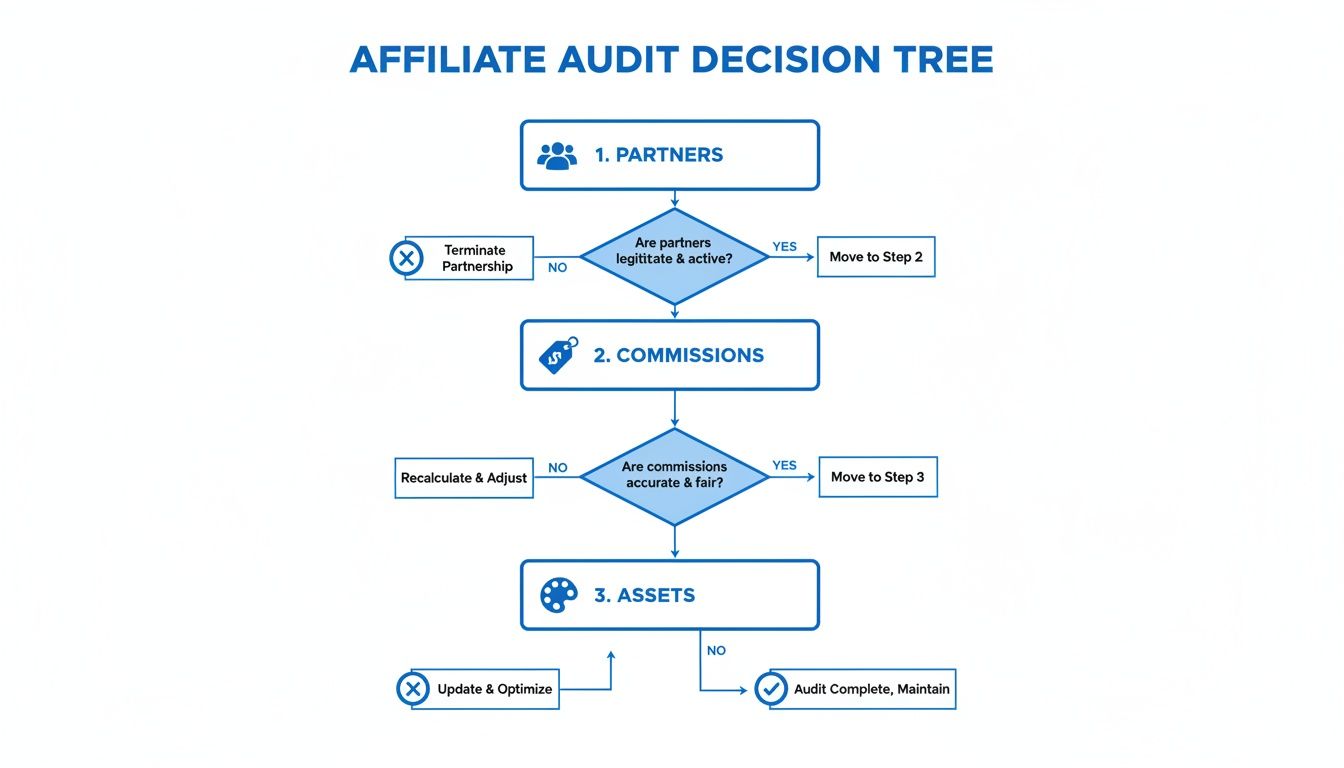
This visual guide helps you systematically check for trouble, starting with your partners, then moving to your commission structure, and finally digging into your creative assets to find the source of the issue.
The Case of the Plummeting Conversion Rate
Let's walk through a classic (and frustrating) scenario: your overall affiliate conversion rate takes a nosedive. Instead of panicking, you can use a simple workflow to pinpoint the cause.
First, segment the data. Did the drop happen across all affiliates, or is it isolated to a specific partner or group? If it’s just one major affiliate, the problem is likely localized to their traffic or promotional methods.
If a single large partner seems to be the source, dig a little deeper:
- Check their traffic sources: Have they recently switched up their promotion strategy? For instance, moving from a detailed blog review to a broad paid ad campaign can completely change traffic quality overnight.
- Review their landing page: Is their main promotional page still sending traffic to the correct URL on your site? Broken links happen more often than you'd think.
- Just reach out: A quick, friendly email can often solve the mystery. They might be testing a new campaign that isn't working out or might not even know there's an issue.
But what if the drop is program-wide? Then the problem is almost certainly on your side. In this case, your investigation turns inward. Start by looking for any recent changes to your website or checkout process. Did you launch a new landing page, update your pricing, or add a new step to the signup flow? Even a tiny tweak can have massive, unforeseen consequences.
A brand I worked with saw conversions drop by half overnight. The culprit? A website update had accidentally broken the promo code field in their checkout. Affiliates were sending tons of qualified traffic, but users couldn't apply the discount they were promised and were abandoning their carts in frustration.
Investigating a Surge in Dormant Affiliates
Another common red flag is a growing list of inactive partners. Your audit showed a high percentage of dormant accounts—now it's time to figure out why. Why are so many good affiliates going quiet or never even getting started in the first place?
The root cause often lies in your onboarding and engagement workflows. Think about the affiliate's journey from the second they sign up.
- The Welcome Experience: Do they get an automated welcome email with everything they need? This should include their unique tracking link, access to the affiliate portal, and a clear guide on where to find marketing assets.
- Initial Activation: Do you have an onboarding sequence that actually encourages them to make their first promotion? A simple "Getting Started" checklist or a small bonus for their first sale can make a world of difference. Research consistently shows that partners who earn a commission in their first 30 days are far more likely to stick around.
- Ongoing Communication: Are you talking to them regularly? A monthly newsletter with product updates, new creative, and performance tips keeps your program from getting lost in the noise.
If your onboarding seems solid, the issue might be your commission structure or the product itself. Maybe your cookie window is too short, or your commissions just aren't competitive enough to make the effort worthwhile. Using a platform like LinkJolt, you can analyze payout data against partner activity. You might discover that affiliates who promote specific features are more engaged simply because those offers convert better for their audience.
Ultimately, diagnosing these common issues requires a methodical approach. By breaking down the problem, segmenting your data, and asking the right questions, you can stop reacting to symptoms and start solving the core problems that are undermining your affiliate program's success.
Actionable Strategies to Improve Program Performance
Once you’ve figured out why things are underperforming, it’s time to get your hands dirty and start applying the right fixes. The secret isn't to throw everything at the wall and see what sticks. It's about being smart and prioritizing the actions that will give you the most bang for your buck. A few targeted adjustments can often deliver far better results than trying to rebuild the entire program from scratch.
We’re focused on tangible results here. Let's walk through some proven tactics that directly address the common problems you likely uncovered during your audit. We'll cover everything from waking up your sleeping partners to completely rethinking the way you pay commissions. This is all about making strategic moves that drive immediate wins and build a stronger, more sustainable program for the long haul.
Revitalize Your Dormant Affiliates
One of the biggest untapped goldmines in almost any affiliate program is that group of partners who signed up, got excited, and then… did nothing. Instead of writing them off as a loss, a targeted re-engagement campaign can breathe new life into these accounts and deliver a serious revenue bump for almost no acquisition cost.
Your job is to figure out what stopped them and remove that friction. Don't just blast out a generic "we miss you" email. Instead, build a dedicated onboarding sequence just for this group.
- Offer a First-Sale Bonus: A small, achievable carrot like an extra $25 on their first commission can be incredibly motivating. It gives them a clear, immediate target to aim for.
- Provide a "Quick Start" Kit: Package up your best-performing email swipe copy, a link to a top-converting landing page, and a quick video tutorial. Put it all in one place so it's impossible to miss.
- Schedule Office Hours: Invite them to a live, informal Q&A with your affiliate manager. That personal touch shows you’re actually invested in their success and helps clear up any questions they were afraid to ask.
The best re-engagement campaigns make partners feel seen and supported, not just nagged. A simple, "Hey, we noticed you haven't started yet—here are three simple steps to earn your first commission this week," is way more powerful than a generic newsletter.
Optimize Your Commission Structure for Value
Think of your commission structure as the primary tool you have for shaping partner behavior. If your audit revealed you're rewarding low-value customers or actions, it's time for a major tune-up. The goal is simple: align your payouts with your actual business goals, making sure your best partners are incentivized to bring in the right kind of customers.
A great way to do this is with a tiered or performance-based model. You could offer a standard commission rate for all sales, but then sprinkle in bonuses for specific, high-value actions.
- Reward High-Tier Plans: Offer a bigger commission percentage or a flat bonus when affiliates drive sales for your annual or enterprise-level plans.
- Incentivize Volume: Set up automated commission bumps for partners who hit a certain number of sales each month. This gamifies performance and encourages them to keep promoting you consistently.
- Pay for Quality: If Customer Lifetime Value (LTV) is your north star metric, think about offering a kicker bonus after a new customer stays active for three months. This rewards partners for bringing in sticky customers, not just one-off signups.
Using a platform like LinkJolt makes managing these kinds of complex structures a breeze. You can set up automated rules that adjust commissions based on performance tiers, specific SKUs, or other custom triggers you define, all without any manual work. This lets you build a sophisticated incentive program that practically runs itself.
Refresh and Deploy High-Impact Creative Assets
Outdated or uninspired creative is a silent killer of conversions. Your partners are counting on you to give them the materials they need to promote you effectively. If those banners and copy are stale, their performance is going to suffer right along with your brand's image. A creative refresh is a high-leverage move that can immediately lift the entire program.
Start by archiving all your old banners and ad copy. Get them out of the system. Replace them with fresh, modern designs that reflect your current branding and messaging. But don't just stop at banners. Think bigger and equip your affiliates with resources that actually help them sell.
Here’s a checklist for a truly powerful asset library:
- Case Studies and Testimonials: Give partners the social proof they need to build trust with their audience.
- Email Swipe Files: Write a few high-converting email templates they can easily adapt for their own newsletters.
- Product Demo Videos: Provide unbranded video walkthroughs they can share directly or embed in their content.
- Detailed Buyer Personas: Help them understand exactly who they should be talking to so they can tailor their messaging.
When you provide these resources through a clean, branded affiliate portal in a platform like LinkJolt, you ensure every partner has instant access to the latest and greatest materials. An organized, well-stocked portal makes affiliates feel like true partners in your business and dramatically improves their ability to represent your brand effectively. You can learn more about building this kind of supportive environment by checking out these affiliate marketing best practices.
By combining these strategic fixes, you can systematically improve your affiliate program’s health and build a more resilient, profitable marketing channel.
Building a System for Continuous Monitoring
An audit gives you a powerful snapshot, but your affiliate program is a living, breathing channel. Its health can change fast. Treating it like something you only check on once a quarter is a surefire way to miss small issues that quietly snowball into major problems.
You need a rhythm, a system for continuous monitoring that helps you spot trouble early. This isn't about being glued to a dashboard 24/7. It's about creating a simple, repeatable cadence for checking your program's vital signs so you can stay ahead of trends and keep things running smoothly.

Establishing Your Monitoring Cadence
A solid monitoring strategy doesn't treat all data the same. Some metrics need daily eyes; others only reveal their secrets when you zoom out over a month or a quarter. Trying to check everything all the time leads to noise, not signals.
Here’s a practical cadence I’ve seen work wonders:
- Weekly Checks: This is your pulse check. Focus on the fast-moving, leading indicators that give you an early warning if something’s off. Look for sudden drops in clicks, a weird spike in your fraud rate, or a slump in new partner applications. A quick 15-minute check every Monday morning is all it takes.
- Monthly Reviews: Now you can zoom out a bit to look for trends. How are your conversion rates holding up? Is your active affiliate percentage climbing? Are you on track to hit your revenue goals? This is also the perfect time to spot your top performers for the month and shoot them a quick, personal thank-you note.
- Quarterly Deep Dives: This is your time for real strategic thinking. You’ll dig into the big-picture, lagging indicators like affiliate-driven Customer Lifetime Value (LTV) and partner churn. You're comparing this quarter against the last and planning your next big moves—maybe it's a re-engagement campaign for dormant partners or a full overhaul of your commission structure.
Think of it like this: your weekly check is like checking the tire pressure on your car. The monthly review is checking the oil. The quarterly deep dive is your full service. All are essential to keep the engine humming.
Designing Your Program Health Dashboard
To make all this efficient, you need one central place to see the data that actually matters. While a platform like LinkJolt gives you powerful real-time analytics out of the box, creating your own focused "Health Dashboard" helps you cut through the noise. This could be as simple as a Google Sheet or a custom report you build within your platform.
I recommend splitting your dashboard into two key categories. This gives you the full story of your program's health.
Leading and Lagging Indicators
- Leading Indicators: These metrics predict your future success. They're all about the activity and engagement happening right now.
- New Affiliate Applications
- Click-Through Rates (CTR)
- Partner Activation Rate (% of sign-ups who grab a link and start promoting)
- Lagging Indicators: These metrics measure past performance. They tell you if the strategies you implemented actually worked.
- Total Affiliate-Driven Revenue
- Customer Lifetime Value (LTV)
- Partner Churn Rate
By tracking both, you get a clear picture of how today's hustle impacts tomorrow's results. For example, a steady climb in your partner activation rate (a leading indicator) should, over time, translate into higher revenue and a healthier LTV (your lagging indicators).
Of course, your program doesn't exist in a vacuum. A truly robust monitoring system also keeps an eye on external factors. It’s crucial to understand your competitive position by mastering share of voice in marketing. This broader perspective ensures your strategy stays sharp and relevant.
When you combine a smart cadence with a clear dashboard, you transform your affiliate program from a reactive channel into a predictable, scalable engine for growth.
Your Affiliate Program Questions, Answered
Running a healthy affiliate program brings up a lot of questions, especially when you're deep in the weeds of managing partners and tracking KPIs. Here are some of the most common ones I hear from SaaS founders and affiliate managers, with straightforward, actionable answers.
What’s A Good Active Affiliate Rate For A SaaS Program?
While the numbers can shift depending on your niche, a healthy SaaS affiliate program usually has 10-20% of its partners actively driving clicks or sales each month. Think of this metric as a vital sign for your program's engagement.
If your active rate is dipping below 10%, it’s often a red flag. This could point to issues with your onboarding flow, a weak engagement strategy, or incentives that just aren't hitting the mark. The goal isn't just to sign up a ton of affiliates; it's to nurture a core group of partners who are genuinely invested. A good first step is to use your affiliate platform to segment active versus inactive partners, then run a targeted re-engagement campaign to bring the dormant ones back.
How Often Should I Be Auditing My Affiliate Program?
You should block off time for a full, deep-dive audit—like the one we've covered in this guide—at least quarterly. This cadence is perfect for spotting long-term trends, measuring the real impact of your strategies, and making significant, well-informed adjustments.
But that doesn't mean you can set it and forget it for three months. Monitoring your key health metrics needs to be a much more frequent habit. I recommend a weekly or bi-weekly check-in. Just a quick glance at your main dashboard can help you spot any sudden conversion drops, weird spikes in traffic that might signal fraud, or a slowdown in new partner applications. This regular pulse check lets you catch small problems before they snowball.
What’s The Most Effective Way To Reduce Affiliate Churn?
At its core, reducing affiliate churn comes down to building real relationships through solid communication and reliable support. Affiliates stick around when they feel valued and have the tools they need to succeed. The simplest starting point is ensuring they have a dedicated manager or at least a clear point of contact they can reach out to with questions.
The secret to affiliate retention is pretty simple: make it easy and profitable for good partners to promote you. A frictionless experience, combined with a genuine sense that you're invested in their success, is your best defense against churn.
Beyond having a dedicated contact, here are a few tactics that work wonders:
- Regular Newsletters: Keep your partners in the loop with product updates, fresh marketing assets, and tips for upcoming promotions.
- High-Quality Resources: A well-organized partner portal with fresh creative, compelling case studies, and ready-to-use email swipe files is a game-changer.
- Celebrate Wins: Publicly shout out your top performers or offer performance-based bonuses. A little recognition goes a long way.
Never underestimate the power of a clean, user-friendly partner portal where affiliates can easily track their performance and grab resources. A positive user experience is fundamental to partner satisfaction and loyalty, and it directly fights churn.
Ready to take control of your affiliate program's health with powerful automation and real-time analytics? LinkJolt gives you all the tools you need to recruit, manage, and optimize your partnerships for sustainable growth. Start building a healthier affiliate program today.
Watch Demo (2 min)


Trusted by 300+ SaaS companies
Start Your Affiliate Program Today
Get 30% off your first 3 months with code LINKJOLT30
✓ 3-day free trial
✓ Cancel anytime