Affiliate Marketing Is It Worth It? A Guide for SaaS and Creators
Affiliate Marketing Is It Worth It? A Guide for SaaS and Creators

Ollie Efez
January 27, 2026•21 min read

For most businesses, whether you’re a scrappy SaaS startup or an established creator, the short answer is a resounding yes—affiliate marketing is absolutely worth it, if you treat it like a core growth channel. Think of it as building a commission-only sales team that hustles for you 24/7, driving real revenue with minimal upfront risk. It's a performance-based engine that pays for results, not just potential.
The Billion-Dollar Question: Is Affiliate Marketing Worth Your Investment?
Asking "is affiliate marketing worth it?" makes perfect sense, especially when every marketing dollar is under a microscope. To answer it, you have to look past the hype and see it for what it truly is: a scalable, low-risk way to win new customers. Unlike traditional advertising where you pay for clicks or eyeballs, affiliate marketing is a pure pay-for-performance model. You only cut a check after a sale is made.
That simple shift flips the entire financial equation on its head. It moves marketing spend from a speculative, upfront cost to a predictable, success-based expense. Your partners—the affiliates—are genuinely motivated to promote your product effectively because their income depends directly on it. They put their own credibility and audience on the line to send qualified traffic your way, creating a powerful network effect that’s tough to replicate.
A Rapidly Expanding Market
The momentum behind this model is undeniable. The global affiliate marketing industry is exploding, with some projections showing the market hitting anywhere from $17 billion to $37.3 billion in 2025 alone. This isn't some niche tactic anymore; over 80% of brands worldwide now use affiliate programs to find new customers and drive sales. You can explore more in-depth statistics about this incredible growth and see why so many businesses are betting big on it.
This decision tree helps visualize if this performance-based growth model is the right fit for your specific goals.
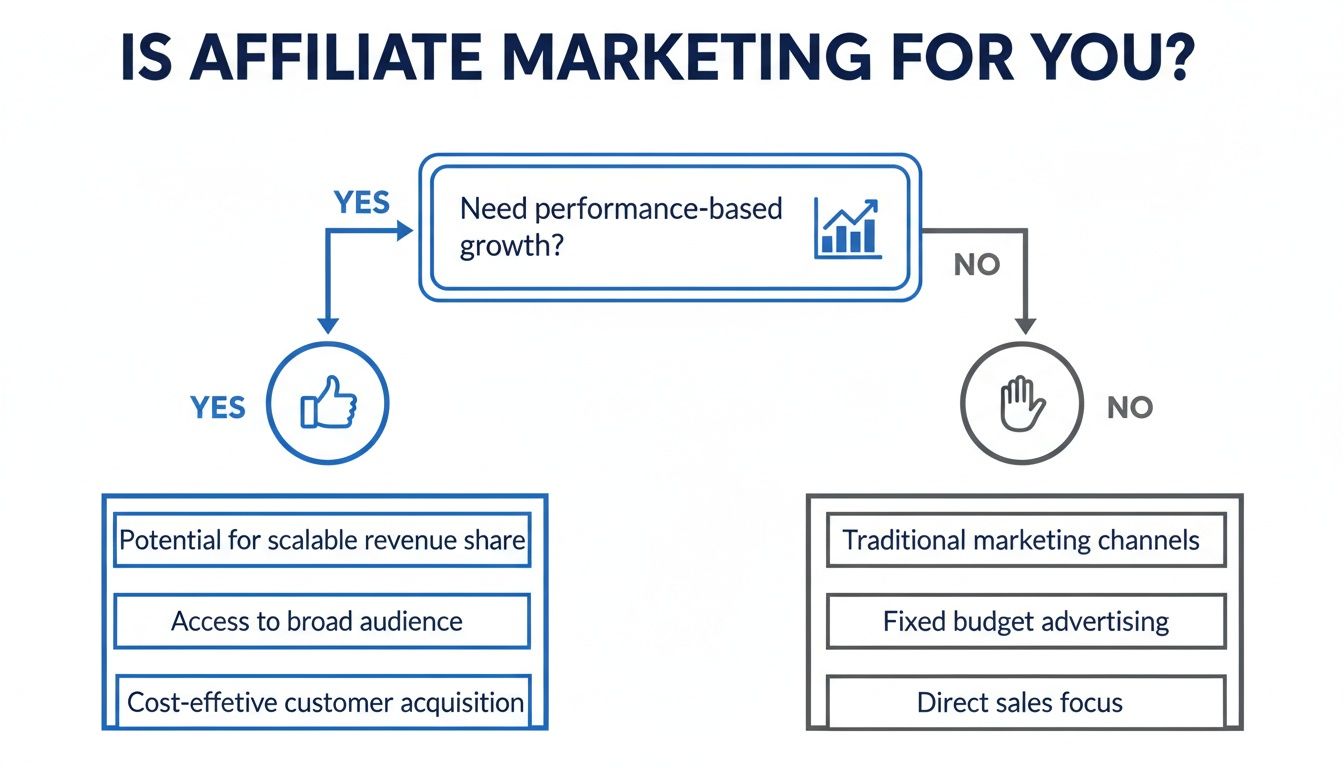
The key takeaway is clear: if your business needs a scalable growth channel where costs are directly tied to results, affiliate marketing offers a proven path forward.
Quick Verdict: Is Affiliate Marketing Worth It For You?
To help you decide, let's break down how this strategy works for different types of businesses. Each one has unique goals, but the underlying benefits of performance-based marketing are a constant.
Affiliate marketing transforms your biggest fans into your most effective sales force. By aligning their success with yours, you create a self-sustaining ecosystem for growth that traditional advertising just can't replicate.
This table gives you a quick snapshot to help you find your use case and get straight to the core value proposition.
While the answer varies slightly for each, the consensus is strong. When managed correctly, an affiliate program isn't just a marketing tactic—it's a strategic asset that can drive sustainable, long-term growth.Understanding How Affiliate Marketing Actually Works
Before we can answer if affiliate marketing is worth it, we need to pop the hood and see how the engine runs. At its core, the whole system is surprisingly simple. It’s built on trusted relationships, kind of like a digital version of word-of-mouth.
Think about it this way: a friend you trust raves about a new coffee shop. You go try it, you love it, and you become a regular. That’s a real-world referral. The coffee shop gets a new customer, and your friend gets the satisfaction of giving a great recommendation.
Affiliate marketing takes that exact idea and builds a system around it. The main players are:
- The Merchant (You): The business with the product or service.
- The Affiliate (Your Partner): The creator, blogger, or publisher who promotes your stuff to their audience.
- The Customer: The person who buys something based on the affiliate's recommendation.
This whole process is held together by one critical piece of technology: a unique referral link.
The Magic of the Referral Link
Every affiliate gets their own special link. When someone clicks it, a small tracking file—often called a cookie—gets placed on their device. This little file has one job: to remember which affiliate sent that person your way.
If the customer makes a purchase within a certain timeframe (usually 30-90 days), that cookie tells your system to credit the sale to the right affiliate.
It's like a digital handshake. The link makes the introduction, and the cookie makes sure the person who made that introduction gets the credit they earned. This is where a dedicated platform like LinkJolt becomes so important. It acts as the impartial middleman, automatically handling all the tracking, attribution, and payouts. For a real-world example of how a company sets this up, take a look at Klap's affiliate page.
With that tracking automated, you can stop worrying about spreadsheets and start focusing on building great relationships with your partners.

Why the Pay-for-Performance Model Changes Everything
Here’s where affiliate marketing really starts to shine. Unlike traditional ads where you pay upfront for clicks or eyeballs with zero guarantee of a sale, this model is purely performance-based.
You only pay a commission after a successful sale has already happened. You don't pay for impressions. You don't pay for clicks. You only pay for results. This fundamentally de-risks your entire marketing investment.
This model flips your marketing budget from a speculative gamble into a predictable cost of acquiring a customer. You’re no longer throwing money at an ad campaign and hoping it works; you’re rewarding proven sales. It makes your growth more efficient and sustainable.
Ultimately, this is why the answer to "is affiliate marketing worth it?" is so often a resounding "yes." You're building a sales team that only gets paid when you do.
Calculating the True ROI of Your Affiliate Program
To really answer the question, "is affiliate marketing worth it?" you have to get out of the clouds and into the numbers. The good news is, calculating the return on investment (ROI) for your affiliate program isn't rocket science. It's the simple act of tracking the right metrics, and it's what separates the programs that guess from the ones that grow.
Think of it like planning a road trip. You wouldn’t just start driving without a destination in mind or a glance at the gas gauge. Running a marketing program without measuring its success is just as reckless. The right KPIs are your dashboard—they tell you exactly how far you’ve come, how efficiently you're burning fuel, and when it’s time to step on the gas.
Key Metrics for Measuring Success
For a crystal-clear picture of your program’s health, you need to zero in on two of the most important metrics in any business: Customer Acquisition Cost (CAC) and Customer Lifetime Value (LTV). These are the north stars that guide sustainable growth.
- Customer Acquisition Cost (CAC): This is the total cost you pay to land a new customer. In affiliate marketing, the formula is beautifully simple: CAC = Total Affiliate Commissions Paid / Number of New Customers Acquired.
- Customer Lifetime Value (LTV): This is the total revenue you can reasonably expect from a single customer throughout their entire relationship with your business. For a subscription model, a basic formula is LTV = Average Monthly Revenue Per Customer x Average Customer Lifespan (in months).
The magic really happens when you put these two numbers side-by-side. A healthy, scalable business needs its LTV to be significantly higher than its CAC—a common benchmark is a ratio of 3:1 or better. Affiliate marketing is a powerhouse here because it keeps your CAC predictable and directly tied to actual sales.
Realistic ROI Examples in Action
Let’s move away from the abstract and look at how this plays out in the real world. Concrete examples make the value proposition undeniable.
Example 1: A SaaS Startup
Picture a SaaS company selling a tool for $50 per month. They offer their affiliates a 20% recurring commission for the first year of a customer's subscription.
- Monthly Commission: $50 x 20% = $10
- Total Annual Commission (Your CAC): $10 x 12 months = $120
- Annual Revenue from Customer: $50 x 12 = $600
- LTV (assuming a customer stays for 18 months): $50 x 18 = $900
In this scenario, the company spends a predictable $120 to acquire a customer who will generate $900 in revenue. That’s an LTV:CAC ratio of 7.5:1, an exceptionally healthy figure that would be the envy of anyone pouring money into paid ads where CAC can spiral out of control.
Example 2: A Content Creator
Now, let's think about a creator selling a digital course for a one-time fee of $300. They give their affiliates a flat 30% commission on every sale.
- Commission per sale (Your CAC): $300 x 30% = $90
- LTV (for a one-time purchase): $300
Here, the creator pays $90 to secure a $300 sale, generating an immediate ROI of 233% on that single transaction. This pay-for-performance model is a lifeline for creators who need to monetize their audience without a massive upfront marketing budget.
To crunch your own numbers and see how this could work for you, check out our free affiliate program ROI calculator.
Affiliate Marketing vs. Other Channels: A Cost-Benefit Analysis
The true value of affiliate marketing snaps into focus when you stack it up against other common customer acquisition channels. Each has its place, but the risk-to-reward balance is dramatically different. And the numbers don't lie: retailers often see 10-20% of their total revenue flow from affiliate channels, and with over 80% of brands running affiliate programs, it's a proven, mainstream strategy.
By paying only for confirmed sales, affiliate marketing completely eliminates the wasted spend that’s baked into channels like PPC, where you pay for clicks whether they convert or not. It aligns your costs perfectly with your revenue growth.
This table gives a clear breakdown of how the channels compare.
Affiliate Marketing vs. Other Channels: A Cost-Benefit Analysis
While a channel like SEO offers incredible long-term returns, it's a marathon that requires patience and a significant upfront investment of time and resources. Paid ads can deliver results quickly, but they come with high financial risk and require constant optimization to stay profitable.Affiliate marketing hits a sweet spot. It offers a scalable, performance-driven approach that protects your bottom line, making the investment undeniably worth it.
How Affiliate Marketing Fits Your Business Model
The worth of affiliate marketing isn't some universal number you can look up—it's a direct reflection of your business, your goals, and your audience. A SaaS founder trying to lock in predictable subscription growth has a completely different playbook than a content creator who needs to monetize their audience without selling out.
So, the question isn't just "is affiliate marketing worth it?" The real question is, "how is it worth it for me?"
Answering that means taking a hard look at how this pay-for-performance model plugs into different business blueprints. The core idea is always the same—rewarding partners for driving real results—but how you apply it and what you hope to achieve can be worlds apart. Let's break down what it really offers for three very different types of businesses.

For SaaS Companies: A Scalable Growth Engine
For any SaaS business, the game is all about sustainable, predictable growth. It's a simple formula on paper: acquire a customer and keep them long enough for their lifetime value (LTV) to crush the initial customer acquisition cost (CAC). Affiliate marketing fits this model like a key in a lock.
Instead of pouring money into paid ad campaigns with volatile costs-per-click, SaaS companies can set a fixed, performance-based CAC. Offer a recurring commission—say, 20% for the customer's first year—and you've just created a powerful incentive for partners to find high-quality users who will actually stick around.
This approach delivers some serious advantages:
- Trust-Based Acquisition: Your best affiliates are often industry experts or trusted voices in a niche. When they recommend your tool, it lands with a layer of social proof that a Google Ad could only dream of. That means higher conversion rates and users who are already bought-in.
- Predictable Unit Economics: You know exactly what it costs to land a new subscriber. This makes financial forecasting cleaner and lets you scale growth with confidence.
- Access to Niche Audiences: Affiliates have already done the hard work of building communities in hyper-specific markets that would be incredibly expensive or difficult for you to target directly.
A strong affiliate program turns your product into a solution recommended by trusted experts, not just another ad in a crowded feed. This elevates your brand and attracts customers who are already convinced of your value.
This is exactly why a platform like LinkJolt was built with SaaS in mind. Features like seamless Stripe and Paddle integrations make tracking subscriptions and automating recurring payouts effortless. It removes the administrative nightmare, so you can focus on what matters: building great relationships with your partners.
For Content Creators: A Path to Authentic Monetization
If you're a YouTuber, blogger, or podcaster, your most valuable asset is the trust you've built with your audience. The constant challenge is figuring out how to monetize that trust without destroying it. Done right, affiliate marketing is the perfect answer.
Unlike jarring display ads or sponsorships that feel shoehorned in, affiliate recommendations can be woven naturally into the content your audience already loves. A creator reviewing camera gear can link to the products they genuinely use every day. A blogger writing about productivity can recommend the software that actually powers their workflow.
For creators, the value is crystal clear:
- Alignment with Audience Interests: You get to pick products that perfectly match what your audience needs and wants. Your recommendation becomes a helpful service, not a sleazy sales pitch.
- Building Passive Income Streams: A single killer piece of content—like a detailed YouTube tutorial or an in-depth review post—can keep generating affiliate revenue for months or even years.
- Diversifying Revenue: It creates a reliable income stream that doesn't depend on the whims of ad revenue or the availability of brand deals.
The secret sauce is authenticity. The most successful creator affiliates only promote products they truly stand behind. Their recommendations feel like advice from a trusted friend, which is precisely why their audiences convert. For a closer look at this strategy, our guide on how to monetize content dives much deeper.
For Marketing Agencies: A Performance-Driven Service
For agencies, adding affiliate program management to your list of services is a no-brainer. More and more, clients are demanding marketing efforts that deliver a clear, measurable return on investment. Affiliate marketing is the ultimate performance channel.
By managing affiliate programs for your clients, you offer a service where your success is directly tied to the revenue you generate. It’s a powerful way to demonstrate undeniable value and build the kind of long-term, results-focused relationships that last.
An agency's role in this world usually involves:
- Strategy and Setup: Designing a competitive commission structure and getting the tech framework set up on a platform.
- Affiliate Recruitment: Finding and onboarding high-quality partners who are a perfect fit for the client’s brand.
- Partner Management: Keeping affiliates engaged with creative assets, support, and the motivation they need to perform.
- Reporting and Optimization: Tracking the right KPIs and constantly tweaking the program to maximize ROI for the client.
This isn't just another service to tack on; it's highly scalable and positions your agency as a strategic growth partner. Offering affiliate management helps you stand out by delivering the one thing every single client wants: profitable growth.
What Affiliate Marketing Really Costs (and the Mistakes That Can Sink You)
To get a real answer to the "is it worth it?" question, you have to look past the commission checks and understand what you’re actually investing. While the upfront financial risk is low, a successful affiliate program is anything but a passive, "set it and forget it" money machine.
The biggest costs aren’t measured in dollars. They’re measured in time, strategic thinking, and consistent, hands-on effort.
Ignoring these hidden investments is the number one mistake I see businesses make. They throw up a program, expect partners to flood in, and then wonder why it’s dead in the water a few months later. A great program is like a garden—you can't just toss some seeds on the ground and walk away. You have to actively nurture it.
The True Price of Partnership
The most common myth is that affiliates will just find you and magically start sending you sales. The reality? Recruiting the right partners is a hands-on, never-ending process. You’re not just looking for anyone with a website; you’re hunting for genuine brand advocates who align with your values and, most importantly, have the trust of your target audience.
This isn’t about sending a mass email blast. It’s about rolling up your sleeves and doing the work:
- Active Recruitment: This means scouring blogs, YouTube channels, and social media to find creators who are a perfect fit for your brand.
- Personalized Outreach: You have to craft compelling, individual pitches that prove you’ve done your homework and actually value what they do.
- Relationship Building: This is about investing real time in building genuine connections, offering support, and treating affiliates like true business partners—not just another number on a dashboard.
An affiliate program's success is built on the quality of its relationships. A handful of highly engaged, authentic partners will always outperform a hundred disengaged ones who just signed up for a link.
This relationship-building is continuous. It means giving them high-quality creative assets, keeping them in the loop on new product features, and being there to answer their questions. It’s an investment in people that pays off massively in the long run.
Navigating Critical Pitfalls and Common Errors
Beyond the time sink, a few critical mistakes can completely derail your program's profitability and even damage your brand. Knowing what they are is the first step to avoiding them.
One of the most dangerous threats is affiliate fraud. This can range from bots generating fake clicks to more sophisticated scams involving credit card fraud or misleading offers that tarnish your brand's reputation. A robust affiliate platform is your first line of defense here, giving you the tools to spot and shut down suspicious activity before it costs you money.
Other common blunders include:
- Setting Unrealistic Expectations: Expecting a flood of sales overnight is a recipe for disappointment. It realistically takes 3-6 months to build real momentum as you find good partners and they start creating content.
- Poor Onboarding and Support: If you don't give new affiliates the tools, info, and creative assets they need to get started, they won't. A confused or unsupported affiliate is an inactive one.
- Treating All Affiliates Equally: Your top-performing partners drive a huge chunk of your sales. You need to recognize and reward them with better commissions or exclusive offers to keep them motivated and loyal.
- Neglecting Communication: Keeping your partners in the dark about product updates, upcoming promotions, or changes to your program is the fastest way to lose their engagement and trust.
By understanding that the real cost is strategic effort and actively sidestepping these common blunders, you can build a secure, profitable, and genuinely worthwhile affiliate program.
A Practical Blueprint for a Profitable Affiliate Program
Alright, theory is great, but let's be honest—results come from action. It's time to shift from asking "is affiliate marketing worth it?" to actually building a program that pays for itself. To do that, you need a plan.
Think of this as the architectural blueprint for your new growth engine. You wouldn't build a house without one, right? The same logic applies here. Following these steps ensures you're building on a solid foundation, not just hoping for the best.
Define Your Program’s Goals and KPIs
Before you write a single email or choose a platform, you have to define what winning looks like. Are you trying to slash your Customer Acquisition Cost (CAC)? Break into a new market? Or maybe just drive a specific number of new subscriptions every month?
Your goals will steer the entire ship. Be brutally specific and set measurable Key Performance Indicators (KPIs) to track whether you're on course.
- Goal Example: Cut our overall CAC by 15% within six months.
- KPIs to Track: Total commissions paid out, number of new customers from affiliates, and the conversion rate of affiliate traffic.
Without clear targets, you’re just guessing. With them, every decision is a calculated move toward profitability.
Set a Competitive and Sustainable Commission Structure
Your commission structure is the fuel that powers your entire program. It needs to be juicy enough to attract top-tier partners but sustainable enough that it doesn't sink your profit margins. A race to the bottom on payouts is a losing game, but a structure that feels stingy is just as bad.
As you figure out your own numbers, seeing how others are setting up an affiliate program can give you a massive head start. For most SaaS businesses, a recurring commission (like 20% for 12 months) is a killer incentive because it aligns your partners' goals with long-term customer value. For products with one-time purchases, a flat percentage like 25-40% is more common.
Key Takeaway: Your commission isn't just a number; it's a message. It tells your partners how much you value them. A competitive rate shows you see them as true growth partners, not just another line item on a spreadsheet.
Recruit the Right Partners
Let's be clear: your program is only as good as the affiliates in it. Don't just open the floodgates and hope for the best. You need to be a recruiter, actively seeking out partners whose audience is a perfect match for your ideal customer. Look for creators, bloggers, and industry experts who have built genuine trust in your niche.
A personalized outreach email will always beat a generic blast. Show potential partners you've actually looked at their work and understand their audience. A handful of highly engaged, perfectly aligned affiliates will run circles around a hundred who are a poor fit. This is where a dedicated platform designed for SaaS affiliate programs can be a game-changer, helping you find and manage these high-value relationships.
Equip Your Affiliates for Success
Once you’ve got great partners on board, your job is to make promoting you the easiest thing they do all day. This means giving them a killer affiliate portal packed with everything they need.
Your affiliate toolkit should include:
- High-quality creative assets (banners, logos, slick product screenshots)
- Pre-written copy and email templates they can easily tweak
- Clear brand and messaging guidelines (so they sound like you)
- A real-time dashboard so they can track their clicks, conversions, and commissions
The less friction they encounter, the more they’ll promote you. By following this blueprint, you stop wondering if affiliate marketing is worth it and start building a program designed to win from day one.
Frequently Asked Questions About Affiliate Marketing
Let's tackle some of the most common questions that come up when people think about starting their own affiliate program. We’ll keep the answers clear, direct, and focused on what you actually need to know.
How Much Does It Cost To Start an Affiliate Program?
Your main costs boil down to two things: your platform subscription and the actual commissions you pay out on successful sales. This is the beauty of it—unlike paid ads, you're not burning cash on clicks or impressions that go nowhere, which is a huge reason why affiliate marketing is worth it for ROI-focused businesses.
Honestly, the biggest investment is often the time you put into recruiting the right partners and keeping them engaged. Picking a platform with zero transaction fees also makes a massive difference in keeping your ongoing costs down.
How Long Does It Take To See Results?
While you might see a few sales pop up early on, a truly strong affiliate program is a long-term asset you build over time. You should expect it to take a solid 3-6 months to really build momentum as you bring on quality partners and they start creating content.
The results are cumulative, often leading to a stable and predictable revenue stream over time. This patience is what separates programs that succeed from those that are abandoned too early.
Can Affiliate Marketing Work for a New Business?
Absolutely. In fact, it can be a game-changer for new businesses that need to build credibility and get traction without a massive upfront marketing budget.
The secret is to find those first few affiliates who genuinely love what you've built. If you offer a competitive commission and a stellar product experience, you can attract true evangelists who will introduce your brand to their audience, building trust and reputation for you from the ground up.
Ready to see if affiliate marketing is worth it for your business? LinkJolt gives you all the tools you need to launch, manage, and scale a profitable affiliate program with zero transaction fees. Start your free trial today.
Watch Demo (2 min)


Trusted by 300+ SaaS companies
Start Your Affiliate Program Today
Get 30% off your first 3 months with code LINKJOLT30
✓ 3-day free trial
✓ Cancel anytime